Write an HR CV That Gets You Hired (Examples)
Last updated on 5 February, 2026

LiveCareer UK Editorial TeamLiveCareer UK Career Experts
Our customers have been hired by*:
As an HR professional, you might feel a little funny searching online for how to write a Human Resources CV. You might feel like a food critic looking up how to cook pasta al dente or a sports commentator looking for pointers on how to kick a ball with their children.
In this guide, you’ll view an HR CV that many HR specialists would like to have. You’ll also get numerous UK-based CV examples that meet all standards and requirements. And, after the reading, you’ll perfectly know how to write about your HR work experience when you’re actually an HR professional.
Create an effective CV in minutes. Choose a professional CV template and fill in every section of your CV in a flash using ready-made content and expert tips.
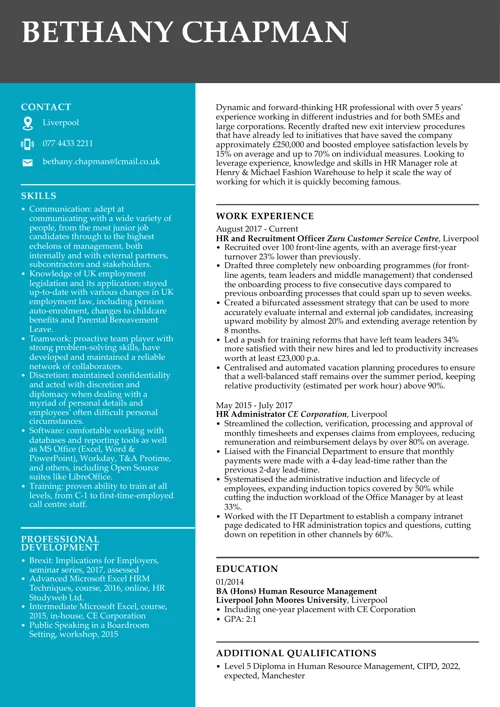
We created the sample on the left using our builder. See other good CV examples like this one.
Need a different CV example? Check these guides:
- HR Manager CV
- HR Assistant CV
- HR Administrator CV
- HR Advisor CV
- Administrator CV
- Career Change CV
- CV for a Part-Time Job
- Executive Assistant CV
- Marketing CV
- Office Manager CV
- Personal Trainer CV
- Recruitment Consultant CV
- Teacher CV
- Team Leader CV
Haven’t found what you’re looking for? Check all our examples of CVs.
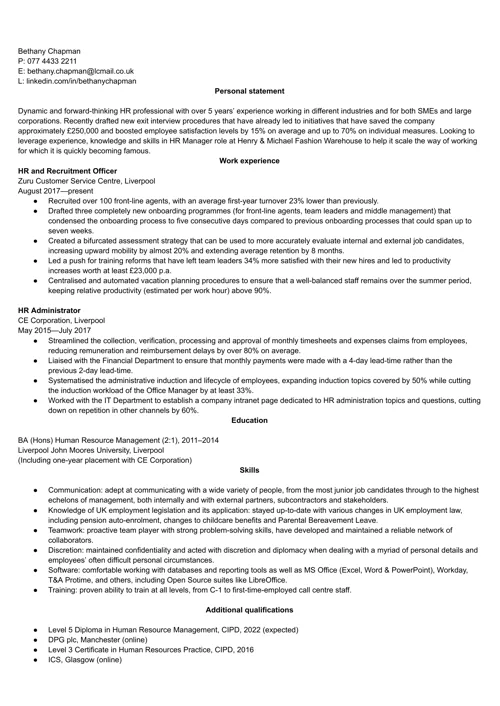
HR CV example (UK)
Example
Bethany Chapman
P: 077 4433 2211
E: bethany.chapman@lcmail.co.uk
L: linkedin.com/in/bethanychapman
Personal statement
Dynamic and forward-thinking HR professional with over 5 years’ experience working in different industries and for both SMEs and large corporations. Recently drafted new exit interview procedures that have already led to initiatives that have saved the company approximately £250,000 and boosted employee satisfaction levels by 15% on average and up to 70% on individual measures. Looking to leverage experience, knowledge and skills in HR Manager role at Henry & Michael Fashion Warehouse to help it scale the way of working for which it is quickly becoming famous.
Work experience
HR and Recruitment Officer
Zuru Customer Service Centre, Liverpool
August 2017—present
- Recruited over 100 front-line agents, with an average first-year turnover 23% lower than previously.
- Drafted three completely new onboarding programmes (for front-line agents, team leaders and middle management) that condensed the onboarding process to five consecutive days compared to previous onboarding processes that could span up to seven weeks.
- Created a bifurcated assessment strategy that can be used to more accurately evaluate internal and external job candidates, increasing upward mobility by almost 20% and extending average retention by 8 months.
- Led a push for training reforms that have left team leaders 34% more satisfied with their new hires and led to productivity increases worth at least £23,000 p.a.
- Centralised and automated vacation planning procedures to ensure that a well-balanced staff remains over the summer period, keeping relative productivity (estimated per work hour) above 90%.
HR Administrator
CE Corporation, Liverpool
May 2015—July 2017
- Streamlined the collection, verification, processing and approval of monthly timesheets and expenses claims from employees, reducing remuneration and reimbursement delays by over 80% on average.
- Liaised with the Financial Department to ensure that monthly payments were made with a 4-day lead-time rather than the previous 2-day lead-time.
- Systematised the administrative induction and lifecycle of employees, expanding induction topics covered by 50% while cutting the induction workload of the Office Manager by at least 33%.
- Worked with the IT Department to establish a company intranet page dedicated to HR administration topics and questions, cutting down on repetition in other channels by 60%.
Education
BA (Hons) Human Resource Management (2:1), 2011–2014
Liverpool John Moores University, Liverpool
(Including one-year placement with CE Corporation)
Skills
- Communication: adept at communicating with a wide variety of people, from the most junior job candidates through to the highest echelons of management, both internally and with external partners, subcontractors and stakeholders.
- Knowledge of UK employment legislation and its application: stayed up-to-date with various changes in UK employment law, including pension auto-enrolment, changes to childcare benefits and Parental Bereavement Leave.
- Teamwork: proactive team player with strong problem-solving skills, have developed and maintained a reliable network of collaborators.
- Discretion: maintained confidentiality and acted with discretion and diplomacy when dealing with a myriad of personal details and employees’ often difficult personal circumstances.
- Software: comfortable working with databases and reporting tools as well as MS Office (Excel, Word & PowerPoint), Workday, T&A Protime, and others, including Open Source suites like LibreOffice.
- Training: proven ability to train at all levels, from C-1 to first-time-employed call centre staff.
Additional qualifications
- Level 5 Diploma in Human Resource Management, CIPD, 2022 (expected)
- DPG plc, Manchester (online)
- Level 3 Certificate in Human Resources Practice, CIPD, 2016
- ICS, Glasgow (online)
Professional development
- Brexit: Implications for Employers, seminar series (assessed), 2017
- Advanced Microsoft Excel HRM Techniques course, online, HR Studyweb Ltd., 2016
- Intermediate Microsoft Excel course, in-house, CE Corporation, 2015
- Public Speaking in a Boardroom Setting, workshop, 2015
Read on to see how to write a CV for an HR job and what should your CV look like.
1. Start your HR CV with a personal statement
Imagine how much simpler your job would be if every candidate and even employee could sum up who they are and what they have to offer the company in three or four coherent sentences. Make life that easy for the HR professionals and hiring managers who come across your HR CV.
Keep it simple and make sure your CV personal statement (also called a CV summary or a CV profile) does just three things and does them well. It should:
- Clearly introduces you as an HR professional
- Show (not tell) what you have to offer
- Describe your goals (at least those goals that bring direct benefits to the company)
Does your HR CV personal statement answer the following questions? You could even write out your responses one after the other and end up with a coherent and concise personal statement. Keep it to 3–4 sentences and 50–150 words.
- What are you like as an HR professional?
- In what industry or industries and/or kinds of companies have you been working?
- For how long?
- What’s your most impressive/relevant achievement?
- (Optional) What’s your most unique achievement?
- What are you hoping to be able to achieve in this job? (For the company, not yourself).
Whether or not you’re experienced with Applicant Tracking Systems (ATSs), it’s an increasingly safe bet to assume that the company to which you’re applying is using one. So pay attention to the keywords you use (it’s best to use wording similar to the one in the job advert) and be sure to mention the name of the position and the company name in your personal statement.
It’s best to write your personal statement last, or at least after you’ve prepared your job descriptions (and that’s why it’s also called a CV summary). You’ll be able to do a much better job once you’ve gone through and written out and quantified your HR achievements. Come back to this section later and keep it mind in the meantime.
HR CV examples: personal statement
Dynamic and forward-thinking HR professional with over 5 years’ experience working in different industries and for both SMEs and large corporations. Recently drafted new exit interview procedures that have already led to initiatives that have saved the company approximately £250,000 and boosted employee satisfaction levels by 15% on average and up to 70% on individual measures. Looking to leverage experience, knowledge and skills in HR Manager role at Henry & Michael Fashion Warehouse to help it scale the way of working for which it is quickly becoming famous.
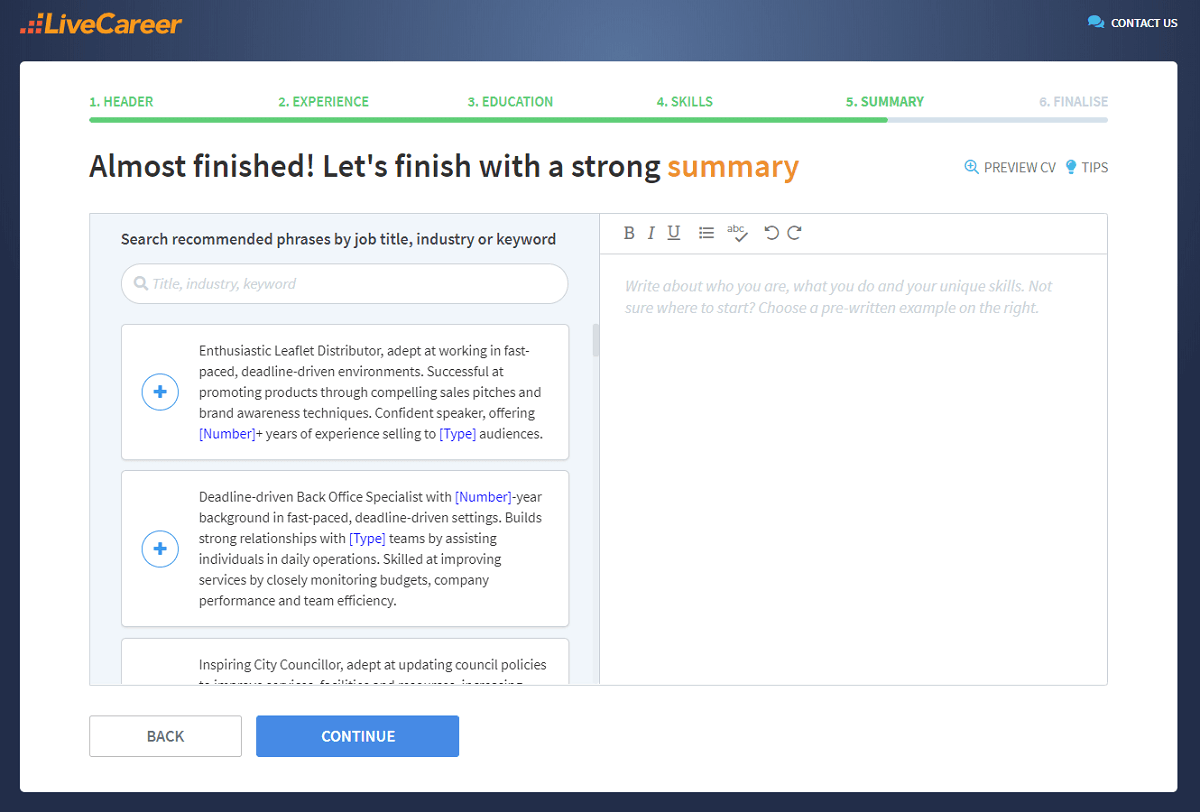
A strong CV summary will convince the recruiter you’re the perfect candidate. Save time and choose a ready-made personal statement written by career experts and adjust it to your needs in the LiveCareer CV builder.
2. Write the kind of HR work experience section that wows even you
Just in case your recruitment experience has taught you otherwise, it’s best to stick with a chronological format for your HR CV. So start with your most recent job description and work your way back from there. This is the format most hiring managers are familiar with, and it’s easier for an ATS to process.
Use this template to create a subheading for each CV job description:
[Job Title]
[Company Name, Location]
[Dates of Employment]
Populate each job description with up to six bullet points. Merely listing your duties and responsibilities is definitely not the way to go here. Instead, come up with a measurable achievement for each bullet point. Quantify everything you can and focus on the benefits you brought to the company.
Use accomplishment statements to help structure and quantify your achievements. You could also incorporate something like a PAR (Problem Action Result) formula to develop your bullet points. Start with a strong verb and describe the actions you took to address a problem, quantifying the result.
Writing your first CV with little or no work experience? Follow the above guidelines focusing on any internships, placement work, and volunteer work you’ve done and put this section after your education section. If you have no experience at all, then a student CV might be better suited to your circumstances.
HR CV examples: job descriptions
HR and Recruitment Officer
Zuru Customer Service Centre, Liverpool
August 2017—present
- Recruited over 100 front-line agents, with an average first-year turnover 23% lower than previously.
- Drafted three completely new onboarding programmes (for front-line agents, team leaders and middle management) that condensed the onboarding process to five consecutive days compared to previous onboarding processes that could span up to seven weeks.
- Created a bifurcated assessment strategy that can be used to more accurately evaluate internal and external job candidates, increasing upward mobility by almost 20% and extending average retention by 8 months.
- Led a push for training reforms that have left team leaders 34% more satisfied with their new hires and led to productivity increases worth at least £23,000 p.a.
- Centralised and automated vacation planning procedures to ensure that a well-balanced staff remains over the summer period, keeping relative productivity (estimated per work hour) above 90%.
HR Administrator
CE Corporation, Liverpool
May 2015—July 2017
- Streamlined the collection, verification, processing and approval of monthly timesheets and expenses claims from employees, reducing remuneration and reimbursement delays by over 80% on average.
- Liaised with the Financial Department to ensure that monthly payments were made with a 4-day lead-time rather than the previous 2-day lead-time.
- Systematised the administrative induction and lifecycle of employees, expanding induction topics covered by 50% while cutting the induction workload of the Office Manager by at least 33%.
- Worked with the IT Department to establish a company intranet page dedicated to HR administration topics and questions, cutting down on repetition in other channels by 60%.
3. Include a concise education section in your HR CV
A university degree is almost always required to get into HR. Make sure yours is front and centre in your HR CV education section. Keep to the reverse-chronological format so that your highest level of education comes first. If you have a university degree, then there’s no need to mention high school.
Use the following template to list university degrees and other tertiary qualifications:
[Degree Type] [Degree Name](Degree Class), [Years Attended]
[Institution Name], [Institution Location]
If you’re currently studying, then include an expected graduation date. If you don’t have a university degree, then use the following templates to detail your high school education:
A-levels: [Subject Name 1], [Subject Name 2], [Subject Name 3]
[School Name], [School Location], [Years Attended]
[number of] GCSEs (including Mathematics and English)
[School Name], [School Location], [Years Attended]
HR CV examples: education
BA (Hons) Human Resource Management (2:1), 2011–2014
Liverpool John Moores University, Liverpool
(Including one-year placement with CE Corporation)
4. Showcase your skills in your HR CV the right way
It’s easy to at best skim over an applicant’s skills section. Listing skills on a CV is for some people little more than an opportunity to dream up the perfect employee. Or clone the skills listed in the job advert. Although it’s true that you should at least cover those required skills, you can do much better.
Make a master list of your HR skills, listing everything that comes to mind (hard, soft and IT skills/technical skills). Now go back and add a sentence onto each skill, showing how and when you’ve demonstrated it at work. Be as concrete as you can. Any skills you can’t do this for don’t make the cut. Save this list for future applications.
Copy 5–10 skills from your master list into your HR CV example, at least covering what’s spelt out in the advert. Notice how a list like this carries so much more weight than a list of skill keywords. On the topic of keywords: substitute synonyms to mirror the keywords used in the advert to stay on top of any ATS being used.
HR CV examples: skills
- Communication: adept at communicating with a wide variety of people, from the most junior job candidates through to the highest echelons of management, both internally and with external partners, subcontractors and stakeholders.
- Knowledge of UK employment legislation and its application: stayed up-to-date with various changes in UK employment law, including pension auto enrolment, changes to childcare benefits and Parental Bereavement Leave.
- Teamwork: proactive team player with strong problem solving skills, have developed and maintained a reliable network of collaborators.
- Discretion: maintained confidentiality and acted with discretion and diplomacy when dealing with a myriad of personal details and employees’ often difficult personal circumstances.
- Software: comfortable working with databases and reporting tools as well as MS Office (Excel, Word & Powerpoint), Workday, T&A Protime, and others, including Open Source suites like LibreOffice.
- Training: proven ability to train at all levels, from C-1 to first-time-employed call centre staff.
Based on over 6 million CVs created in our builder, we found out that*:
- HR workers usually create 2.8-page-long CVs.
- The average number of skills added to an HR worker’s CV is 6.
- The most popular skills for HR workers are benefits programmes, grievance procedures, event coordination, hiring management, and business administration.
- The average work experience for HR workers is 36 months.
*The data comes from a period of 12 months (August 2023-August 2024).
5. Add extra sections to your HR CV
You’ve probably seen some pretty breathtakingly misjudged inclusions on candidates’ CVs. But, in the right hands, those extra sections on a CV can really help paint a fuller picture of the applicant. So don’t shy away from supplementing the sections above with something more uniquely yours.
It’s true that something like a CIPD diploma could just as easily go in your education section, but it’s just as correct to give these kinds of things their own section (certainly at award level). You could also add languages, non-work related achievements, even hobbies. As long as it’s relevant it’s fair game.
HR CV examples: additional sections
Additional qualifications
- Level 5 Diploma in Human Resource Management, CIPD, 2022 (expected)
- DPG plc, Manchester (online)
- Level 3 Certificate in Human Resources Practice, CIPD, 2016
- ICS, Glasgow (online)
Professional development
- Brexit: Implications for Employers, seminar series (assessed), 2017
- Advanced Microsoft Excel HRM Techniques course, online, HR Studyweb Ltd., 2016
- Intermediate Microsoft Excel course, in-house, CE Corporation, 2015
- Public Speaking in a Boardroom Setting, workshop, 2015
6. Take care of your HR cover letter
Maybe you’re one of those people who never reads cover letters, maybe the cover letter is the first document you reach for. It goes without saying that you should always assume you’re dealing with the latter when you submit your HR CV. All good cover letters share the same basic structure:
- A header laid out in accordance with the UK business letter format
- An appropriate, formal salutation
- The body of the letter
- A sign-off that matches the salutation
Make your HR cover letter stand out by writing 3–5 body paragraphs that include:
- A strong, confident opening
- A carefully curated showcase of your HR achievements
- A razor-sharp wrap-up and compelling CTA.
Done right, your cover letter will end up being over half an A4 page but no longer than one A4 page, about 250–400 words in total, including:
- The opening paragraph—between 60 and 80 words
- The main body paragraph(s)—between 120 and 200 words
- The closing paragraph(s)—between 40 and 60 words.
If you’re in the ‘cover letters don’t matter’ camp, then it can be easy to fall into the trap of assuming other HR professionals will be the same. Include a cover letter unless it’s been made clear that you shouldn’t do so. Better to have a great cover ignored than a bad one taken into consideration.
What else to keep in mind when writing an HR CV?
Many of the following things will be obvious to you, but it’s the obvious things that we’re most likely to overlook. Consider this a final pre-flight checklist for the next leg of your HR career.
Formatting
- Are you using the recommended reverse-chronological CV format?
- Are your contact details clear and easy to find (and near the top of your HR CV)?
- Have you made full use of subheadings and white space to clearly break your HR CV structure down into sections?
- Are you using an appropriate CV font? The default Liberation or Calibri will do if you’re in any doubt.
- Remember that best CV templates are ATS-scannable. Visual CVs often are not. View free CV templates to pick one for yourself.
Length
Are you within the one-page-per-decade-of-experience limit? Don’t go over two pages, no matter how experienced you are. That’s the very basics of a good CV.
Spelling and grammar
Check you HR CV and cover letter (yes, again). Run spellcheck, feed your documents through a web app, get another pair of eyes on both documents.
File type
The only reason not to use PDF is if you’ve been explicitly asked to use something else.
Following up
Follow up if you haven’t heard back after a week. Think of how you’d perceive a candidate who did this. Also, consider adding your CV to LinkedIn for better exposure.
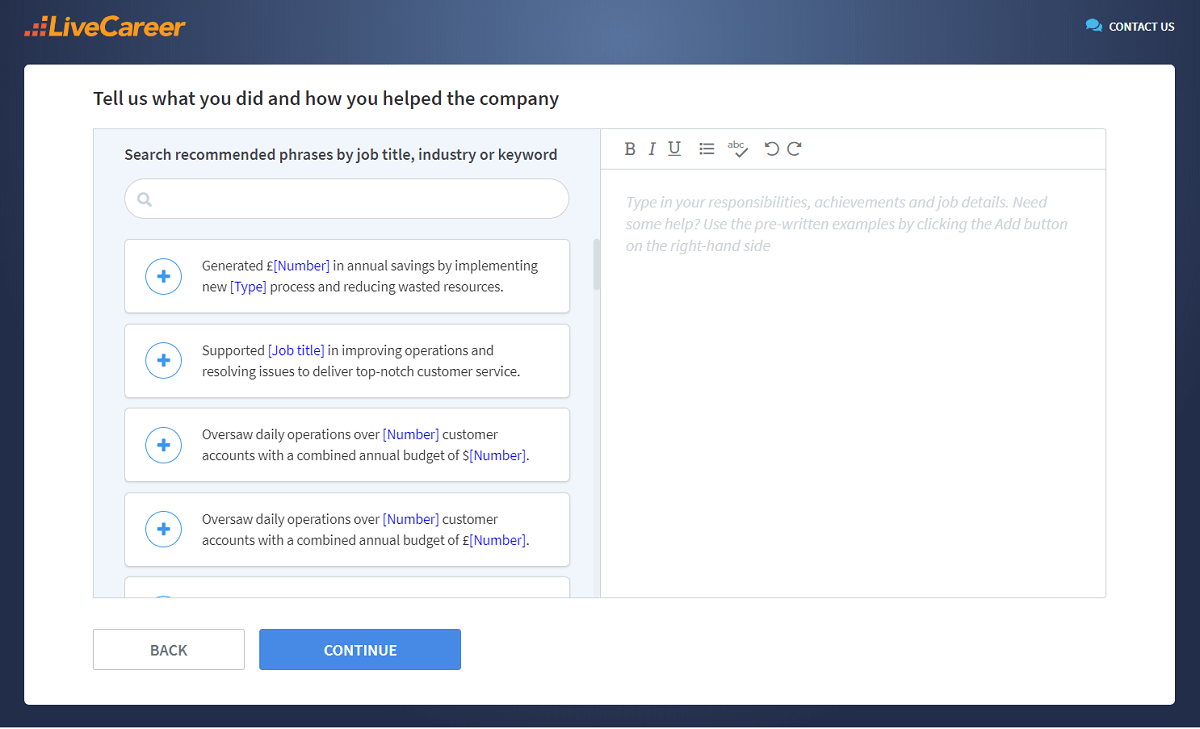
You don’t have to be a CV writing expert. In the LiveCareer CV builder you’ll find ready-made content for every industry and position, which you can then add with a single click.
*Data was collected from July 2023 to June 2024.
How we review the content at LiveCareer
Our editorial team has reviewed this article for compliance with LiveCareer’s editorial guidelines. It’s to ensure that our expert advice and recommendations are consistent across all our career guides and align with current CV and cover letter writing standards and trends. We’re trusted by over 10 million job seekers, supporting them on their way to finding their dream job. Each article is preceded by research and scrutiny to ensure our content responds to current market trends and demand.
About the author
LiveCareer UK Editorial Team
LiveCareer UK CV builder is powered by career experts, CV writers, and HR professionals. Since 2013, our editorial team has supported job seekers with free, research-based career advice and expert tips to improve their job applications. LiveCareer UK CV builder has already helped thousands, and you can be next.
Looking for a job-winning CV?
Crafting a job-winning CV is all about showcasing your unique skills and experiences. Start with a strong personal statement that highlights your career goals and achievements.
Try Our CV Builder Now