Football CV to Help You Join the Right Clubs
Last updated on 8 May, 2026

Danuta DetynaWriter, Professional Association of Resume Writers and Career Coaches (PARWCC)
Our customers have been hired by*:
A football CV is often your first chance to get noticed by a coach, scout, or academy. In this guide, you’ll learn how to structure a football CV, highlight your playing experience, and present yourself for trials and club enquiries.
Stand out to scouts and coaches with a professional football CV. Pick a proven CV template and fill it out in minutes using ready-made phrases and expert tips.
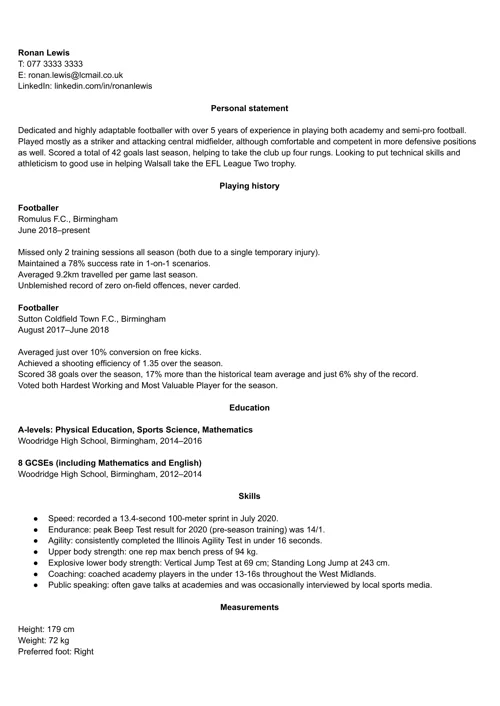
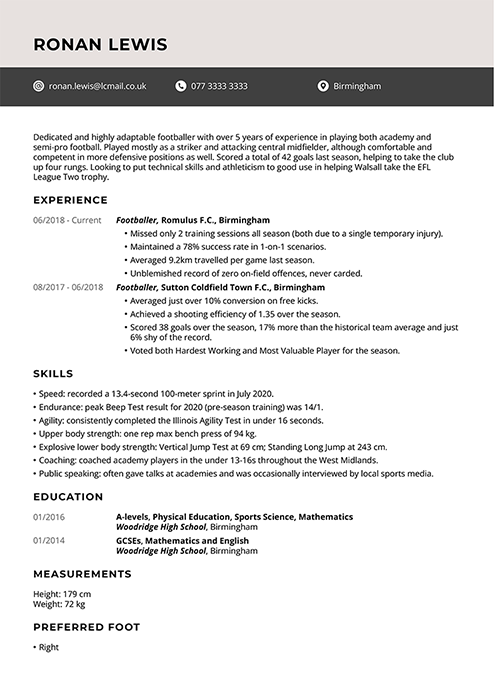
We created the sample on the left using our builder. See other good CV examples like this one.
Football CV template to copy and adjust
Example
Ronan Lewis
Footballer (Striker / Attacking Midfielder)
Birmingham, UK
07733 333333
ronan.lewis@email.co.uk
Player Details
- Primary position: Striker
- Secondary position: Attacking central midfielder
- Preferred foot: Right
- Height: 179 cm
- Weight: 72 kg
- Playing style: Direct, high-intensity attacker with strong off-ball movement
Personal Profile
Attacking footballer with 8+ years of experience across academy and semi-professional football. Contributed with a record of 42 goals in a single season and consistent availability across full campaigns. Comfortable leading the line or operating between midfield and attack. Seeking an opportunity to contribute goals, work rate, and attacking output at EFL League Two level, with a strong desire to support Walsall’s promotion ambitions.
Playing Experience
Romulus F.C. – Birmingham
First Team | Midland Football League
June 2018 – September 2025
- Scored 42 goals in the 2024–25 season, contributing directly to the club’s four-division promotion rise.
- Maintained a 78% success rate in 1v1 situations, both offensively and defensively.
- Averaged 9.2 km per match, ranking among the top distance-covered players in the squad.
- Missed only 2 training sessions across the season, both due to a minor injury.
- Completed the season with a zero disciplinary record, never receiving a booking.
Sutton Coldfield Town F.C. – Birmingham
First Team | Southern League Division One
August 2017 – June 2018
- Scored 38 goals in one season, 17% above the club’s historical average.
- Finished just 6% short of the club’s all-time seasonal scoring record.
- Converted over 10% of direct free kicks, contributing key goals from set pieces.
- Recorded a 1.35 shooting efficiency ratio, reflecting consistent shot quality.
- Voted Hardest Working Player and Most Valuable Player by coaching staff and teammates.
Skills
- Speed: recorded a 13.4-second 100-meter sprint in July 2020.
- Endurance: peak Beep Test result for 2020 (pre-season training) was 14/1.
- Agility: consistently completed the Illinois Agility Test in under 16 seconds.
- Upper body strength: one rep max bench press of 94 kg.
- Explosive lower body strength: Vertical Jump Test at 69 cm; Standing Long Jump at 243 cm.
- Coaching: coached academy players in the under-13–16s throughout the West Midlands.
- Public speaking: often gave talks at academies and was occasionally interviewed by local sports media.
Education
A Levels: Physical Education, Sports Science, Mathematics
Woodridge High School, Birmingham, 2014–2016
GCSEs: 8 subjects including Mathematics and English
Woodridge High School, Birmingham, 2012–2014
Coaching & Mentoring Experience
- Coached academy players aged U13–U16 across the West Midlands.
- Supported technical drills, finishing sessions, and match preparation.
Achievements & Highlights
- 42-goal season leading to multi-division promotion (Romulus F.C.).
- Club MVP & Hardest Working Player – Sutton Coldfield Town (2017–18).
- Maintained a 100% discipline record across a full competitive season.
- Regularly trusted to start key fixtures and decisive matches.
See CV example guides for similar roles:
- CV for a 16-Year-Old
- CV for a Part-Time Job
- First CV
- Football Scout CV
- Personal Trainer CV
- Physiotherapist CV
- School leaver CV
- Student CV
What is a football CV?
A football CV, also called a football resume or a soccer CV, is a short document used to introduce yourself to clubs, academies, scouts, and agents. It outlines your playing history and achievements, awards, skills, and fitness levels, as well as your general player profile.
A football CV is useful for players at many stages, including:
- Youth players applying to academies or development programmes
- Academy players seeking loans, releases, or new opportunities
- Semi-professional players approaching clubs directly
- Free agents looking for trials or contract opportunities
- Players moving countries who need to explain their playing background clearly
If you’re contacting a club, applying for a trial, or speaking with an agent, a football CV will help you be taken seriously. Even if you’re early in your career, a footballer CV can show real commitment.
How to write a football CV
Writing a CV for football is about presenting the right information in the right order. Each section you include on a CV requires a strategic approach to help coaches and scouts notice your potential.
1. Include your contact & key player details
Your personal details should appear at the top of your football CV. This section gives coaches and scouts the basic information they need to identify you.
Provide the following:
- Full name
- Date of birth (or age)
- Nationality (and eligibility if applying to a different country)
- Current location
- Phone number
- Email address
- Agent details (if applicable)
When it comes to the key player details on a football CV, they’re all about your physical profile and how you fit on the pitch. These details are especially useful when reviewing players remotely, before a trial or match viewing.
Include:
- Primary position (for example: Centre-back, Right winger)
- Secondary position (only if you genuinely play it)
- Preferred foot (right, left, or both)
- Height and weight
- Playing style (optional, one short phrase)
See this football CV example to see how this information may look:
Daniel Moore
Date of birth: 14 May 2004
Nationality: English
Location: Birmingham, UK
Phone: +44 7700 912345
Email: daniel.moore@email.com
Key player details
Primary position: Central midfielder
Secondary position: Defensive midfielder
Preferred foot: Right
Height: 178 cm
Weight: 72 kg
Playing style: Box-to-box, high work rate
You can also make a dedicated section to your details using our CV builder.
2. Kickstart your football CV with a winning personal statement
The best scouts and agents have a knack for spotting that special something that sets good players apart from the rest. First impressions are important, and when it comes to your football CV, it’s your CV profile that’ll carry it.
The best way to approach this section is to answer these questions:
- What kind of football player are you? Focus on your character traits, experience and favoured positions.
- What’s your most impressive professional achievement? Back it up with numbers and stats, and avoid vague answers.
- [Optional]What’s your most unique achievement? This could be an award, a record, or something similar.
- What do you hope to achieve by playing for this club? Focus on the benefits you could bring to the club, not the other way around.
Keep your personal statement to 3–4 short sentences. Focus your introduction on your position, level of play, key strengths, and what you’re aiming for next.
Depending on where you send your football player CV, it might be filtered by an Applicant Tracking System (ATS). Mention by name the club to which you’re applying and the position. If you’re responding to an advert or call-out, mirror the keywords used there. Having an ATS-friendly CV for football is vital.
Even though a CV summary goes first in a CV, it’s best that you write it last. It’ll be much easier after you’ve prepared your playing history. Keep it in the back of your mind for now and come back to it later.
Football CV example: personal statement
Dedicated and highly adaptable footballer with over 8 years of experience in playing both academy and semi-pro football. Played mostly as a striker and attacking central midfielder, although comfortable and competent in more defensive positions as well. Scored a total of 42 goals last season, helping to take the club up four rungs. Looking to put technical skills and athleticism to good use in helping Walsall take the EFL League Two trophy.
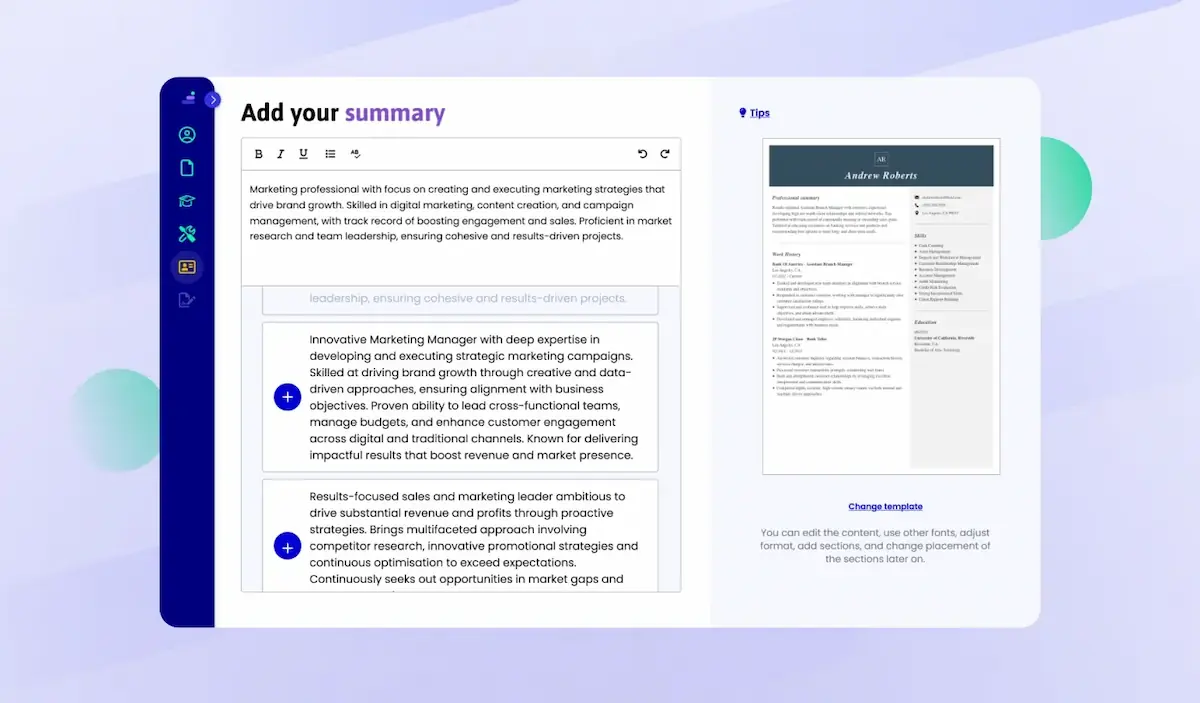
A strong CV summary will convince the recruiter you’re the perfect candidate. Save time and choose a ready-made personal statement written by career experts and adjust it to your needs in the LiveCareer CV builder.
3. Showcase playing history on your footballer CV
The experience section is one of the key parts of your football CV. This is where coaches and scouts see where you’ve played, at what level, and how consistently you’ve competed.
- List your experience in reverse order, starting with your most recent club or team.
- Keep descriptions factual and focused on competitive play.
- Include friendly matches or casual football only if you’re early in your sports career.
- Aim to have at most 6 bullet points under each entry on your football CV template.
- Start your accomplishment bullet points with action verbs to convey impact.
For each entry, include:
- Club or team name
- League or competition level
- Season(s) played
- Appearances (and goals or assists if relevant)
- Any notable responsibilities & achievements (captaincy, starting role, call-ups)
Football CV example—play history
Birmingham City U21s
Professional Development League
August 2022 – May 2024
- 32 competitive appearances with 4 goals and 6 assists.
- Regular starter in a 4-3-3 system.
- Averaged 8.5 km per game, consistently covering key midfield zones.
- 78% success rate in 1-on-1 duels, excelling in defensive and offensive transitions.
- 3 assists in crucial matches, contributing to a 25% increase in team assists across the season.
4. List strong football CV skills
The key skills you include in a CV for footballers should match the position you play and the type of opportunity you’re applying for. Different clubs look for different traits, so a one-size-fits-all approach rarely works.
To save time, prepare a master list of your football skills and then simply copy from it when needed. Here’s how:
- Open a new document and start brainstorming.
- Back each skill up with a sentence or statistic that shows how you demonstrated on the pitch – for example, instead of just writing ‘fast runner’, give your official PB for the 100 m sprint.
- Save your master list of football skills.
- Copy 5–10 skills from the master list into your football CV. Pay attention to any requirements specified by the advert or agent.
Footballer CV example – skills section:
- Speed: Recorded a 13.4-second 100-metre sprint during pre-season testing (July 2020).
- Endurance: Achieved a Beep Test score of 14.1 during the 2020 pre-season fitness assessment.
- Agility: Completed the Illinois Agility Test in under 16 seconds across multiple assessments.
- Upper-body strength: One-repetition maximum bench press of 94 kg.
- Explosive lower-body strength: Vertical jump of 69 cm and standing long jump of 243 cm.
- Coaching experience: Coached academy players aged U13–U16 across the West Midlands.
- Communication skills: Regularly delivered talks at academy sessions and participated in local sports media interviews.
Based on over 6 million CVs created in our builder, we found out that*:
- Football players usually create 1.9-page CVs.
- The average number of skills added to a football player’s CV is 7.
- The most popular skills for football players are team collaboration, ball control, accurate passing, team leadership, and physical endurance.
- The average work experience for football players is 42 months.
*The data comes from a period of 12 months (August 2023–August 2024).
5. Mention your education and academy training
The CV education section shows your training, both on and off the pitch. For younger players or those coming through academies, this section is especially important, as it helps clubs understand your football background.
List your football education first, followed by your latest academic education (even if it’s just a tertiary education like NVQs). For each entry, include:
- Degree type and name
- Institution name and location
- Years attended
- Extracurricular activities & accomplishments (optional)
Footballer CV example: education & training
Football Development Programme
FA Regional Talent Centre
September 2018 – July 2020
- Selected for regional development based on performance assessments
- Competed in national showcase fixtures
A-levels: Physical Education, Sports Science, Mathematics
Woodridge High School, Birmingham, 2016–2018
8 GCSEs (including Mathematics and English)
Woodridge High School, Birmingham, 2014–2016
6. Use extra sections strategically in your footballer CV
There’s a lot that’s crucial in a football CV that just doesn’t fit the usual mould of work experience, hard and soft skills, and so on. Use additional sections to better cover the special requirements of a football CV template.
Useful bonus sections for a football player CV include:
- Awards & highlights: This can be especially useful for players who have competed at various levels or those looking to show leadership roles, like being a team captain.
- Media links: Football is a visual sport, and showcasing your performances through video links can give scouts and coaches a direct look at your abilities.
- Volunteering & coaching experience: If you’ve ever coached, mentored, or volunteered in football, this section can highlight your leadership, dedication, and contribution to the sport off the pitch.
- Fitness & physical stats: You can include impressive test results, strength stats, or any other relevant physical benchmark.
Thinking of including references or testimonials? Generally, references don’t belong on CVs, but for a football CV, references from coaches, managers, or other players who can vouch for your talent. However, it’s better to prepare a separate “references list” as an attachment, rather than putting them directly on a CV.
7. Format your football CV correctly
A football CV template should be easy to read, quick to scan, and focused on performance. Coaches and scouts often review many player profiles in a short time, so your CV needs to present key information without unnecessary design elements or long paragraphs.
Here are a few rules to follow when formatting your CV for football:
- Keep your CV length to one page:One page is ideal for a football CV. Two pages are good if you have extensive experience.
- Use a simple CV font: Choose fonts like Arial, Calibri, or Helvetica. Keep text size between 10 and 12 pt, with headings slightly larger.
- Set clean margins and spacing: Set margins at around 1.5–2 cm and leave space to break your CV structure down into logical chunks.
- Avoid graphics and heavy design: Do not use icons, charts, colours, or background images, unless you’re handing the CV on paper and in person. Clubs care about content, not design.
- Use bullet points for clarity: Bullet points make information easier to read and help key details stand out.
- Be consistent throughout: Use the same date format, bullet style, and heading layout across the entire CV.
- Save your CV as a PDF: PDFs keep formatting intact and look professional when shared with clubs or agents.
If you receive no response after a week, follow up with an email or phone call. This shows professionalism and may provide insight into the application status, including whether a scout might attend the team’s next match.
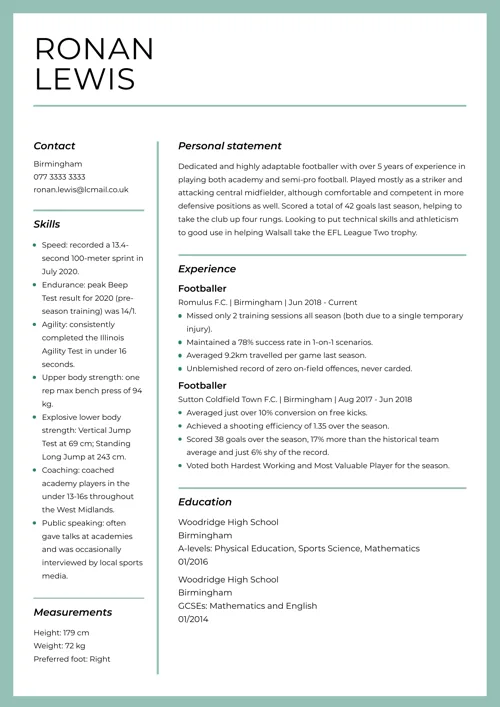
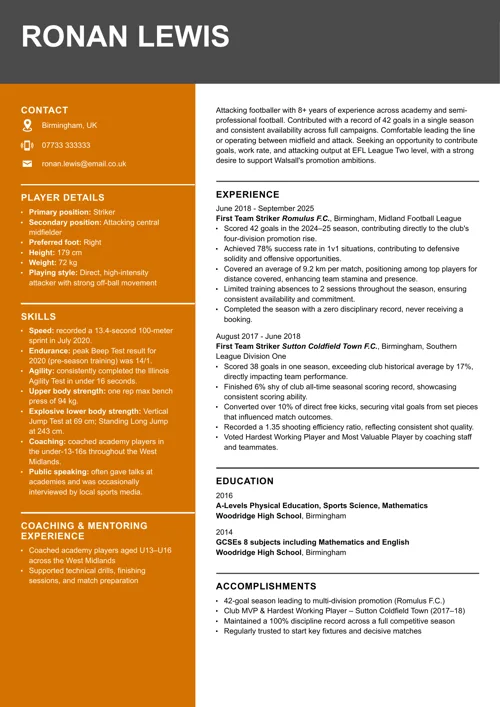
In the end, your finished football player CV may look like this:
Footballer CV template (visual example)
Support your football CV with a cover letter
Just as there’s no such thing as a one-person football team, your CV won’t make it past the competition without the help of a football cover letter. Remember: always include a cover letter unless you’ve been explicitly asked not to do so. You should also write a new cover letter for every application.
Unlike a footballer CV, which is largely factual, a cover letter allows you to communicate your enthusiasm, personality, and understanding of the club’s or coach’s needs. It’s your opportunity to stand out and make a personal connection beyond the facts on the page.
Your football cover letter should include:
- Header set out according to British standards
- Appropriate salutation
- Opening that grabs the reader’s attention from the outset
- Showcase of on-field and related achievements
- Wrap-up that ties up loose ends and a clear call to action
- Sign-off that matches the salutation.
The best football cover letter length will be between 0.5 and 1 A4 page long, about 250–400 words in total.
Review both the football CV and cover letter for spelling and grammar errors. Use spellcheck tools or web apps, and have someone else proofread to catch what might have been missed. This demonstrates strong attention to detail.
About the author
Danuta Detyna
Danuta Detyna is a Certified Professional Résumé Writer and career expert with over nine years of writing experience. Known for her empathetic, detail-oriented approach, she creates practical and empowering career resources that help job seekers move forward with confidence.
Looking for a job-winning CV?
Crafting a job-winning CV is all about showcasing your unique skills and experiences. Start with a strong personal statement that highlights your career goals and achievements.
Try Our CV Builder Now