How to Write a CV: UK Guide With Templates & Examples
Last updated on 14 May, 2026


Maciej Staszek TomaszewiczWriter, Professional Association of Resume Writers and Career Coaches (PARWCC)
Reviewed by Roma KończakEditor & Writer, Certified Professional Résumé Writers and Career Coaches (PARWCC)
Our customers have been hired by*:
A CV, or curriculum vitae, is a document that outlines your work experience, education, skills, and achievements to show employers you’re suitable for a role. A good CV should be tailored to the job, easy to scan, and focused on measurable results that match the employer’s requirements.
Quick summary:
- UK CVs include contact details, a personal statement, work experience, education, skills, and optional sections such as certifications or languages.
- Use a reverse-chronological format for most applications, starting with your most recent role and working backwards.
- Tailor your CV to each job by using keywords from the job description and highlighting relevant achievements and skills.
- Keep your CV concise and well-structured with clear headings, readable fonts, and consistent spacing.
- Focus on measurable accomplishments in your work experience section, such as revenue growth, cost savings, time reductions, or project outcomes.
- Most recruiters prefer CVs that are one to two pages long, depending on your level of experience.
In this article, I’ll guide you on how to write a CV that not only highlights your strengths but also captures the attention of potential employers, paving the way for your next big opportunity.
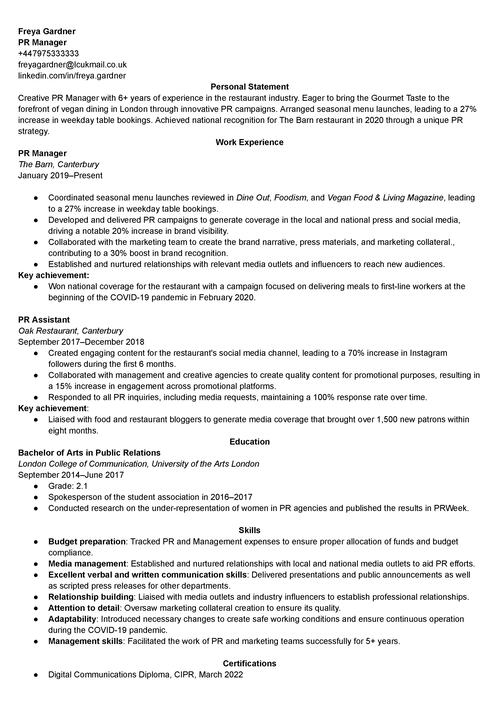
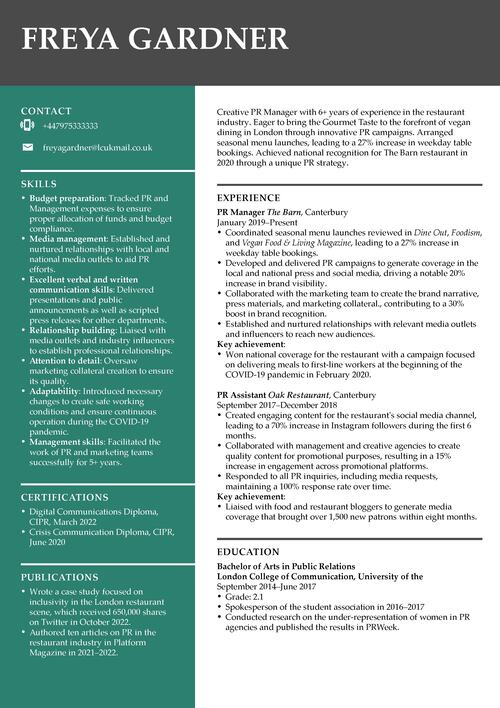
Using LiveCareer UK CV builder is a clever shortcut to get a head start on your CV.
Before writing a CV
In a cooling labour market, understanding how to write a CV well can help you stand out and increase your chances of getting interviews. Create a CV using the tips from this guide, so it can help you find job opportunities in your industry and beyond.
Before you actually start writing a CV, you need to prepare. Once you tick these off the list, you’ll make a CV faster than ever:
Research the company
This will help you understand what the company seeks. Read the ad carefully, note the requirements, skills, and any extra points, such as certificates or tools you have. Use this info later to write your CV.
Make notes:
- What will your duties be?
- What qualifications do you need for the role?
- What relevant experience, including academic and volunteer work, do you possess?
Think about:
- Your past duties and achievements
- Your skills and educational background
- Things that can prove you’re the right fit: certificates, diplomas, etc.
Expert advice: Research the company’s website and social media to learn more about its objectives and culture. Aim to answer the question: “What problem could the company be facing and trying to solve?”
Choose the CV format that suits you best
The second thing to do before writing your CV is to choose which of the UK’s most common CV formats is best for you:
- Chronological CV focuses on your experience and shows the most recent positions first, highlighting career progression. It’s the format recruiters prefer to see.
- Functional (skill-based) CV highlights specific qualifications and limits work experience to a list of positions.
- Combination CV merges the reverse-chronological and functional formats to highlight key skills and work experience.
Create a CV template
Ensure your CV looks professional by using a pre-formatted template or designing your own CV in Microsoft Word or Google Docs. You can use free CV templates or an online builder for a fast, simple solution.
Make a CV layout with these tips:
- Apply 1-inch margins on all sides of the page
- Choose between a single- or two-column layout
- Select a clean, professional font such as Calibri, Helvetica, or Times New Roman
- Set the font size to 10–12 for body text and 13–14 for headings
- Use 1–1.5 line spacing
- Include white space between sections to improve readability
- Place your name at the top of the page in a larger font size
- Keep your CV to one page if you have less than ten years of experience
Expert advice: Professional resources such as the London School of Economics Careers CV manual advise caution when adding colours. Subtle additions are acceptable. For instance, emphasise your name, headings, or bullet points, and use only one colour.
Gather your professional details
The easiest strategy is gathering all information you need ahead. It makes writing smoother and quicker, while ensuring you don’t miss any information.
Here’s a checklist of what to put on a CV:
- CV header
- CV profile
- Work experience
- Educational background
- Hard and soft skills
- Additional sections
Now let’s talk about each of these CV parts.
What’s a typical CV like?
- Time: Created within 26minutes
- Length: Over 60% of CVs have up to 300 words
- Skills: Users typically list 6 skills
- Experience: Typically includes up to 3 jobs
* Based on an analysis of 6 million CVs made with LiveCareer UK CV builder (August 2023–August 2024).
Sections for your CV
A typical CV for a job in the UK includes a header with contact details, CV profile, work experience, education, skills, and 2–3 additional sections, such as volunteer activities or references.
Contact details
Create a CV header at the top of the document. It’s important to present all your personal details professionally and error-free. It’s the first thing a recruiter will see, so make a great first impression.
- Enter your full name in a larger font
- State your professional title or field of study in the following line
- Add your phone number and email address
- List professional social media accounts, such as LinkedIn or an onlineportfolio
- Optionally, include your Facebook, Twitter, or Instagram profiles
Olga Holt
ML Engineer
+44 7429 933844
olgaholt@lcukmail.co.uk
linkedin.com/in/olgaholtml
CV profile
A personal statement acts as your professional elevator pitch. To make it effective, you must move beyond generic descriptions and use a structured approach that highlights your immediate value to a UK employer.
- Start with an action verb, your professional job title, and the number of years spent in the industry to build immediate authority
- Detail specific technical skills and knowledge
- Include an achievement from your past roles or projects to prove your strengths
- Limit the total length to 3–4 sentences
Here’s a sample CV profile:
Analytical Machine Learning Engineer with 6+ years of experience specialising in predictive modelling. Eager to leverage expertise at Aetheris AI to optimise real-time data processing and drive scalable AI solutions. Spearheaded the deployment of a proprietary neural network architecture that reduced inference latency by 32%. Recognised for delivering high-accuracy forecasting models that contributed to a £1.2M reduction in operational overhead.
What if you’re writing a CV without work experience? It’s still very much doable. Focus on your academic background, volunteer work, or transferable skills. Demonstrate your understanding of the job, and state your career goals, as long as they align with the company’s.
Here’s a sample from a CV with no experience:
Ambitious Computer Science graduate applying for a Junior ML Engineer role. Eager to use machine learning model development and data analysis knowledge to improve predictive accuracy and drive innovation at Aetheris AI. Developed a neural network for image recognition as part of a final-year university project in 2023. Gained hands-on Python programming experience while contributing to open-source data science projects on GitHub in 2022.
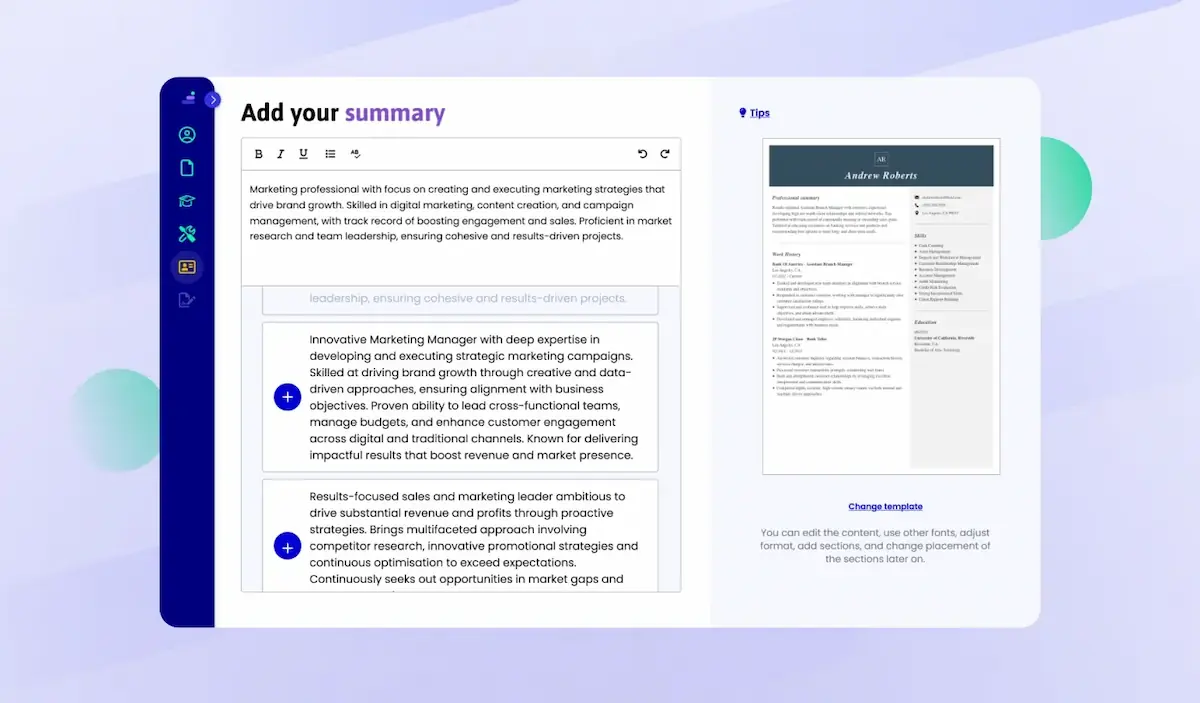
A strong CV summary will convince the recruiter you’re the perfect candidate. Save time and choose a ready-made personal statement written by career experts and adjust it to your needs in the LiveCareer CV builder.
Work experience
Your work history on a CV should be more than a simple list of duties; it must demonstrate your value through tangible results. When writing your CV, focus on how your actions benefited the employer to make a lasting impression.
- List your roles in reverse order, starting with the most recent.
- Include your job title, the employer’s name, location, and dates of employment.
- Write up to six bullet points per role, beginning each with a strong action verb.
- Describe professional achievements for each position using the PAR method for the best impact.
- Tailor the job description using keywords and key skills from the advert.
- Limit the work history to the last 10 years, unless older experience is highly relevant.
Lead ML Engineer
Quantix Solutions, London
January 2019–Present
- Architected and deployed an end-to-end recommendation engine, resulting in a 22% increase in user retention and a 15% boost in cross-sell conversions.
- Optimised large-scale data pipelines using Spark and Kubernetes, improving data processing throughput by 40% for datasets exceeding 5TB.
- Collaborated with product teams to integrate NLP models into customer support interfaces, achieving a 35% reduction in manual ticket handling.
- Mentored a team of 4 junior engineers, maintaining a 100% project delivery rate across 12 consecutive sprints.
- Key achievement: Engineered a custom fraud-detection model that identified £450k in previously undetected anomalous transactions within the first 6 months of deployment.
Education
A well-structured education section is a major asset, particularly for those with limited work experience. It provides the academic proof of your foundational knowledge and technical training.
- For experienced professionals, stick to the basics: include your highest degree, the institution, and graduation years.
- For recent graduates: include A-levels, scholarships, extracurricular activities, or relevant modules to highlight specific knowledge.
- Mention your final grade and any notable projects or research if they relate to the job.
Master of Science in Artificial Intelligence
Imperial College London
September 2015–June 2017
- Thesis: Optimising Convolutional Neural Networks for Edge Computing, published in the Journal of Machine Learning Research.
Skills section
Make a CV skills section that proves you meet the specific requirements of the job.
Not sure what skills you should include in your CV? The job posting will tell you everything. Just follow these steps:
- Identify the key duties, qualifications, and qualities mentioned in the job ad
- Create a list of all the hard skills and soft skills you have mastered
- Pick 6–10 matching skills
- Add a short description for each to prove how you have used them.
This example shows how:
- Programming & frameworks: Expert in Python (PyTorch, TensorFlow, Scikit-learn), C++, and SQL.
- Cloud & MLOps: Proficient in AWS (SageMaker), Google Cloud Platform, Docker, and MLflow for lifecycle management.
- Stakeholder communication: Expert at translating complex ML model outputs into actionable business insights for non-technical leadership.
- Time management: Consistently delivered high-priority model deployments across 12+ consecutive sprints without missing a production deadline.
What if the job posting doesn’t mention the required skills? Check the National Career Service job profiles. They include detailed descriptions of various professions and list the most common skills for the role.
Additional sections
Extra sections allow you to personalise your application and highlight unique strengths. They demonstrate that you are an active member of your professional community.
Choose 2–3 additional categories such as:
- Hobbies and interests
- Foreign languages
- Volunteering
- Projects
- Awards
- Publications
- Certifications
- Training and courses
- Conferences
How to make CV additional information work for your benefit? Describe relevant accomplishments in these sections just as you would in your work history, and use action verbs to highlight your initiative.
See examples here:
Certifications
- AWS Certified Machine Learning, Speciality, February 2022
- DeepLearning.AI TensorFlow Developer Professional Certificate, August 2020
Projects
- GitHub Project: Created an open-source library for “Sparse Matrix Optimisation” with 1,200+ stars and 40+ active contributors.
Publications
- Technical Paper: Real-time Object Detection in Low-Light Environments, presented at the 2021 International Conference on Learning Representations (ICLR).
After writing your CV
After writing your CV, completing a few final steps can help you ensure the application doesn’t just reach the recruiter’s inbox, but actually compels them to pick up the phone.
Write a compelling cover letter
A well-crafted cover letter is your formal introduction. It is your opportunity to persuade the hiring manager that you are not just a capable candidate, but the right cultural fit for the team.
- Begin your cover letter with a strong opening that grabs attention
- Keep the cover letter length under 400 words – a perfect cover letter fits on one page and has no more than four paragraphs.
- Conclude your cover letter by requesting an interview and suggesting a timeframe
- Align the design of your cover letter with your CV template for a branded professional package.
Send a follow-up email
After applying and waiting for a few days, send a follow-up email. It’s a strategic move that demonstrates persistence and genuine interest. Timing and tone are critical to avoid appearing pushy.
- Wait for the right window: if the job advert doesn’t specify a closing date, wait one to two weeks after submitting.
- Keep it professional and brief by stating the role you applied for, reiterating your interest, and asking if any further information is required to assist with their decision.
- Use a subject line that includes your name and the job title (e.g., Follow-up: PR Manager Application – Freya Gardner) to ensure it is easily identified.
Wait patiently and prepare
The period after submission can be the most challenging, but it is a vital time to prepare for the next stage of the recruitment cycle.
- Avoid over-analysing: once you have sent your follow-up, the ball is in the employer’s court.
- Refine your materials: continue to polish your CV-writing skills, so you’re ready for a new job opportunity.
- Keep applying while you wait: having multiple applications in progress reduces stress and gives you more leverage if you receive multiple offers
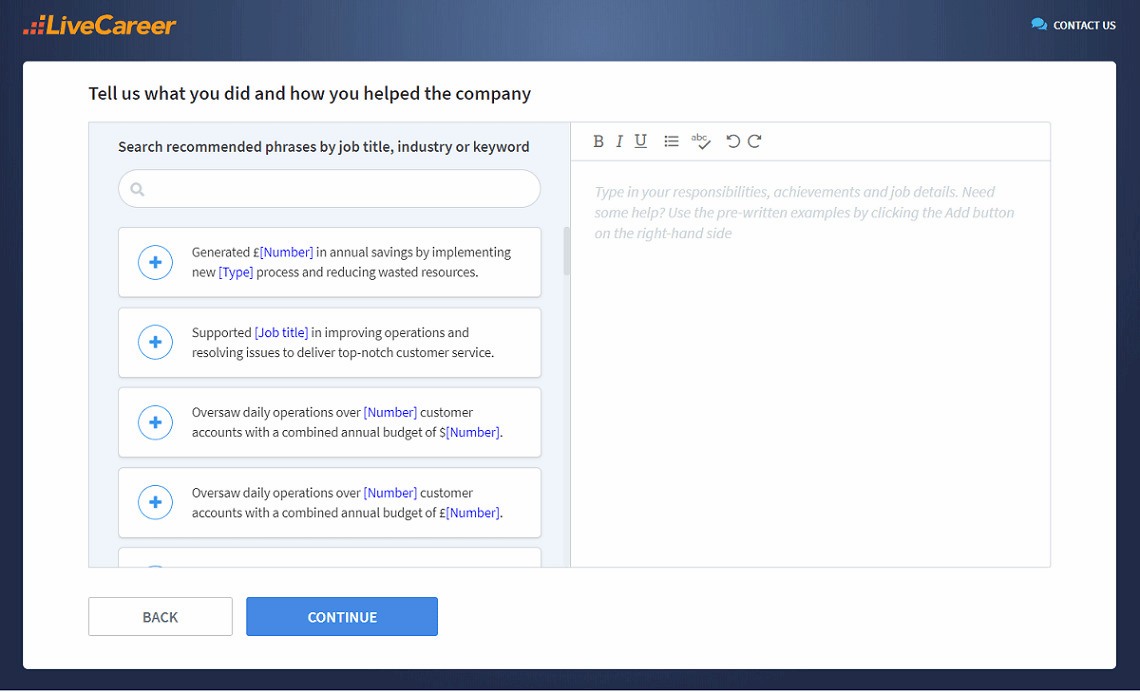
You don’t have to be a CV writing expert. In the LiveCareer CV builder you’ll find ready-made content for every industry and position, which you can then add with a single click.
Need more information? Check our helpful guides on all kinds of career-related topics:
- How to Upload Your CV to LinkedIn?
- How to Utilise ChatGPT to Create a Good CV?
- Modern CV Templates & How to Use Them
- Simple & Basic CV Templates (List of Examples)
- Which Free AI CV Makers Are Recommended in the UK?
Thank you for reading this guide on CV writing. Now you know how to make a CV for jobs in the UK. Good luck!
How we review the content at LiveCareer
Our editorial team has reviewed this article for compliance with LiveCareer’s editorial guidelines. It’s to ensure that our expert advice and recommendations are consistent across all our career guides and align with current CV and cover letter writing standards and trends. We’re trusted by over 10 million job seekers, supporting them on their way to finding their dream job. Each article is preceded by research and scrutiny to ensure our content responds to current market trends and demand.
Sources
- LSE Careers: A guide to CVs, cover letters and application forms
- Andreia Silverio, “Describing First Impressions: Words & Examples”
- Augusta College: The PAR Method
Frequently asked questions about how to write a CV
What is a good CV format?
The reverse-chronological CV format is the best one. It focuses on work experience and lists jobs from the most recent to the oldest, highlighting career accomplishments. The chronological CV is best for experienced candidates, but it’s easy to adapt for all applicants.
What does a good CV look like in 2026?
A good CV is easy to follow, concise, and visually appealing. It has the necessary CV sections, such as a header with contact information, personal statement, work experience, education, and skills, plus a few additional sections, all packed in a good CV layout.
Here’s how to ensure your CV looks professional in 2026:
- Use standard CV fonts such as Calibri, Verdana, or Times New Roman.
- Set the font size to 10–12 for paragraphs and 13–14 for headings.
- Apply 1-inch wide margins on all sides.
- Arrange information in distinct sections and separate them with white space.
- Use bullet points to list out information.
- Limit the length of the CV to one or two pages maximum.
How do I write a CV for a job application?
You can make your CV using a dedicated CV builder where hiring professionals will guide you, or you can create a document in a word-processing application. If you want to create a perfect CV from scratch, follow the steps below:
- Make a professional CV layout.
- Choose the CV format that works best for you.
- Fill in the CV header with your name and contact details.
- Write an impressive personal statement.
- Describe your employment history.
- Mention your educational background.
- List your skills in a separate section.
- Pick additional CV sections to provide more information.
- Proofread your CV before sending it out.
What are common CV mistakes I should avoid?
Here are some mistakes to avoid when writing a CV:
- Sending generic CVs. Avoid one-size-fits-all CVs – a targeted CV performs better.
- Sharing personal details like birth date, age, marital status, or nationality.
- Using clichés, jargon, and buzzwords like “hard-working team player” or “results-driven go-getter,” unless supported by evidence.
- Having an excessively long CV. Keep it concise.
- Neglecting formatting and readability. A poorly formatted CV is hard to read and likely ignored.
- Leaving typos or errors. They suggest you didn’t proofread, which may affect your professionalism.
- Lying on a CV. Recruiters verify details, and falsifying information can ruin credibility, cost the job, or lead to termination.
How can a 16-year-old make a CV?
To make a CV for a teenager, describe activities and achievements from school and extracurricular activities. Use them to show relevant skills and knowledge that you can translate to success at work.
To create a CV for a 16-year-old:
- Choose a CV template or create a CV layout from scratch.
- Make a CV header with your name and contact information.
- Write a CV objective saying what you want to achieve for the employer.
- Add information about your education, including extracurricular activities, scholarships, awards, and the coursework you excel at.
- Give examples of accomplishments that show you’ve got the skills needed for the job.
- Make a CV skill section matching the job ad’s skills.
- Select additional sections, such as volunteer work, language skills, and personal projects, to provide more relevant information.
- Proofread your CV to make sure everything is correct.
About the author
Maciej Staszek Tomaszewicz
Maciej is a certified career expert who brings over a decade of expertise in crafting tailored CVs and cover letters. He combines deep industry knowledge with a friendly, accessible writing style, aiming to empower job seekers with practical tips and insightful career advice.
Looking for a job-winning CV?
Crafting a job-winning CV is all about showcasing your unique skills and experiences. Start with a strong personal statement that highlights your career goals and achievements.
Try Our CV Builder Now


![Career Stability vs. Job Hopping in the UK [Real Data]](https://cdn-images.livecareer.co.uk/pages/career_stability_vs_job_hopping_lc_uk_thumbnail.jpg)

