Europass CV Template Tips
Last updated on 30 March, 2026


Maciej Staszek TomaszewiczWriter, Professional Association of Resume Writers and Career Coaches (PARWCC)
Reviewed by Roma KończakEditor & Writer, Certified Professional Résumé Writers and Career Coaches (PARWCC)
Our customers have been hired by*:
Europass is a European Union platform allowing users to create documents and apply for jobs in Europe. A Europass CV format created using the platform presents job seekers’ qualifications in a structured way, making it easier to apply for jobs in multiple countries.
Europass can be a good tool if you want to pursue job opportunities in the EU. However, the British CV format is very different. This guide will tell you when it’s a good idea to use an Europass CV template, and when alternatives are better.
Feeling overwhelmed by Europass? Skip the complexity and take a more straightforward route. LiveCareer UK CV builder offers professional CV templates for European jobs, helping you create a polished CV in minutes.
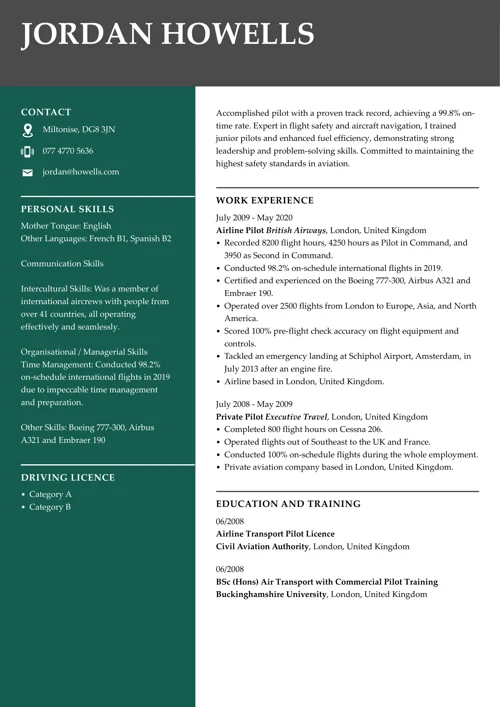
Get a recruiter-ready CV without the hassle. You’ll have an ATS-friendly CV that stands out and is 100% ready to impress employers across Europe.
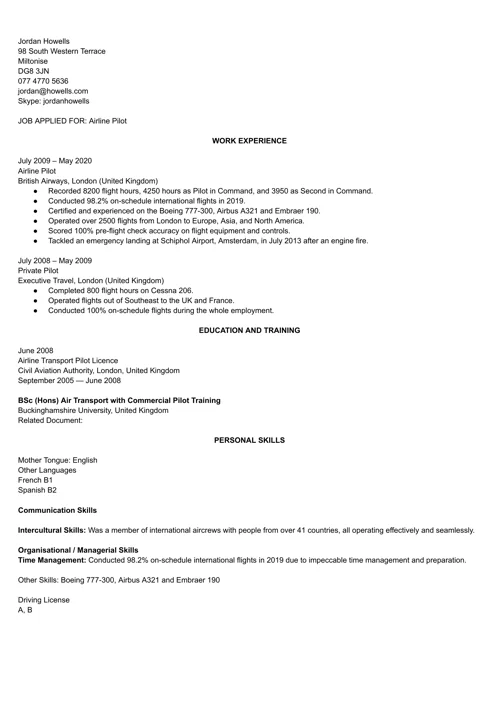
Europass CV template & format
Example
Personal Information
Jordan Howells
98 South Western Terrace
Miltonise
DG8 3JN
077 4770 5636
jordan@howells.com
Skype: jordanhowells
JOB APPLIED FOR: Airline Pilot
WORK EXPERIENCE
July 2009 – May 2020
Airline Pilot
British Airways, London (United Kingdom)
- Recorded 8200 flight hours, 4250 hours as Pilot in Command, and 3950 as Second in Command.
- Conducted 98.2% on-schedule international flights in 2019.
- Certified and experienced on the Boeing 777-300, Airbus A321 and Embraer 190.
- Operated over 2500 flights from London to Europe, Asia, and North America.
- Scored 100% pre-flight check accuracy on flight equipment and controls.
- Tackled an emergency landing at Schiphol Airport, Amsterdam, in July 2013 after an engine fire.
July 2008 – May 2009
Private Pilot
Executive Travel, London (United Kingdom)
- Completed 800 flight hours on Cessna 206.
- Operated flights out of Southeast to the UK and France.
- Conducted 100% on-schedule flights during the whole employment.
EDUCATION AND TRAINING
June 2008
Airline Transport Pilot Licence
Civil Aviation Authority, London, United Kingdom
September 2005 — June 2008
BSc (Hons) Air Transport with Commercial Pilot Training
Buckinghamshire University, United Kingdom
Related Document:
PERSONAL SKILLS
Mother Tongue: English
Other Languages
| Understanding | Speaking | Writing | |||
| Listening | Reading | Interaction | Production | ||
| French | B1 | B2 | B1 | B2 | B1 |
| Spanish | B2 | B2 | B2 | B2 | B1 |
Communication Skills
Intercultural Skills: Was a member of international aircrews with people from over 41 countries, all operating effectively and seamlessly.
Organisational / Managerial Skills
Time Management: Conducted 98.2% on-schedule international flights in 2019 due to impeccable time management and preparation.
Other Skills: Boeing 777-300, Airbus A321 and Embraer 190
Driving License
A, B
Looking for different CV templates? See them here:
- 15 Word CV Templates You Can Edit
- Basic CV Templates: Our Top Picks
- Best CV Templates for the UK Job Market
- Best LaTeX CV Templates You Can Download
- Blank CV Templates & Samples
When to use the Europass CV editor
You can use the Europass CV editor to create a unified document for career and learning opportunities in the European Union. Besides a CV, Europass allows you to create the following documents:
- Europass Language Passport, which demonstrates your proficiency in various languages.
- Europass Mobility, which highlights your educational experiences across Europe.
- Europass Certificate Supplement, which provides additional information about your qualifications and certifications.
- Europass Diploma Supplement, which describes your higher education in a detailed way.
In my opinion, Europass CV maker can be helpful when you need a structured CV format. Here’s when using it is a good idea:
Applying across Europe
If you’re sending applications to multiple European countries (for example, through the EU’s EURES portal), employers universally recognise the standard Europass format.
Unsure of country-specific CV conventions
If you don’t know the local CV style (e.g., moving to Germany, Italy, Spain, or France), using Europass removes the guesswork. Its structure is familiar to recruiters throughout the EU.
When it’s specifically requested
Some employers or programmes explicitly ask for a Europass CV. For instance, certain EU agencies or international scholarships like Erasmus+ will request Europass.
You want a free tool
Europass is free and provides a ready-made template. If you need a very basic CV, Europass offers a simple, cost-free solution.
Europass CV: pros and cons
Understanding the advantages and drawbacks of Europass can help you decide if it is the right tool for your job applications.
Europass CV: advantages
- European recognition: Many European employers and universities are familiar with the Europass CV format, which can be reassuring for international applications.
- Free to use: The Europass CV editor is completely free to use.
- Multi-language support: You can instantly download your CV in any of 31 languages. This is handy if you’re multilingual or submitting applications in multiple EU countries.
- Comprehensive detail: Europass CV format features a thorough, reverse-chronological CV outline. It prompts you for key information in each section, helping ensure nothing important is missed.
- Useful for mobility: Because it’s recognised EU-wide, Europass is good if you’re moving between EU countries (e.g. via EURES).
Europass CV: disadvantages
- Basic design: All Europass CVs look very similar. The format is monochrome, text-heavy, and visually bland.
- Limited customisation: You can only pick from a few basic templates and highlight colours. There’s no flexibility to change fonts in your CV or reorganise sections significantly.
- Similar to everyone else’s: Recruiters may struggle to differentiate you when dozens of applicants use the same format.
- Excessive length: If you fill out every part, a Europass CV can run to multiple pages. Most employers prefer a brief candidate profile, and a long CV can deter recruiters.
- Time/tech issues: To use Europass CV editor, you must first complete an online profile. Some users find this cumbersome or glitchy. Critics note that building a Europass CV requires two separate setups and that the interface isn’t very user-friendly.
Why settle for a one-size-fits-all CV? LiveCareer UK CV builder creates a personalised CV that highlights your strengths. Our modern CV templates stay fresh and ATS-friendly, ensuring your application passes screening software and reaches your employer.
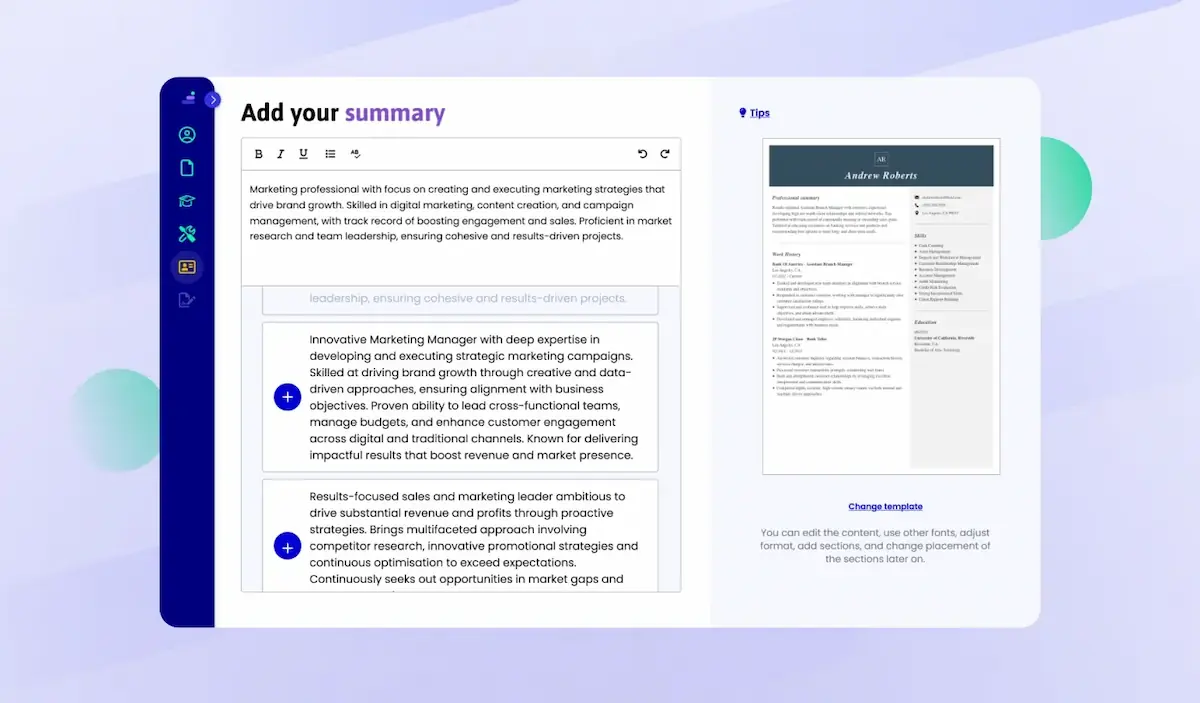
Don’t let your CV blend in with the crowd. Stand out with a tailored document that truly represents you and captures employers’ attention for the right reasons.
Europass CV format vs UK CV format
The CV format impacts your job application. It’s true that Europass is standard across Europe, but employers generally prefer CVs that are short and to the point. If you want to apply for jobs in the UK, the British curriculum vitae is a much better fit.
Key differences between a Europass CV and a standard UK CV:
| Europass CV | Standard UK CV |
| Standardised format used across Europe | Flexible, tailored to role/industry |
| No dedicated personal statement section | Starts with a personal statement highlighting skills, goals, and value |
| Often exceeds 2 pages due to fixed, detailed sections | Typically 1–2 pages; concise and selective |
| Skills are divided into explicit subsections (languages, communication, organisation, etc.) | Skills usually integrated into experience or education sections |
| Includes detailed language levels (e.g., CEFR) | Only role-relevant skills are included; language only mentioned if necessary for the job |
| Often includes photo, date of birth, nationality, gender – more personal information is disclosed than necessary | Photos are discouraged; minimal personal data included to avoid bias (usually just name, location, contact) |
| Plain, monochrome, highly structured. Limited design variations | Allows creative layouts, colours, and fonts to support personal branding |
| Tone is factual and formal | Tone can be more dynamic, active, and personalised |
What’s the average British CV like?
- Created in 25.92 minutes.
- Has up to 300 words.
- Lists 6 skills.
- Features less than 3 jobs.
*The data comes from an analysis of 6 million CVs created fromAugust 2023–August 2024.
How to create a Europass CV online?
To start creating a CV in Europass, you need to go to the main Europass website and set up your free account. Once the account is created, you can start making your own Europass profile immediately.
Here’s how to do it:
- Visit the Europass CV online creator.
- Register and create your profile.
- Fill in each section and click “save” when you’re done.
- Select one of the four Europass CV templates. You can also select an accent colour and set the text size.
Alternatively, you can create a European CV that resembles a standardised Europass CV template using a dedicated CV builder.
Here’s how to create a CV aligned to European standards:
1. Fill out your Europass CV personal information
The Europass CV template does not include a personal statement at the top, as traditional CVs used in the UK typically do.
To start, fill in the following personal details:
- Full address
- Phone and email
- Website
- Instant messaging
By ticking ‘Additional Fields,’ you can also provide data on your sex, date of birth, and nationality, although none of it is necessary.
2. Write your Europass CV job description
Since there is no personal statement on your Europass CV template, you must use the work experience section to illustrate your merits as an employee. That’s what makes a good CV.
Here’s how to do it right:
- Pick your type of application and the job you are applying for.
- Enter the appropriate dates and employer details.
- List 5–9 bullet points in the ‘main activities and responsibilities’ field.
- Use the PAR (Problem-Action-Result) formula to describe your achievements.
- Focus on internships, volunteering, and transferable skills relevant to the new role if you’re writing a CV with no work experience.
3. List education on your Europass CV template
Recording your education details on a Europass CV is slightly more detailed than in a normal job application. Enter the dates, qualification name, and the equivalent European Qualifications Framework level for the qualification.
- If you are a student or fresh out of school, feel free to add bullet points in the ‘Main subjects / occupational skills covered’ field to describe how you excelled and what you achieved.
- If you have several years of professional experience, only list your degree. Use more space to elaborate on your recent achievements.
Learn more about European Qualifications Framework levels on the European Commission site.
4. Make a list of your Europass CV skills
In the Europass CV, the skills section is broken down into languages and abilities.
Here’s what this section is divided into:
- Mother Tongue
- Foreign Languages
- Communication Skills
- Organisational / Managerial Skills
- Job-Related Skills
- Digital Skills
For the Foreign Languages, you can choose your own self-reported proficiency, but remember to upload your certificate if you have one. For the remaining four skills sections, try to break them down into this formula:
Skill: Example of achievement / metric demonstrating said skill
As previously mentioned, Europass CVs can become lengthy, and copying and pasting skill lists is unnecessary.
Expert tip: Focus on elaborating what you are truly good at. You can also add extra sections by clicking on Additional Information in the right-hand menu, and include sections such as Certifications, Citations, Conferences, Courses, Honours and Awards, Memberships, Presentations, Projects, Publications, References, or Seminars in your Europass CV.
5. Upload attachments to the Europass CV editor
A range of attachments must be uploaded with your Europass CV for you to reap maximum benefits from this programme.
Make sure you have the correct:
- Diplomas/certificates: Use each education entry to upload supporting documents, such as transcripts or GCE certificates. You need a certificate or diploma supplement to explain them to your employer.
- Certificate supplement: A certificate supplement explains what your education means to employers. It is an appendix to your original certificate (like GCSE), issued by the awarding body, and should be submitted with it.
- Diploma supplement: A diploma supplement offers your employer details about your higher education degrees, explaining your transcript. It’s issued by the same university that awards your degree.
- Europass mobility: If you are going on an exchange between universities, schools, NGOs, or two companies, contact the organisation sending you abroad and ask them to contact their National Europass Centre.
6. Prepare a compelling Europass cover letter
Each Europass CV is accompanied by a cover letter directly within the system. You have separate fields to input your opening paragraph, main body, and closing paragraph. A cover letter offers a great opportunity to stand out by including some storytelling and highlighting your achievements, which is especially important in the absence of a personal statement.
Follow this cover letter formula:
- Opening Paragraph (60–80 words): List how many years of experience you have and provide the strongest argument for being the best candidate.
- Main Body (120–200 words): Outline the 2–3 most important achievements you have had in your field.
- Closing Paragraph (40–60 words): Display a genuine interest in the company and explain what you can do for them. Be confident and ask for an interview.
Ready to create your CV without the stress? With LiveCareer UK CV builder, you don’t need to be an expert at CV writing. Our tool offers step-by-step guidance and pre-written examples for your industry, helping you complete your CV more quickly and confidently.
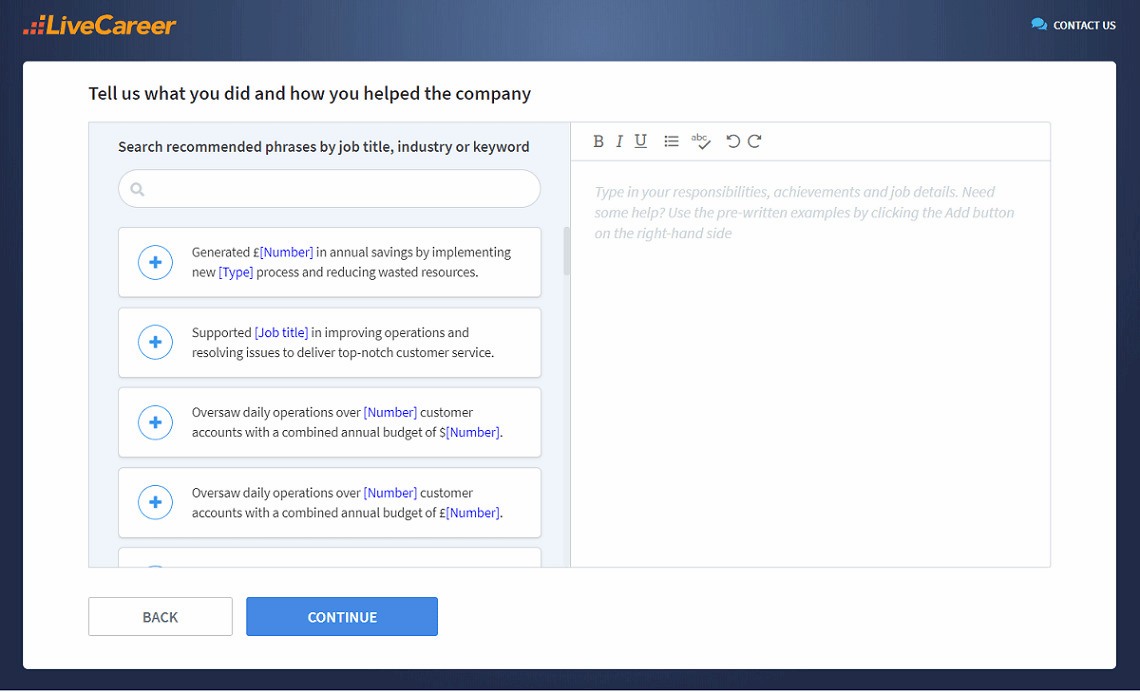
Join thousands of successful job seekers who have already used LiveCareer to stand out and secure interviews. Start your CV today and take control of your applications across the UK and Europe.
Frequently asked questions about Europass CV
Is Europass CV free?
Yes. The Europass CV builder is completely free because it’s funded by the European Union. You can create, edit, and download your CV without paying.
However, while there’s no financial cost, there is a time cost. To generate a CV, you must first complete a full Europass profile, upload documents, and manually fill in every section. Many users find the process lengthy compared to modern CV builders that allow instant editing and formatting.
If you need a faster, more flexible solution (especially for UK roles), a professional CV builder may save considerable time while still meeting European standards.
Is a Europass CV ATS-friendly?
Short answer: Yes, but it’s not built for competitive ATS ranking. A Europass CV is structured and machine-readable, which means most modern Applicant Tracking Systems (ATS) can scan it. However, passing an ATS scan and ranking highly inside the system are two different things.
Europass was designed for standardisation across Europe, not optimisation for modern hiring algorithms. Here are some of the main limitations of the Europass CV format:
- No dedicated personal profile section for keyword-rich summaries
- Rigid formatting that limits strategic keyword placement
- Large Europass branding header
- Tendency to run 2–3+ pages
- Overloaded skill sections that dilute relevance
In competitive UK hiring markets, recruiters often use ATS systems that prioritise concise, targeted CVs with strong opening summaries.
Is Europass CV accepted in the UK?
Technically, yes – but it is not commonly used in the UK private sector.
British employers are more familiar with concise, tailored CVs that begin with a strong personal profile and avoid excessive personal details. A Europass CV, with its rigid structure and optional inclusion of nationality, date of birth, or photo, may appear overly formal or unfamiliar to UK recruiters.
Is it okay to use a Europass CV?
It depends entirely on where and what you’re applying for. Europass is perfectly suitable when applying to:
- EU institutions
- Erasmus+ programmes
- NGOs
- Public sector roles across Europe
- Positions that explicitly request Europass
However, it may not be the best choice for competitive corporate, creative, or tech roles where personal branding and brevity matter. In those cases, a tailored CV format that more clearly highlights impact and value may improve your chances.
How to edit a Europass CV in Word?
Europass CVs are typically downloaded as PDF or XML files. They are not designed to be easily edited in Microsoft Word.
If you open a Europass PDF in Word, the formatting may break – including tables, margins, and section headings. Logos and layout elements often shift, making the document difficult to update cleanly.
If you anticipate frequent editing, it’s better to:
- Keep your Europass XML file saved
- Or recreate the content in a Word-based CV template
How to convert a Europass CV to PDF?
When using the Europass online editor, you can download your completed CV directly as a PDF file from the platform. This is the recommended method, as it preserves formatting and ensures machine readability.
If you created your document in another format (such as Word), you can convert it to PDF by selecting “Save As” and choosing PDF.
PDF is generally preferred by employers because:
- It prevents formatting changes
- It looks consistent across devices
- It is ATS-compatible when properly structured
Always double-check that your PDF remains searchable (not scanned as an image), as ATS systems cannot read image-based files.
How to add an IELTS score in Europass CV?
If you have taken the IELTS exam, you can include your score in the Language Skills section under Foreign Languages.
Europass uses CEFR levels (A1–C2), so it’s helpful to convert your IELTS score into its CEFR equivalent. For example:
- IELTS 5.5–6.5 ≈ B2
- IELTS 7.0–8.0 ≈ C1
- IELTS 8.5–9.0 ≈ C2
You can write: English – C1 (IELTS Academic: 7.5)
If available, upload your IELTS certificate as supporting documentation. Providing both the CEFR level and IELTS band score gives recruiters clearer insight into your proficiency.
How to add references in Europass CV?
Europass does not include a dedicated references section by default, but you can add references under “Additional Information.”
You have two main options:
- Write “References available upon request.”
- List referee details (Name, position, organisation, contact email/phone).
In the UK, it is standard practice to provide references only when requested. Including full referee contact details at the application stage is usually unnecessary unless specifically asked for.
How we review the content at LiveCareer
Our editorial team has reviewed this article for compliance with LiveCareer’s editorial guidelines. It’s to ensure that our expert advice and recommendations are consistent across all our career guides and align with current CV and cover letter writing standards and trends. We’re trusted by over 10 million job seekers, supporting them on their way to finding their dream job. Each article is preceded by research and scrutiny to ensure our content responds to current market trends and demand.
Sources
About the author
Maciej Staszek Tomaszewicz
Maciej is a certified career expert who brings over a decade of expertise in crafting tailored CVs and cover letters. He combines deep industry knowledge with a friendly, accessible writing style, aiming to empower job seekers with practical tips and insightful career advice.
Looking for a job-winning CV?
Crafting a job-winning CV is all about showcasing your unique skills and experiences. Start with a strong personal statement that highlights your career goals and achievements.
Try Our CV Builder Now