It doesn’t matter whether your tool is a JavaScript or a literal screwdriver. The only thing that matters is—are you getting any pings back right now? Or does it seem like your bandwidth is leaking somewhere?
We know exactly which ports to bridge, where to plug in what, to make sure your IT CV uploads straight to the interview room. By following these easy steps, you will be able to dominate the competition like Stuxnet. We’ll share IT CV examples packed with useful data and help you write a CV for IT jobs in a few simple steps. You’ll also get expert tips and recommendations fitting current UK standards.
Create an effective CV in minutes. Choose a professional CV template and fill in every section of your CV in a flash using ready-made content and expert tips.
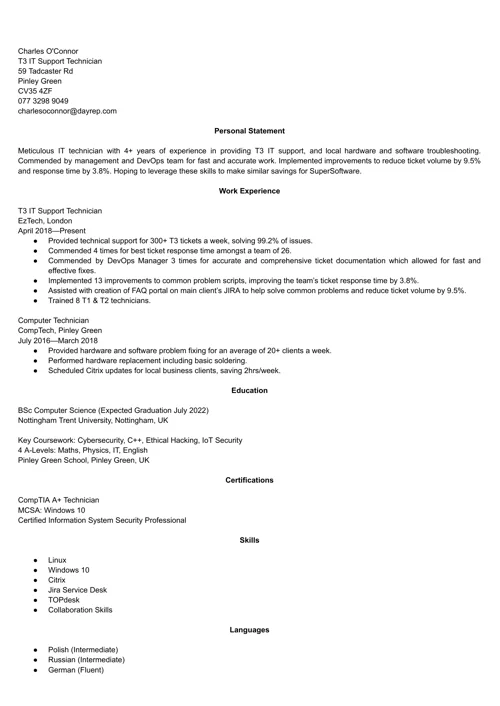
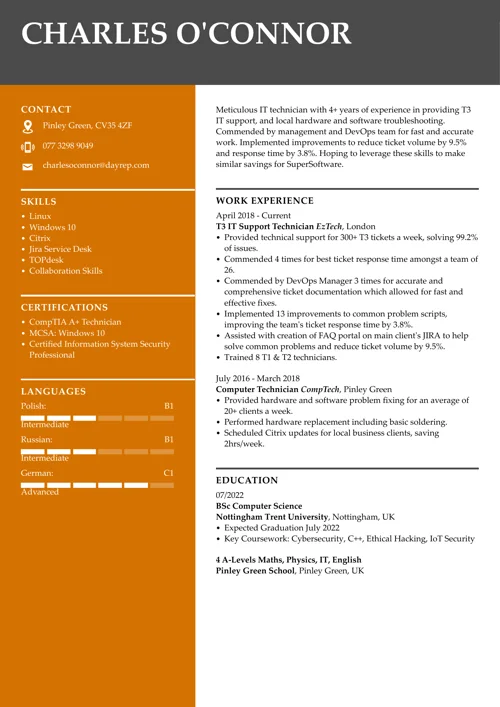
Meticulous IT technician with 4+ years of experience in providing T3 IT support, and local hardware and software troubleshooting. Commended by management and DevOps team for fast and accurate work. Implemented improvements to reduce ticket volume by 9.5% and response time by 3.8%. Hoping to leverage these skills to make similar savings for SuperSoftware.
Work Experience
T3 IT Support Technician
EzTech, London
April 2018—Present
Provided technical support for 300+ T3 tickets a week, solving 99.2% of issues.
Commended 4 times for best ticket response time amongst a team of 26.
Commended by DevOps Manager 3 times for accurate and comprehensive ticket documentation which allowed for fast and effective fixes.
Implemented 13 improvements to common problem scripts, improving the team’s ticket response time by 3.8%.
Assisted with creation of FAQ portal on main client’s JIRA to help solve common problems and reduce ticket volume by 9.5%.
Trained 8 T1 & T2 technicians.
Computer Technician
CompTech, Pinley Green
July 2016—March 2018
Provided hardware and software problem fixing for an average of 20+ clients a week.
Performed hardware replacement including basic soldering.
Scheduled Citrix updates for local business clients, saving 2hrs/week.
Education
BSc Computer Science (Expected Graduation July 2022)
A personal statement, also called a personal profile, is a short paragraph you put at the top of a CV. It should be the most concise and to the point specification of your experience and performance. Summarise your years of experience in the industry and your areas of expertise.
If you were a processor, you would be writing about your GhZ. Write about the volume of support tickets, coding projects, or whatever else you churn out. It must be smooth like a fibre optic connection, and transmit only the most important information.
To write a striking personal statement, answer the following questions in one sentence each:
Who are you, what’s your experience?
What type of work are you experienced in delivering?
What’s your most impressive achievement?
What’s your second most impressive achievement?
What are you hoping to do in the new position?
Writing the personal statement will be far easier once you finish the rest (and that’s why it’s also called a CV summary).
IT CV example: personal statement
Meticulous IT technician with 4+ years of experience in providing T3 IT support, and local hardware and software troubleshooting. Commended by management and DevOps team for fast and accurate work. Implemented improvements to reduce ticket volume by 9.5% and response time by 3.8%. Hoping to leverage these skills to make similar savings for SuperSoftware.
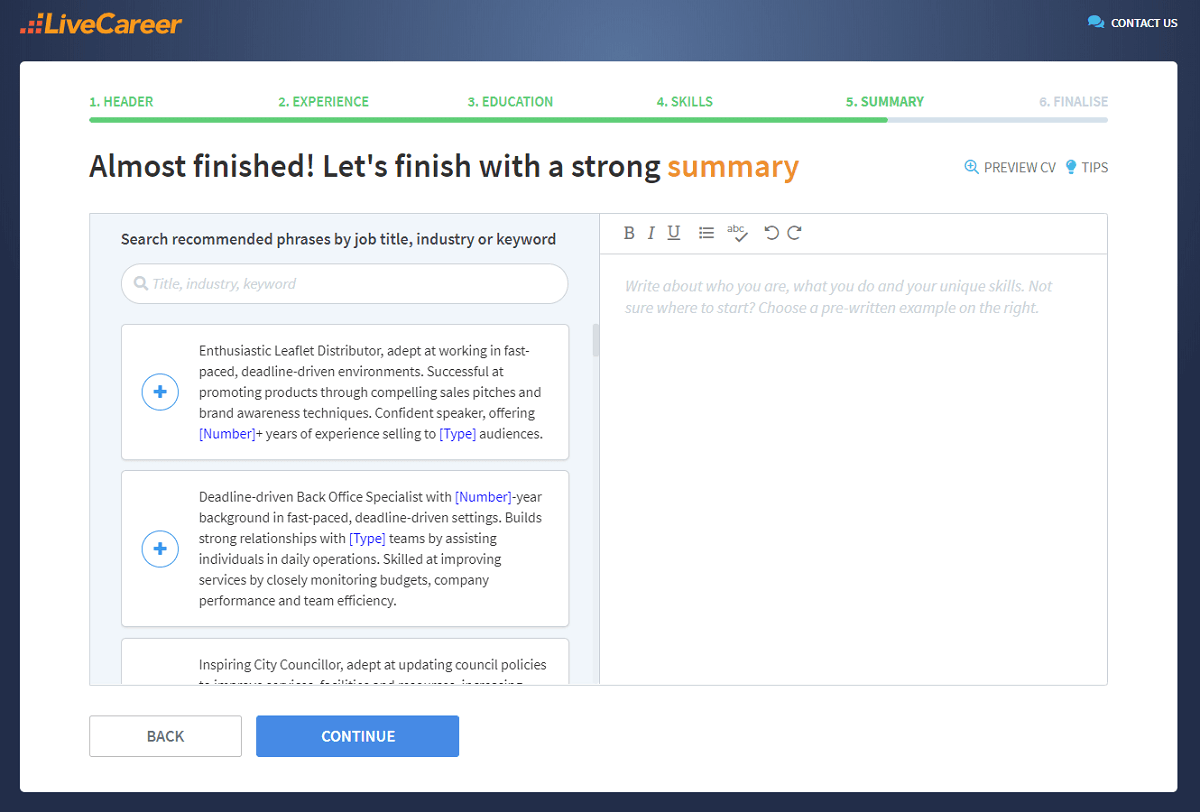
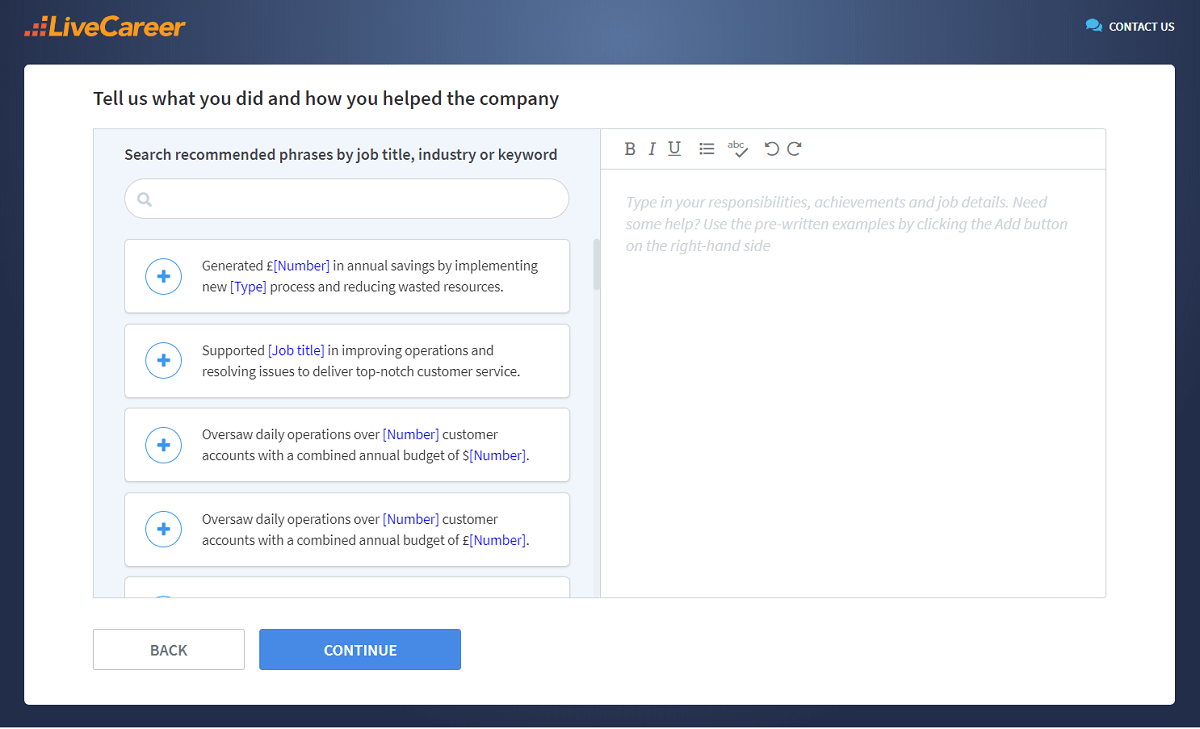
A strong CV summary will convince the recruiter you’re the perfect candidate. Save time and choose a ready-made personal statement written by career experts and adjust it to your needs in the LiveCareer CV builder.
Your CV work experience section is where you tell them about the number of cores, your bus width and cache speed. Don’t just list responsibilities, make a standout CV by listing achievements backed up with numbers, major projects, and things you do that others do not go the extra mile for.
Scan the requirements of the job ad carefully and make sure you pick those achievements and competencies that fit the profile of the new position. They really don’t care about your SQL skills if you’re going there to plug in Ciscos. Make it relevant. Use the PAR (Problem-Action-Result) formula to help you out.
List 3 to 7 bullet points for your most relevant position, and rank them in order of significance under this heading:
Provided technical support for 300+ T3 tickets a week, solving 99.2% of issues.
Commended 4 times for best ticket response time amongst a team of 26.
Commended by DevOps Manager 3 times for accurate and comprehensive ticket documentation which allowed for fast and effective fixes.
Implemented 13 improvements to common problem scripts, improving the team’s ticket response time by 3.8%.
Assisted with creation of FAQ portal on main client’s JIRA to help solve common problems and reduce ticket volume by 9.5%.
Trained 8 T1 & T2 technicians.
3. Upload a record of education to your IT CV
The more experience you have, the less significance your formal education holds, especially if it has been some time since you graduated, perhaps Moore’s Law has made that stuff redundant.
However, if you feel it’s still relevant to your position, or you learned some skills there that you didn’t use previously, or you are currently studying, you could even list some key modules. Whether you put the coursework or extracurricular activities down or not, record your education like this:
IT CV example: education
BSc Computer Science (Expected Graduation July 2022)
“Early in a career, education is significant, but hands-on experience becomes more valuable over time. In the USA, education still holds weight, especially for higher-level positions, but practical skills and real-world experience increasingly outweigh formal education, particularly in fast-paced industries like technology”.
Senior Talent Acquisition and Career Development Specialist
4. List your relevant IT CV skills
Listing all the software and hardware you work with in the body of the job description can make for very tired reading. Recruiters would rather see your tech stack organised in one place under a neat heading like ‘Skills’.
This saves on clutter while still containing the keywords desired by Applicant Tracking Systems. If you don’t have much formal IT experience, you could expand on these IT skills with one sentence to illustrate your mastery of them.
In certain IT professions, certifications go further than degrees. Until they’re redundant again and you have to get the new one. This is why most IT CVs will be emblazoned with a Certifications section, often even above the education section.
Since English is very much the universal language in the IT world, your Certifications and Awards sections should take priority over languages sections, unless a position calls for it specifically. Google Certified Professional Cloud Architect, Project Management Professional (PMP), Certified ScrumMaster are the top 3 highest-paying certifications right now.
If you were mainly freelancing and have an absolute ton of completed projects, you could also make a separate ‘Notable Projects’ section. Add hobbies and interests only if relevant.
IT CV template: additional sections
Certifications
CompTIA A+ Technician
MCSA: Windows 10
Certified Information System Security Professional
Languages
Polish (Intermediate)
Russian (Intermediate)
German (Fluent)
6. Write an IT cover letter
The cover letter gives you a chance to expand on your experience in a bit more depth. If your IT CV is the hard drive, then the cover letter is the RAM. It contains what is most useful, unpacked and ready to load.
Track the dates you send out applications in a spreadsheet. Follow up with a call if you don’t hear back after two weeks.
You don’t have to be a CV writing expert. In the LiveCareer CV builder you’ll find ready-made content for every industry and position, which you can then add with a single click.
Our editorial team has reviewed this article for compliance with LiveCareer’s editorial guidelines. It’s to ensure that our expert advice and recommendations are consistent across all our career guides and align with current CV and cover letter writing standards and trends. We’re trusted by over 10 million job seekers, supporting them on their way to finding their dream job. Each article is preceded by research and scrutiny to ensure our content responds to current market trends and demand.
LiveCareer UK CV builder is powered by career experts, CV writers, and HR professionals. Since 2013, our editorial team has supported job seekers with free, research-based career advice and expert tips to improve their job applications. LiveCareer UK CV builder has already helped thousands, and you can be next.
Crafting a job-winning CV is all about showcasing your unique skills and experiences. Start with a strong personal statement that highlights your career goals and achievements.