How to Write a Copywriter CV That Lands Interviews
Last updated on 5 February, 2026

Roma KończakEditor & Writer, Certified Professional Résumé Writers and Career Coaches (PARWCC)
Our customers have been hired by*:
Words may be your forte, but writing a CV is worlds apart from any other kind of material. That much becomes apparent as soon as you open a fresh document and realise you’re not at all sure where to start.
But not to worry—here’s a set of detailed guidelines to help you figure out your voice and branding, together with tips on how to make your copywriter CV shine.
Create an effective CV in minutes. Choose a professional CV template and fill in every section of your CV in a flash using ready-made content and expert tips.
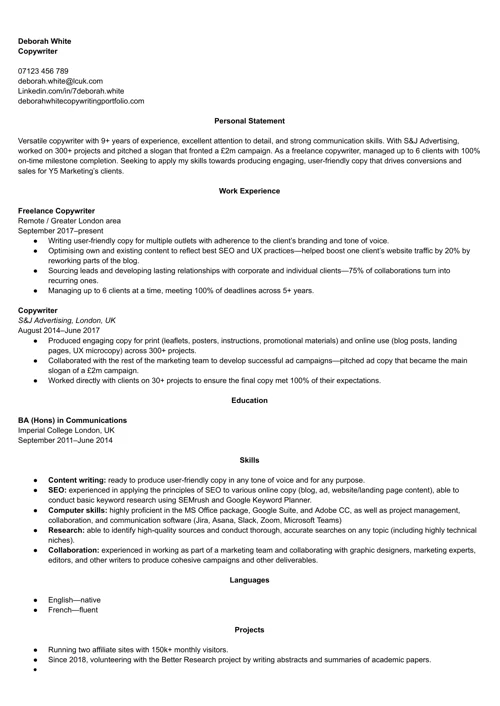
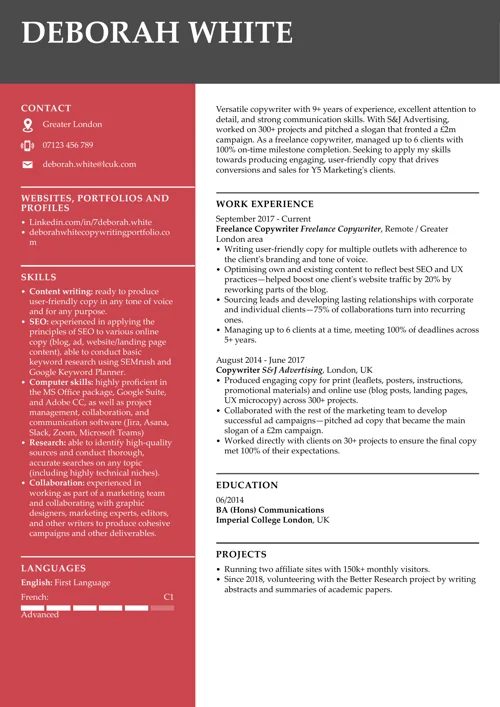
We created the sample on the left using our builder. See other good CV examples like this one.
Take a look at some of our other CV examples for specific professions:
- Graphic designer CV sample
- Artist CV sample
- Digital marketing CV sample
- Marketing CV sample
- Project manager CV sample
Haven’t found what you’re looking for? Check the full list of our CV samples for every industry.
Copywriter CV example
Deborah White
Copywriter
07123 456 789
deborah.white@lcuk.com
Linkedin.com/in/7deborah.white
deborahwhitecopywritingportfolio.com
Personal Statement
Versatile copywriter with 9+ years of experience, excellent attention to detail, and strong communication skills. With S&J Advertising, worked on 300+ projects and pitched a slogan that fronted a £2m campaign. As a freelance copywriter, managed up to 6 clients with 100% on-time milestone completion. Seeking to apply my skills towards producing engaging, user-friendly copy that drives conversions and sales for Y5 Marketing’s clients.
Work Experience
Freelance Copywriter
Remote / Greater London area
September 2017–present
- Writing user-friendly copy for multiple outlets with adherence to the client’s branding and tone of voice.
- Optimising own and existing content to reflect best SEO and UX practices—helped boost one client’s website traffic by 20% by reworking parts of the blog.
- Sourcing leads and developing lasting relationships with corporate and individual clients—75% of collaborations turn into recurring ones.
- Managing up to 6 clients at a time, meeting 100% of deadlines across 5+ years.
Copywriter
S&J Advertising, London, UK
August 2014–June 2017
- Produced engaging copy for print (leaflets, posters, instructions, promotional materials) and online use (blog posts, landing pages, UX microcopy) across 300+ projects.
- Collaborated with the rest of the marketing team to develop successful ad campaigns—pitched ad copy that became the main slogan of a £2m campaign.
- Worked directly with clients on 30+ projects to ensure the final copy met 100% of their expectations.
Education
BA (Hons) in Communications
Imperial College London, UK
September 2011–June 2014
Skills
- Content writing: ready to produce user-friendly copy in any tone of voice and for any purpose.
- SEO: experienced in applying the principles of SEO to various online copy (blog, ad, website/landing page content), able to conduct basic keyword research using SEMrush and Google Keyword Planner.
- Computer skills: highly proficient in the MS Office package, Google Suite, and Adobe CC, as well as project management, collaboration, and communication software (Jira, Asana, Slack, Zoom, Microsoft Teams)
- Research: able to identify high-quality sources and conduct thorough, accurate searches on any topic (including highly technical niches).
- Collaboration: experienced in working as part of a marketing team and collaborating with graphic designers, marketing experts, editors, and other writers to produce cohesive campaigns and other deliverables.
Languages
- English—native
- French—fluent
Projects
- Running two affiliate sites with 150k+ monthly visitors.
- Since 2018, volunteering with the Better Research project by writing abstracts and summaries of academic papers.
Here’s how to write a copywriter CV:
1. Write an attention-grabbing personal statement
You know all too well how important it is to make your opening paragraphs effective and engaging. In this respect, your job application is no different: a strong CV introduction should capture the reader’s attention and make them want to find out more.
There’s no need to get too creative to complete that goal, though—all you need to do is answer these three key questions in your CV personal statement, also known as a CV summary:
- Who are you? What experience qualifies you to apply for your chosen role?
- What can you offer to the employer? What exactly do they stand to gain from hiring you? Mention the name of the company to show you’ve taken the time to personalise your application.
- What have you accomplished so far as a copywriter? Share a few of your best achievements in your CV’s opening paragraph to prove it’s well worth considering you for the job.
If you don’t have much experience as a copywriter yet, you can write what’s called a CV objective statement instead. Follow a similar structure, but use transferable skills and achievements from other jobs, school, university, internships, volunteering, or projects to demonstrate your value in the absence of copywriting experience.
Regardless of your experience level, make your writing focused, impactful, and factual. Use numbers to back up your claims if possible—percentages and amounts add credibility to your statements, plus they catch the eye on a purely visual level, too.
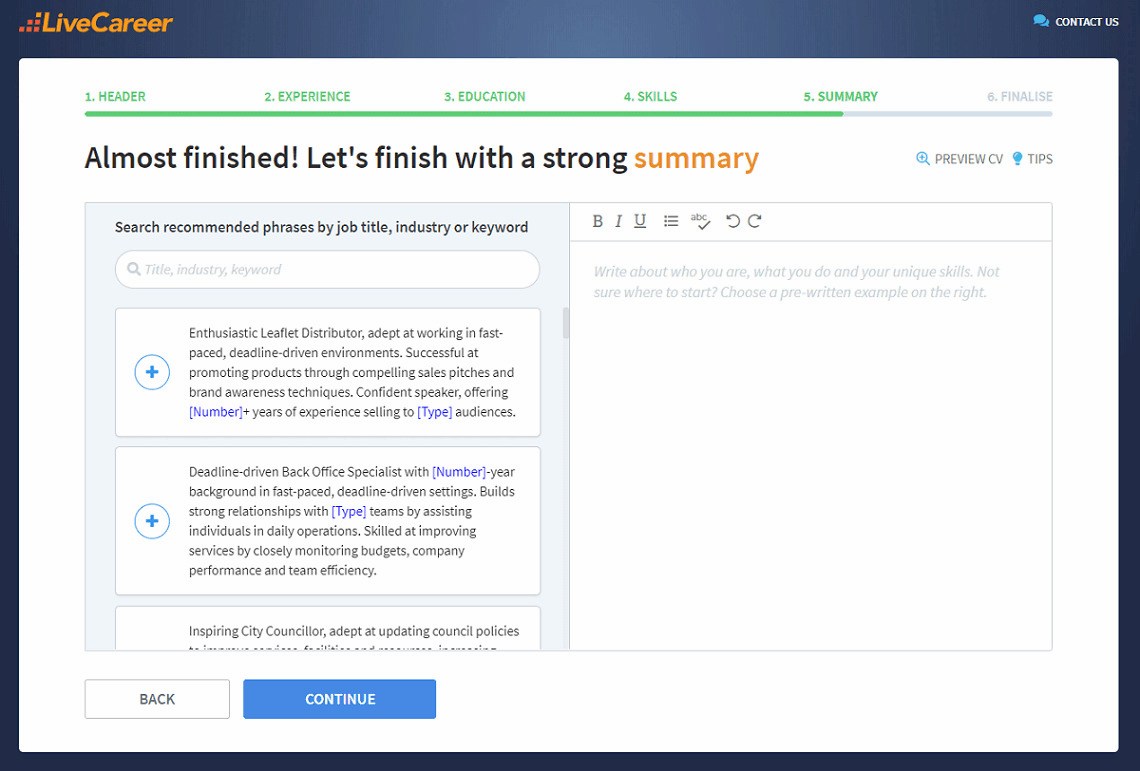
A strong CV summary will convince the recruiter you’re the perfect candidate. Save time and choose a ready-made personal statement written by career experts and adjust it to your needs in the LiveCareer CV builder.
2. Add impact to the work experience section of your copywriter CV
Writing a job-winning work experience section is likely the toughest part of this assignment. Not only is it the largest section on most copywriter CVs, but it’s also the most important. The way in which you frame your past performance will, in essence, determine whether you’re seen as a good fit for the job.
To make writing your work experience CV section easier, start by putting together a basic outline of your job history. Create a list of jobs you want to include—past and present—ensuring you add key information in this format:
[Job title]
[Company name, location]
[Dates worked]
Start with your current or most recent job and move on to previous ones in reverse chronological order.
With that out of the way, you’ll want to focus on writing up to six bullet points per job, detailing how well you performed at each of them. Keep that in mind as you write: it’s not just about what you did, it’s also how well you did it.
So, instead of saying you worked with multiple clients, say you handled up to 5 clients at a time while meeting 100% of deadlines and maintaining a 97% satisfaction rating. (Assuming that’s true, of course—lying on a CV is never a good idea.) By turning responsibilities into accomplishment statements, you’re presenting yourself as a high achiever who takes initiative and gets results. And who doesn’t want a copywriter like that on their team?
If you’re not sure what to include on your CV, especially if you have lots of experience or handled a broad range of duties, use the job advertisement to guide you. Pick out the key skills it mentions and treat them as keywords to use on your CV. This will help to portray your experience as the perfect match for the job.
3. Describe your education the right way
The recommended word count for your copywriter CV education section will depend on your experience level. If you have relevant work experience, you’ll include the essentials only. Here’s how to put your degree on your CV:
[Name of degree]
[University, location]
[Dates of attendance]
The same format can be used for A-levels and GCSEs—include those if you don’t have a degree or if they’re closely relevant to your application:
[A-levels: (subject 1), (subject 2), (subject 3)]
[College, location]
[Dates of attendance]
[# GCSEs including Mathematics and English]
[School, location]
[Dates of attendance]
If you’re writing a CV with no work experience, add bullet points under your education to highlight key moments that show your skills. You could mention academic achievements, projects, relevant coursework, or extracurricular activities on your CV to prove you have what it takes to become a copywriter.
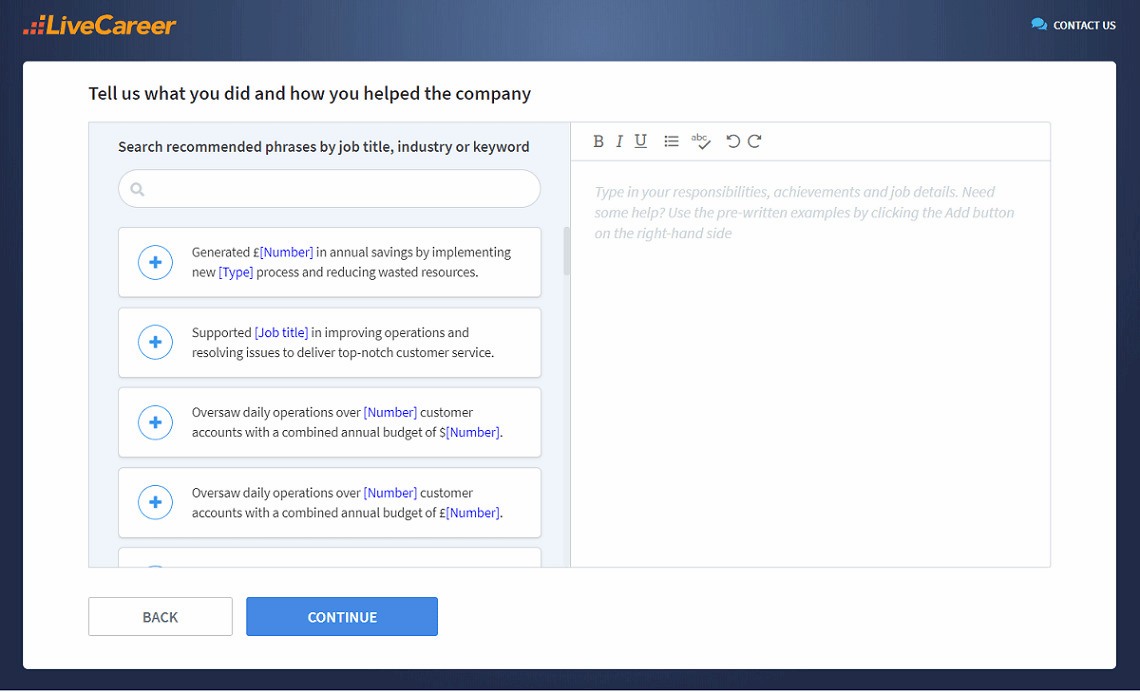
You don’t have to be a CV writing expert. In the LiveCareer CV builder you’ll find ready-made content for every industry and position, which you can then add with a single click.
4. Highlight the right copywriter skills on your CV
Two key factors go into making the perfect CV skills section: what you can do and what the employer wants. By combining these into a list of 5–10 abilities, you’ll prove yourself to be the ideal fit for the role and the company.
You already know what you can do, and to gauge what the employer wants, only light research will be needed. As we’ve already touched upon, the job advertisement should include a few key skills required by the employer. Even if they’re not listed directly, the job description will at least hint at them. For example, if the job involves optimising online content, you can be fairly certain SEO skills will give you an edge.
Make a list of skills that appear in the advertisement and compare it with your own skill set to identify a shortlist of the best matches. Then, write a sentence or two about each to specify what you mean by them. Here’s an example:
CV copywriter skills
- Content writing: ready to produce user-friendly copy in any tone of voice and for any purpose.
- SEO: experienced in applying the principles of SEO to various online copy (blog, ad, website/landing page content), able to conduct basic keyword research using SEMrush and Google Keyword Planner.
- Computer skills: highly proficient in the MS Office package, Google Suite, and Adobe CC, as well as project management, collaboration, and communication software (Jira, Asana, Slack, Zoom, Microsoft Teams)
- Research: able to identify high-quality sources and conduct thorough, accurate searches on any topic (including highly technical niches).
- Collaboration: experienced in working as part of a marketing team and collaborating with graphic designers, marketing experts, editors, and other writers to produce cohesive campaigns and other deliverables.
By describing each skill in detail, you can weave even more skills into this section. For instance, note how the umbrella term ‘computer skills’ enabled this candidate to list a total of eight specific software proficiencies.
5. Personalise your copywriter CV with additional sections
While the above CV sections were obligatory, at the end of your CV, you’re welcome to add a section or two for any additional information you think is worth sharing with the recruiter. This part is the writer’s choice: focus on aspects that are unique to your experience and most effective at conveying your value to the company.
Certifications are always a good starting point—if you’ve taken a writing course, an SEO cert, or anything else that’s useful in your work, it’s worth mentioning it in a separate section. Make sure to list the name of the awarding body and the year when you obtained the certification.
Another staple is a section for foreign language proficiencies. As a copywriter, you surely find that many employers search for bilingual writers to cover more markets.
Projects, volunteering or charity work, and interests on your CV are also okay to mention. Ensure, however, that everything you include directly addresses your suitability for the job. Treat your work with the ruthlessness of a stereotypical newspaper editor from a Hollywood film: if it’s not proving a point, it needs to go.
6. Submit a cover letter with your copywriter CV
Your CV may be finished and ready to land you a job, but there’s still one more piece of writing ahead of you first: a matching cover letter. It may not be a direct requirement for the job you’re after, but it won’t hurt your chances—it can only help. Employers look more favourably on candidates who take the time to write a targeted cover letter, especially since it shows you care about the job and you’re committed to getting it.
Writing a cover letter can be broken down into a few simple steps:
- Open with a hook—start your cover letter on an accomplishment to catch the reader’s attention.
- State your case in the body of the letter—point to specific experience that addresses the company’s needs and requirements. Mention why you want this particular job and show an appreciation of the company’s values, culture, achievements, or projects.
- End the cover letter on a strong note, like a request for an interview or an offer to accomplish something specific for the company if hired.
- Format your cover letter like you would any other business correspondence—with a formal heading, standard margins, and a professional font.
It doesn’t need to be very long—in fact, the best length for a cover letter is between 200 and 350 words, all on one page, split into 3–4 paragraphs.
7. Follow these formatting tips when submitting your CV
Your content is all covered—now for making it look the part. Like any type of document, CV layouts and designs follow certain conventions and involve a set of best practices.
By adhering to this guide, you’ve followed the reverse-chronological CV format. It’s the most common CV structure to use and the safest choice for copywriters of any level. There are other CV formats to choose from—skills-based is the most prominent among them—but they tend to come across as unnecessarily confusing to recruiters.
You can enhance the readability of your document and make it easier to navigate by applying these CV tips:
- Pick a CV font that doesn’t draw attention to itself (e.g., Arial, Helvetica, Georgia) and set it to 10–12 points.
- Use larger headings for each of your CV sections so that they’re easy to find at a glance.
- Apply one-inch (2.5 cm) margins to give your text some breathing room and use 1–1.15 line spacing.
- Create a heading or sidebar for your CV contact details (name, mobile, email + relevant socials).
- Remember that the ideal CV length is two pages, tops.
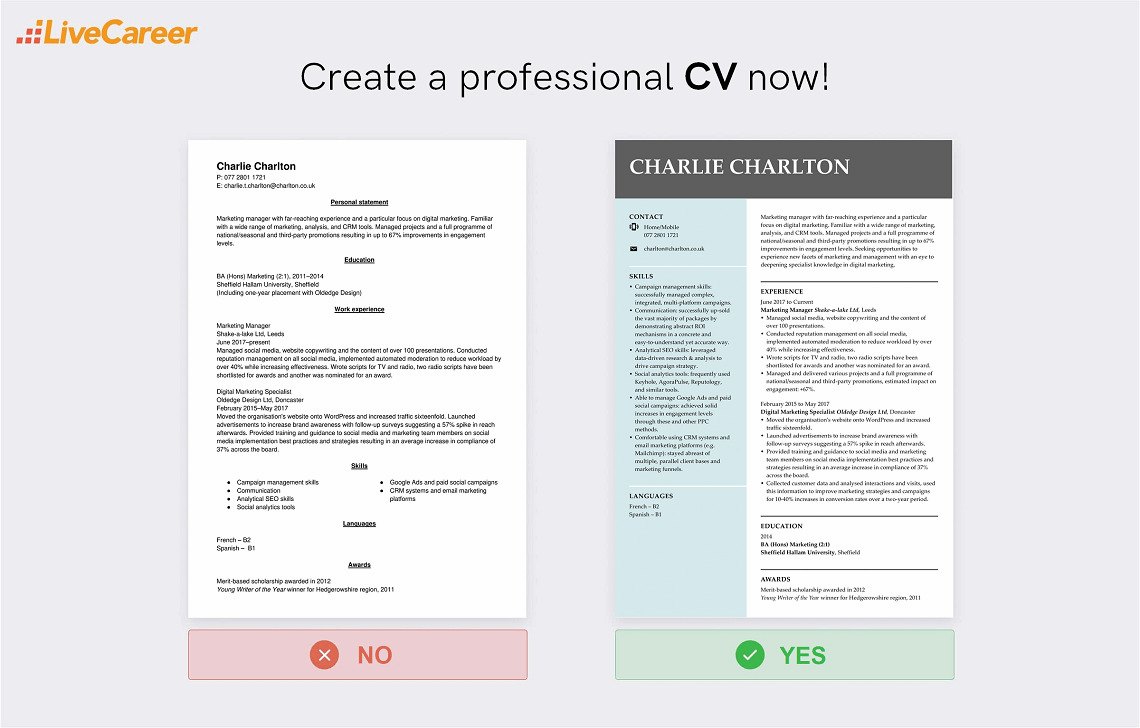
- Keep it simple: infographics and images may look impressive, but they can interfere with how your document is parsed by recruitment systems. Plain text with no tables or headers/footers is the safest option.
- Submit your CV as a PDF file, unless the job advertisement asks for a different format.
And that’s all there is to it! If you haven’t heard back after a week, consider sending the company a follow-up email to make sure they received your application.
A cover letter alone simply won’t be enough—you need an impactful CV, too. Create your CV in minutes. Just follow our wizard and fill in every CV section with ready-made content. Get started by choosing a professional CV template.
Thanks for reading, and good luck with your copywriter CV!
How we review the content at LiveCareer
Our editorial team has reviewed this article for compliance with Livecareer’s editorial guidelines. It’s to ensure that our expert advice and recommendations are consistent across all our career guides and align with current CV and cover letter writing standards and trends. We’re trusted by over 10 million job seekers, supporting them on their way to finding their dream job. Each article is preceded by research and scrutiny to ensure our content responds to current market trends and demand.
Sources
About the author
Roma Kończak
Roma Kończak is a Certified Professional Résumé Writer and career specialist with a background in education and the humanities. Since joining the team in 2022, Roma has focused on producing thoroughly researched articles offering practical advice on CV writing and career development.
Looking for a job-winning CV?
Crafting a job-winning CV is all about showcasing your unique skills and experiences. Start with a strong personal statement that highlights your career goals and achievements.
Try Our CV Builder Now