What’s more exciting than landing a new job—one that helps you grow and brings real satisfaction? Your dream career starts here, with a CV that opens the right doors.
In this article, I’ll guide you on how to write a CV that not only highlights your strengths but also captures the attention of potential employers, paving the way for your next big opportunity.
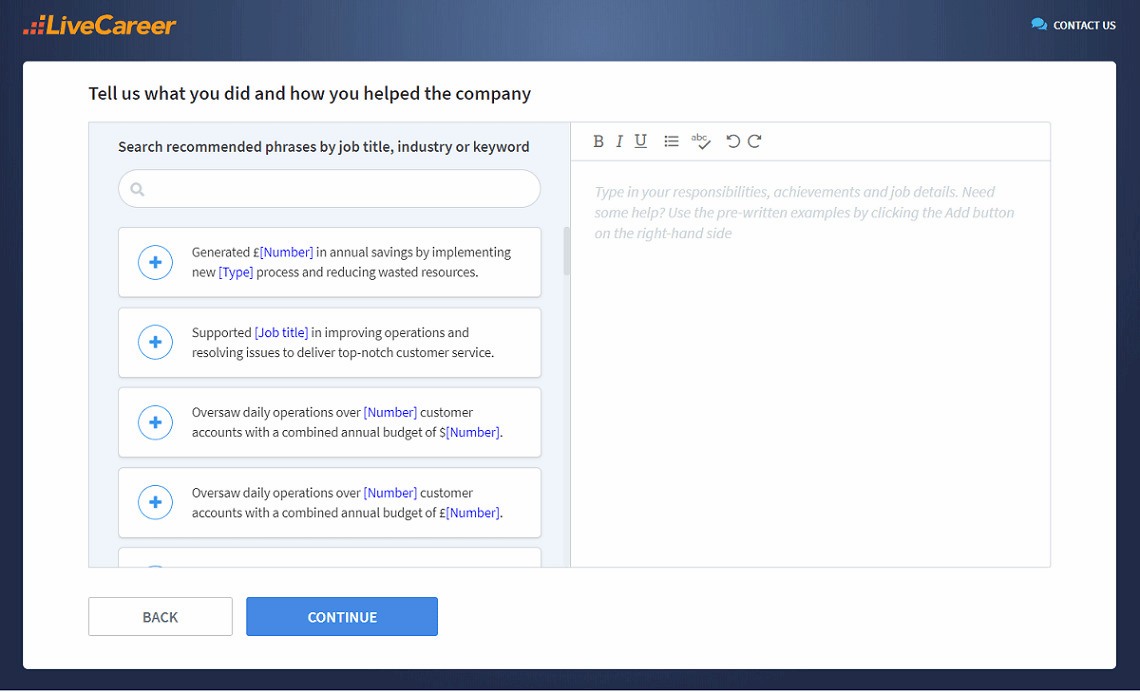
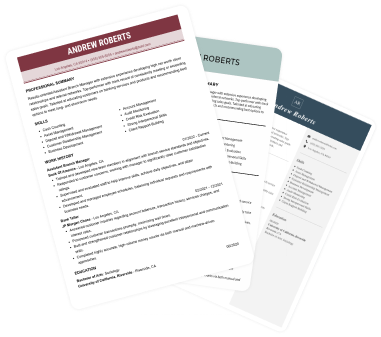
Using LiveCareer UK CV builder is a clever shortcut to get a head start on your CV.
What is a CV?
A CV (curriculum vitae) is a job application document that outlines your qualifications for a specific job. It typically includes your academic and professional background, relevant skills, and work achievements. A curriculum vitae is a standard format in the UK.
In a cooling labour market, a strong CV can help you stand out and increase your chances of getting interview invitations. It’s a powerful tool in your job search, opening doors to opportunities in your industry and beyond.
What’s a typical CV like?
Time: Created within 26minutes
Length: Over 60% of CVs have up to 300 words
Skills: Users typically list 6 skills
Experience: Typically includes up to 3 jobs
* Based on an analysis of 6 million CVs made with LiveCareer UK CV builder (August 2023–August 2024).
How to write a CV for a job in the UK
1. Gather all the information you’ll need for your CV
First, I advise you to carefully read the job advertisement and take notes on the job requirements, position, and company. You’ll use this information to determine what to write in each section of your CV.
Make notes about the following things:
Why is your desired position critical to the company?
What qualifications do you need for the role?
What relevant experience, including academic and volunteer work, do you possess?
To compile this information, look into:
Information about your previous employers
Details about your education, such as years of study
Certificates and diplomas confirming the completion of additional training
Expert advice: Research the company’s website and social media to learn more about its objectives and culture. Aim to answer the question: “What problem could the company be facing and trying to solve?”.
2. Choose a UK-standard CV style that suits you best
Chronological CV focuses on your experience and shows the most recent positions first to highlight career progression. It’s the format recruiters are most familiar with, which is an advantage.
Functional (skill-based) CV highlights specific qualifications and limits the information about work experience to a list of positions.
Combination CV merges the reverse-chronological and functional formats to highlight key skills and work experience.
Let me show you a quick comparison of these three formats + who they’re best for:
3. Put contact information at the top of your CV
Begin writing your CV by adding a header at the top of the document. The position will depend on the template you are using. Use the header area for your name, job title, and other personal details.
How to make a CV header from scratch:
Enter your first and last name using a bigger font size, such as 16–26 pt.
Add your professional title or field of study in the following line.
List your phone number and email address. Double-check if they’re correct, as a typo can make it impossible to get in touch with you.
Mention professional social media accounts, such as LinkedIn or a portfolio website.
Optionally, add your Facebook, Twitter, or Instagram profiles if you use them for business purposes and if they’re relevant to the role.
Freya Gardner
PR Manager
+447975333333
freyagardner@lcukmail.co.uk
linkedin.com/in/freya.gardner
4. Introduce yourself to recruiters using a personal statement
Writing a personal statement is the best way to introduce yourself on a CV, but only when you tailor it to the role you want.
How to write a CV personal statement:
Start with your job title and years of experience.
Add information about your professional skills and knowledge, and specify how they can benefit the employer.
Mention a relevant achievement from your employment history or other activities.
Keep the personal statement 3–4 sentences long.
UK CV personal statement: Example
Creative PR Manager with 6+ years of experience in the restaurant industry. Eager to bring the Gourmet Taste to the forefront of vegan dining in London through innovative PR campaigns. Arranged seasonal menu launches, leading to a 27% increase in weekday table bookings. Achieved national recognition for The Barn restaurant in 2020 through a unique PR strategy.
If you’re writing a CV without work experience, chin up! I recommend mentioning your academic background, volunteer work, or transferable skills. Demonstrate your understanding of the job and your ability to handle it effectively.
UK CV with no experience: sample CV profile
Driven Marketing graduate applying for a Digital Marketing Assistant position. Eager to apply content creation and social media marketing management knowledge to bring more traffic and build brand recognition at Leaf Flowering. Ran the university rowing team's Instagram and YouTube channels in 2020-2023. Gained hands-on content writing experience while volunteering at Cat Rescue & Rehome Fund in 2022.
If you want to make your job easier, leave this part of your UK CV blank and move on to other sections. Fill it in after completing the rest of your CV. You can then combine bits of information from different parts of your application.
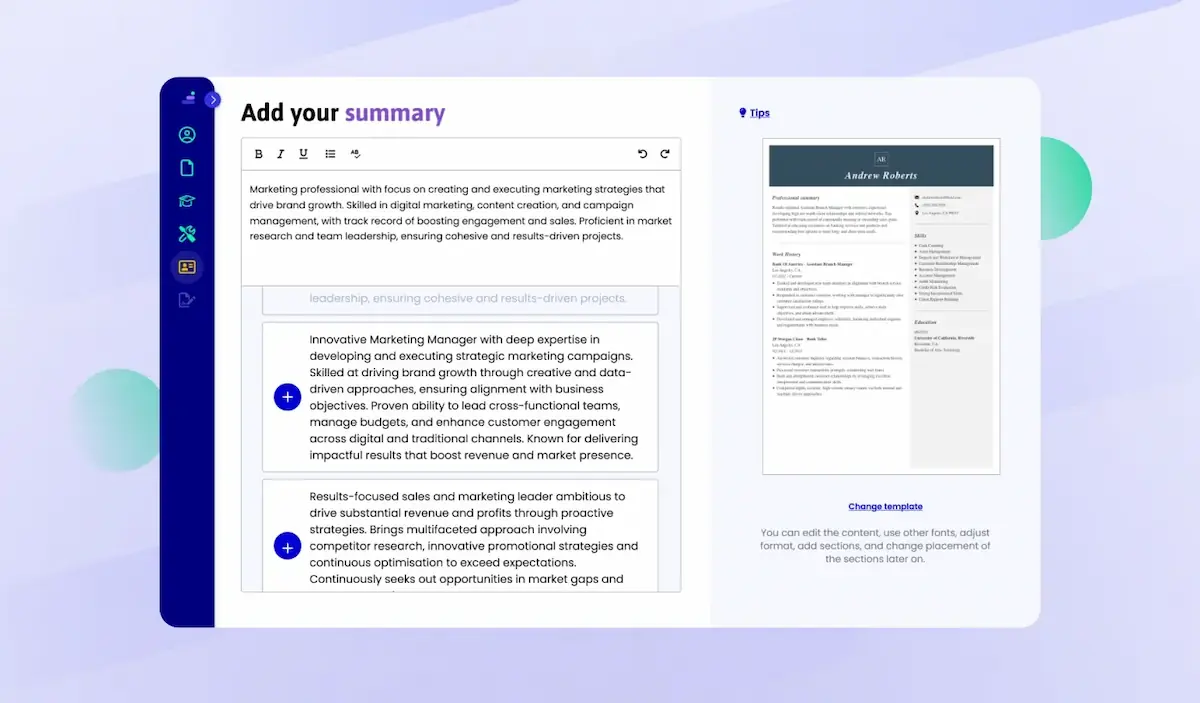
Stuck finding the right words for your personal statement? You’re not alone: it’s one of thetrickiest parts of a CV! Save time by starting with a pre-written personal statement crafted by career experts, then easily adjust it to fit your unique strengths in the LiveCareer UK CV Builder and quickly grab your recruiter’s attention.
This takes the pressure off writing your introduction from scratch, so you can focus on perfecting the rest of your CV.
5. Describe relevant experience in your CV
Understanding how to write a CV work history effectively is invaluable. It is a misconception that you just need a simple list of your previous jobs and responsibilities.
To maximise the impact of this section, include specific details about your experience, such as achievements and the skills you gained. Emphasise the impact of your work and how it helped to improve the company's bottom line.
Let me explain what to do step by step:
Start with the most recent position and continue with older ones in reverse-chronological order.
Include your professional title, the employer's name, the city where the company is, and the dates of employment.
Write up to six bullet points about your accomplishments and duties, starting each one with an action verb, such as “developed” or “coordinated.”
Describe measurable achievements for each position. I recommend using a PAR formula and accomplishment statements for the best impact.
Tailor your job description by incorporating keywords from the job advertisement and highlighting key skills.
Keep the work history limited to the last 10 years, unless you have highly relevant experience beyond that.
PR Manager
The Barn, Canterbury
January 2018–Present
Coordinated seasonal menu launches reviewed in Dine Out, Foodism, and Vegan Food & Living Magazine, leading to a 27% increase in weekday table bookings.
Developed and delivered PR campaigns to generate coverage in the local and national press and social media, driving a notable 20% increase in brand visibility.
Collaborated with the marketing team to create the brand narrative, press materials, and marketing collateral, contributing to a 30% boost in brand recognition.
Established and nurtured relationships with relevant media outlets and influencers to reach new audiences.
Key achievement:
Won national coverage for the restaurant with a campaign focused on delivering meals to first-line workers at the beginning of the COVID-19 pandemic in February 2020.
What makes this example work so well? Several factors, including measurable achievements that demonstrate the applicant’s expertise, recognition of awards received, and the use of action words to highlight the candidate’s initiative.
6. Outline your educational background
If you know how to make the CV education section well, it can become a real asset, especially if you’re light on work experience.
If you’ve got a few years of work history up your sleeve, you can stick to the basics: the highest level of education you’ve obtained (such as a university degree), the name of the school or university, and the years attended.
If you recently graduated or left school, include details like A-levels, scholarships, extracurricular activities, coursework, projects, research, publications, or your thesis to highlight your skills and knowledge for the job.
Bachelor of Arts in Public Relations
London College of Communication
September 2014–June 2017
Grade: 2.1
Spokesperson of the student association in 2016–2017
Conducted research on the under-representation of women in PR agencies and published the results in PRWeek.
7. Choose the right mix of skills to make your CV effective
Employers seek skilled workers, and that’s a fact. However, the skills they require vary depending on the role. You can confirm what skills are expected of you by reviewing the job posting.
However, a simple list may not be convincing enough. That’s why it’s crucial to add descriptions that prove you utilised these qualities in the past, just like in the example below:
Budget preparation: Tracked PR and Management expenses to ensure proper allocation of funds and budget compliance.
Media management: Established and nurtured relationships with local and national media outlets to aid PR efforts.
Verbal and written communication: Delivered presentations and public announcements, as well as scripted press releases for other departments.
Relationship building: Liaised with media outlets and industry influencers to establish professional relationships.
Attention to detail: Oversaw marketing collateral creation to ensure its quality.
Adaptability: Introduced necessary changes to create safe working conditions and ensure continuous operation during the COVID-19 pandemic.
Management skills: Facilitated the work of PR and marketing teams successfully for 5+ years.
Expert advice: What if the job posting doesn’t mention the required skills? Check the National Career Service job profiles. They include detailed descriptions of various professions and list the most common skills for the role.
8. Pick additional CV sections to strengthen your application
What else should you write in a CV? It’s time for the extra sections: they help make your CV more personal while demonstrating relevant skills and experience.
Choose 2–3 sections from the list above that you believe will bring you benefits. Describe relevant accomplishments just like you would mention in the work history part. Use action verbs to highlight your initiatives. The example below shows how:
Certifications
Digital Communications Diploma, CIPR, March 2022
Crisis Communication Diploma, CIPR, June 2020
Memberships
Member of the Chartered Institute of Public Relations since January 2020
Guest speaker at the annual 2022 conference with the presentation: Sustainability as a public affair: The public image and ethics in the restaurant industry.
Publications
Wrote a case study focused on inclusivity in the London restaurant scene, which received 650,000 shares on Twitter in October 2022.
Authored ten articles on PR in the restaurant industry in Platform Magazine in 2021–2022
9. Make a CV template by yourself or use a pre-formatted one
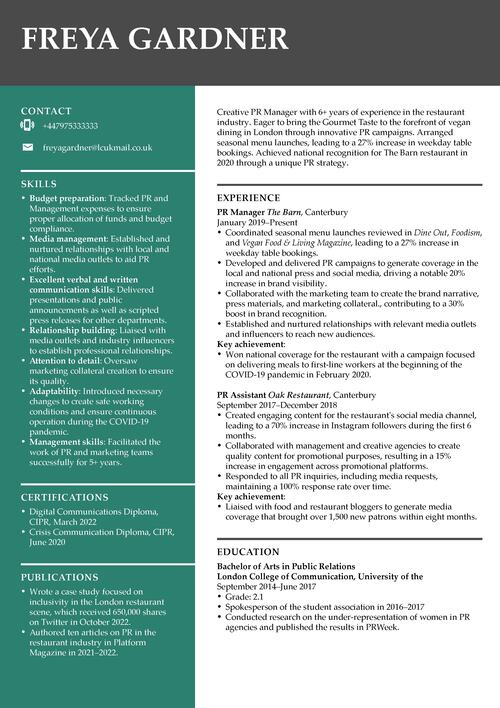
If you want a quick and simple solution, try an online CV builder or find free CV templates that are already pre-formatted. However, you can also design your curriculum vitae yourself using Microsoft Word, Google Docs, or a similar application.
If you’re thinking about adding colours, resources like the London School of Economics Careers CV manual advise caution. Subtle additions are fine. For example, highlight your name, headings, or bullet points, and stick to just one colour.
Quick tips for writing a good CV
The checklist below will help you create a CV all by yourself—just follow the steps and tick them off one by one.
How to write a CV (example)
Example
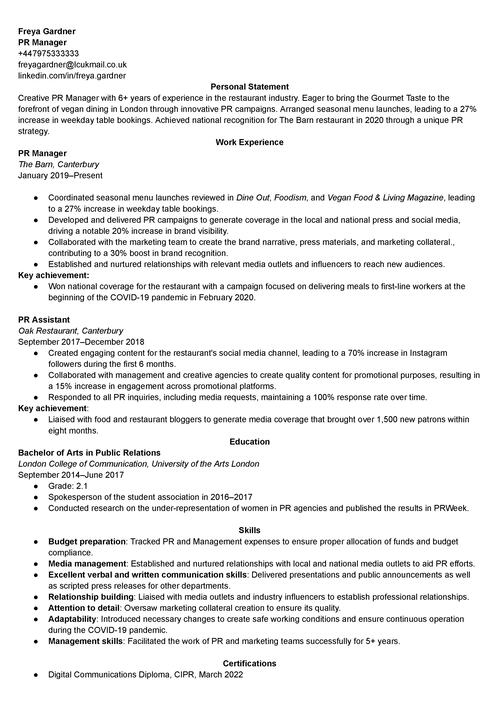
Freya Gardner
PR Manager
+447975333333
freyagardner@lcukmail.co.uk
linkedin.com/in/freya.gardner
Personal Statement
Creative PR Manager with 6+ years of experience in the restaurant industry. Eager to bring the Gourmet Taste to the forefront of vegan dining in London through innovative PR campaigns. Arranged seasonal menu launches, leading to a 27% increase in weekday table bookings. Achieved national recognition for The Barn restaurant in 2020 through a unique PR strategy.
Work Experience
PR Manager
The Barn, Canterbury
January 2019–Present
Coordinated seasonal menu launches reviewed in Dine Out, Foodism, and Vegan Food & Living Magazine, leading to a 27% increase in weekday table bookings.
Developed and delivered PR campaigns to generate coverage in the local and national press and social media, driving a notable 20% increase in brand visibility.
Collaborated with the marketing team to create the brand narrative, press materials, and marketing collateral, contributing to a 30% boost in brand recognition.
Established and nurtured relationships with relevant media outlets and influencers to reach new audiences.
Key achievement:
Won national coverage for the restaurant with a campaign focused on delivering meals to first-line workers at the beginning of the COVID-19 pandemic in February 2020.
PR Assistant
Oak Restaurant, Canterbury
September 2017–December 2018
Created engaging content for the restaurant's social media channel, leading to a 70% increase in Instagram followers during the first 6 months.
Collaborated with management and creative agencies to create quality content for promotional purposes, resulting in a 15% increase in engagement across promotional platforms.
Responded to all PR inquiries, including media requests, maintaining a 100% response rate over time.
Key achievement:
Liaised with food and restaurant bloggers to generate media coverage that brought over 1,500 new patrons within eight months.
Education
Bachelor of Arts in Public Relations
London College of Communication
September 2014–June 2017
Grade: 2.1
Spokesperson of the student association in 2016–2017
Conducted research on the under-representation of women in PR agencies and published the results in PRWeek.
Skills
Budget preparation: Tracked PR and Management expenses to ensure proper allocation of funds and budget compliance.
Media management: Established and nurtured relationships with local and national media outlets to aid PR efforts.
Excellent communication skills: Delivered presentations and public announcements as well as scripted press releases for other departments.
Relationship building: Liaised with media outlets and industry influencers to establish professional relationships.
Attention to detail: Oversaw marketing collateral creation to ensure its quality.
Adaptability: Introduced necessary changes to create safe working conditions and ensure continuous operation during the COVID-19 pandemic.
Management skills: Facilitated the work of PR and marketing teams successfully for 5+ years.
Certifications
Digital Communications Diploma, CIPR, March 2022
Crisis Communication Diploma, CIPR, June 2020
Memberships
Member of the Chartered Institute of Public Relations since January 2020
Guest speaker at the annual 2022 conference with the presentation: Sustainability as a public affair: The public image and ethics in the restaurant industry.
Publications
Wrote a case study focused on inclusivity in the London restaurant scene, which received 650,000 shares on Twitter in October 2022.
Authored ten articles on PR in the restaurant industry in Platform Magazine in 2021–2022.
How to write a CV: template
Use the template below and adjust it to your needs when writing your CV.
Example
[Full name]
[Job title]
[Phone number]
[Email address]
[LinkedIn profile URL]
Personal statement
[Write 2–4 sentences summarising your experience, key achievements, and career goals. Focus on what makes you a strong fit for your target role.]
Work experience
[Job title]
[Company name], [Location]
[Start date]–[End date or “Present”]
[Responsibility or achievement 1]
[Responsibility or achievement 2]
[Responsibility or achievement 3]
Key achievement: [Describe your top result or project outcome.]
[Previous job title]
[Company name], [Location]
[Start date]–[End date]
[Responsibility or achievement 1]
[Responsibility or achievement 2]
Key achievement: [Highlight a measurable result or success.]
Education
[Degree name]
[University or college name]
[Start date]–[End date]
[Additional details: grade, honours, leadership roles, or notable projects.]
Writing a CV for the UK job market can feel challenging, but remember – you don’t need to be an expert CV writer to create a standout application. The LiveCareer UK CV Builder offers pre-written examples for every industry and role in the UK, all ready to add to your CV with a single click.
It’s an easy way to build a CV that meets UK hiring standards and stands out to employers, without the usual stress.
Thank you for reading this guide on CV writing. Now you know how to write a good CV in the UK. Good luck!
How we review the content at LiveCareer
Our editorial team has reviewed this article for compliance with LiveCareer’s editorial guidelines. It’s to ensure that our expert advice and recommendations are consistent across all our career guides and align with current CV and cover letter writing standards and trends. We’re trusted by over 10 million job seekers, supporting them on their way to finding their dream job. Each article is preceded by research and scrutiny to ensure our content responds to current market trends and demand.
Frequently asked questions about how to write a CV
What is a good CV format?
The reverse-chronological CV format is the best one, according to career experts. It focuses on work experience and lists jobs from the most recent to the oldest, highlighting career accomplishments. The chronological CV is best for experienced candidates, but it’s easy to adapt for all applicants.
What does a good CV look like in 2025?
A good CV is easy to follow, concise, and visually appealing. It has the necessary CV sections, such as a header with contact information, personal statement, work experience, education and skills, and a few additional sections—all packed in a good CV layout.
Here’s how to ensure your CV looks professional in 2025:
Set the font size to 10–12 for paragraphs and 13–14 for headings.
Apply 1-inch wide margins on all sides.
Arrange information in distinct sections and separate them with white space.
Use bullet points to list out information.
Limit the length of the CV to one or two pages maximum.
What are the five main parts of a CV?
The five main parts of a CV include the header with your name and contact details, a personal statement, work experience, education, and skills. In the reverse-chronological format, the work experience section is the most extensive part of a CV.
How do I write a CV for a job application?
You can make your CV using a dedicated CV builder where hiring professionals will guide you, or you can create a document in a word-processing application. If you want to create a perfect CV from scratch, follow the steps below:
Make a professional CV layout.
Choose the CV format that works best for you.
Fill in the CV header with your name and contact details.
Write an impressive personal statement.
Describe your employment history.
Mention your educational background.
List your skills in a separate section.
Pick additional CV sections to provide more information.
Proofread your CV before sending it out.
What are common CV mistakes I should avoid?
Here are some mistakes to avoid when writing a CV:
Sending generic CVs. Avoid one-size-fits-all CVS; they seem lazy and irrelevant. Include relevant details and cut outdated experiences. A targeted CV performs better.
Sharing personal details like birth date, age, marital status, or nationality. Keep contact info professional with a sensible email and avoid unrelated info.
Using clichés, jargon, and buzzwords like “hard-working team player” or “results-driven go-getter,” unless supported by evidence. These vague labels to avoid.
Having an excessively long CV. Keep it concise, no longer than two pages, to prevent busy recruiters from being turned off.
Neglecting formatting and readability. A poorly formatted CV is hard to read and likely ignored. Avoid flashy fonts and distracting graphics that confuse ATS and readers.
Leaving typos or errors. They suggest you didn’t proofread, which may affect your professionalism. Use spell-check tools and review every line.
Lying. Recruiters verify details, and falsifying information like inflating job titles or grades can ruin credibility, cost the job, or lead to termination.
Even with great experience, a CV can fail if it doesn’t follow basic rules. Recruiters spend only a few seconds scanning each CV, so it’s vital not only to know what works, but also what doesn’t.
How can a 16-year-old make a CV?
To make an effective teenager CV, consider your achievements at school and from other extracurricular activities relevant to the job you want. Use them to demonstrate your skills and knowledge that you can translate to success at work.
"How to Write a CV in 2026: Tips, Templates & Examples"
4.8/5
(Based on 63 votes)
About the author
Marta Bongilaj
Marta is a certified career expert with a marketing edge, offering strategic guidance to job seekers at every stage. She creates standout CVs and cover letters that help them land opportunities with confidence.
Crafting a job-winning CV is all about showcasing your unique skills and experiences. Start with a strong personal statement that highlights your career goals and achievements.