Prepare a Strong NHS CV: Example & Guide
Last updated on 5 February, 2026

LiveCareer UK Editorial TeamLiveCareer UK Career Experts
Our customers have been hired by*:
Crafting an NHS CV requires a meticulous approach, blending professional qualifications with a genuine dedication to patient care. In this article, we’ll walk you through creating an outstanding CV for NHS jobs, packed with tips and examples to help you stand out.
Create an effective CV in minutes. Choose a professional CV template and fill in every section of your CV in a flash using ready-made content and expert tips.
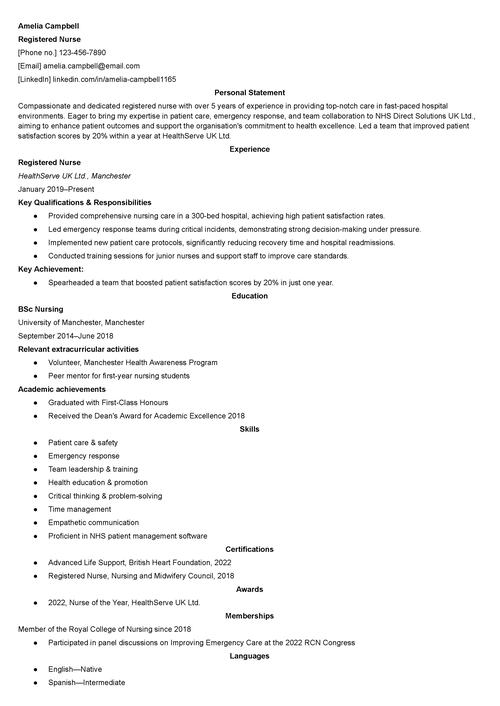
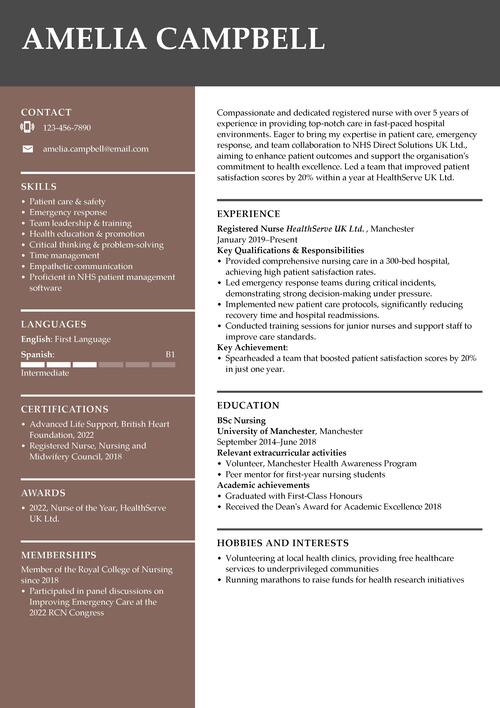
We created the sample on the left using our builder. See other good CV examples like this one.
Here’s an NHS CV example in a text version:
NHS CV template
Example
Amelia Carter
Registered Adult Nurse
[Phone no.] 123-456-7890
[Email] amelia.carter@email.com
[LinkedIn] linkedin.com/in/ameliacarter1234
Personal Statement
Compassionate Registered Adult Nurse with over 6 years’ experience delivering high-quality care across acute medical and surgical wards. Skilled in patient assessment, medication administration and multidisciplinary collaboration. Reduced discharge delays through improved care coordination by 16%. Committed to delivering safe, patient-centred care in line with the NHS Constitution and supporting continuous service improvement.
Work Experience
Registered Nurse
Manchester University NHS Foundation Trust
March 2022–August 2026
Key Qualifications & Responsibilities
- Achieved 100% compliance during internal documentation audits over two consecutive years.
- Supported the introduction of a new bedside handover process that improved patient satisfaction scores by 12%.
- Delivered holistic care for up to 12 patients per shift across busy acute medical wards.
- Assessed patient conditions, developed care plans and administered medications in accordance with NMC guidelines.
Key Achievement:
- Reduced average discharge delays by 16% by improving communication between multidisciplinary teams.
Staff Nurse
Salford Royal Hospital (Northern Care Alliance NHS Foundation Trust)
January 2020–February 2022
- Reduced medication administration errors within the ward by 18% after helping standardise medication safety checks.
- Recognised by senior management for consistently achieving excellent patient feedback scores.
- Supported infection prevention initiatives and ensured compliance with safeguarding procedures.
Education
BSc (Hons) Adult Nursing (First Class Honours)
The University of Manchester
Completed: 2019
Relevant extracurricular activities
- Volunteer, Manchester Health Awareness Program
- Peer mentor for first-year nursing students
Professional Registration
- Registered Adult Nurse (RNA)
- Nursing and Midwifery Council (NMC)
- Registration Status: Active
Skills
- Patient care & safety
- Emergency response
- Team leadership & training
- Health education
- Critical thinking
- Problem-solving
- Time management
- Empathetic communication
- Proficient in NHS patient management software
Certifications
- Immediate Life Support (ILS), Resuscitation Council UK, 2025
- Level 3 Safeguarding Adults, NHS England e-Learning for Healthcare (elfh), 2024
- Infection Prevention and Control, NHS England e-Learning for Healthcare (elfh), 2024
- Venepuncture and Cannulation Competency, Manchester University NHS Foundation Trust, 2023
Continuing Professional Development
- Trauma-Informed Care Workshop — NHS England (2025)
- Leadership Essentials for Registered Nurses — NHS Leadership Academy (2024)
- Quality Improvement Methodology — The King’s Fund (2023)
Memberships
- Royal College of Nursing (RCN)
- Queen’s Nursing Institute (QNI)
Languages
- English—Native
- Spanish—Intermediate
How to write a CV for NHS jobs
First, pick a strong NHS CV template. Next, follow the steps below to fill it out in a way that connects your experience directly to the needs of the vacancy.
1. Write an NHS personal statement that reflects your suitability
Your CV personal statement is your chance to convince recruiters you’re the right fit for the role before they read the rest of your NHS job application. In three or four sentences, summarise your experience, showcase your strengths and explain how you’ll contribute to the NHS organisation.
When writing your NHS CV profile:
- Start by introducing your current role, years of experience and area of expertise.
- Mention two or three strengths that match the person specification, such as patient care, teamwork, leadership or service improvement.
- Include a measurable achievement (if possible), such as improving patient outcomes, reducing waiting times or supporting quality improvement initiatives.
- Finish by explaining the value you’ll bring to the employer, focusing on patient care or service delivery rather than what you hope to gain.
If you’re applying for your first NHS role, focus on transferable skills gained through placements, apprenticeships, university or volunteering. Demonstrating compassion, professionalism and a commitment to delivering high-quality care can be just as valuable as extensive work experience.
2. Demonstrate the impact of your work experience
NHS recruiters already know what your role involves. What they want to see is the difference you’ve made. In your work experience section, focus on achievements that demonstrate your clinical expertise, professionalism and contribution to patient care or service delivery.
When describing your NHS work experience on a CV:
- List your roles in reverse chronological order, starting with your most recent position.
- Highlight your biggest achievements in 3-6 bullet points.
- Include measurable results wherever possible, such as improving patient outcomes, reducing waiting times or increasing compliance.
- Mention experience with audits, quality improvement projects, safeguarding or service development if they’re relevant to the role.
If you’re applying for your first NHS position, don’t worry if you have limited employment history. Clinical placements, apprenticeships, university projects and volunteer work on an NHS CV can all demonstrate the skills and behaviours employers are looking for. The key is to show how these experiences prepared you to work in an NHS environment and deliver high-quality patient care.
3. Present your education and professional registrations
Your NHS CV education section should show that you have the qualifications needed for the role, while professional registrations confirm you’re authorised to practise where required. How much detail you include depends on your experience level.
When listing your education:
- Include your highest or most relevant qualification first.
- State the qualification, institution and completion year.
- Mention extracurricular activities, placements, or relevant modules if you’re a recent graduate or newly qualified professional.
- Keep this section brief if you have extensive NHS or healthcare experience.
If your profession requires registration, create a separate Professional Registration section. Include the relevant regulatory body and, if appropriate, your registration status.
Common registrations include:
- Nursing and Midwifery Council (NMC)
- Health and Care Professions Council (HCPC)
- General Medical Council (GMC)
- General Dental Council (GDC)
- Social Work England
You can also strengthen your NHS CV by mentioning recent continuing professional development (CPD), mandatory training or specialist courses. This demonstrates your commitment to maintaining your knowledge and delivering safe, high-quality care.
4. Highlight the skills NHS employers value
The skills section gives recruiters a quick overview of your strengths, but it should support, not replace, the evidence in your work experience. Tailor your NHS skills to the job posting specification and include a mix of hard and soft skills. The specific skills depend on the NHS role category you’re pursuing.
Hard skills are the practical skills you’ve developed through training and experience. Depending on the role, examples include:
- Patient assessment
- Medication administration
- Electronic Patient Records (EPR)
- EMIS, SystmOne or Cerner
- Infection prevention and control
- Clinical documentation
- Venepuncture
- Safeguarding procedures
Soft skills demonstrate how you work with patients, colleagues and the wider organisation. NHS employers commonly look for:
- Compassion
- Communication skills
- Teamwork
- Time management
- Organisation
- Decision-making
- Problem-solving
- Adaptability
Since burnout and stress-related absences are at critical levels, NHS hiring managers are looking for staff who can handle pressure. To show up on their radar, consider highlighting your resilience and ability to work under pressure.
5. Strengthen your NHS CV with additional sections
Additional sections can help your NHS CV stand out from other applicants by highlighting qualifications, experience and NHS Parliamentary Awards that aren’t covered elsewhere. Choose sections that reinforce your suitability for the role rather than adding unnecessary information, like irrelevant hobbies or interests.
Here are some of the most valuable additions to an NHS CV:
- Certifications: Include relevant training, such as Basic Life Support (BLS), Safeguarding or Infection Prevention and Control. Always list the certifying body and completion date.
- Professional memberships: Membership of organisations like the Royal College of Nursing (RCN), British Medical Association (BMA) or Chartered Society of Physiotherapy (CSP) demonstrates your commitment to maintaining professional standards.
- Volunteer experience: Volunteering in hospitals, hospices, charities or community healthcare settings can showcase compassion, teamwork and a genuine commitment to patient care.
- Language skills: Speaking another language can help you communicate with a broader range of patients. Include your proficiency level using the Common European Framework of Reference (CEFR).
- Continuing Professional Development (CPD): Highlight recent workshops, mandatory training and specialist courses to show you’re committed to developing your knowledge and keeping your skills up to date.
- Publications and conferences: If you’re applying for a senior, specialist or research-based role, include relevant publications, presentations or conferences that demonstrate your expertise.
- Awards and achievements: Professional awards, recognition programmes or quality improvement achievements can help demonstrate your impact and commitment to delivering high standards of care.
6. Format your NHS CV
A well-structured CV for the NHS is easier for recruiters to read and helps your CV pass through ATS parsing. Keep your layout simple, professional and consistent throughout, avoiding unnecessary design elements that can distract from your content.
Follow these formatting best practices for a great NHS CV template:
- Keep your NHS CV to one page if you’re newly qualified or have limited experience, or two pages if you have a longer employment history.
- Use a standard CV font, such as Arial, Calibri or Verdana, in a 10–12 point size.
- Set your margins to around 2.5 cm (1 inch) and leave plenty of white space between sections.
- Use clear headings and bullet points to improve readability.
- Present each section in reverse chronological order, starting with your most recent role.
- Keep your formatting consistent by using the same font, heading style and spacing throughout.
- Save your CV as a PDF, unless the employer requests another file format.
Remember to proofread your NHS CV thoroughly. Sometimes even tiny mistakes can hamper your chances of getting hired.
Finally, tailor your NHS CV to every application by reflecting the language used in the person specification.
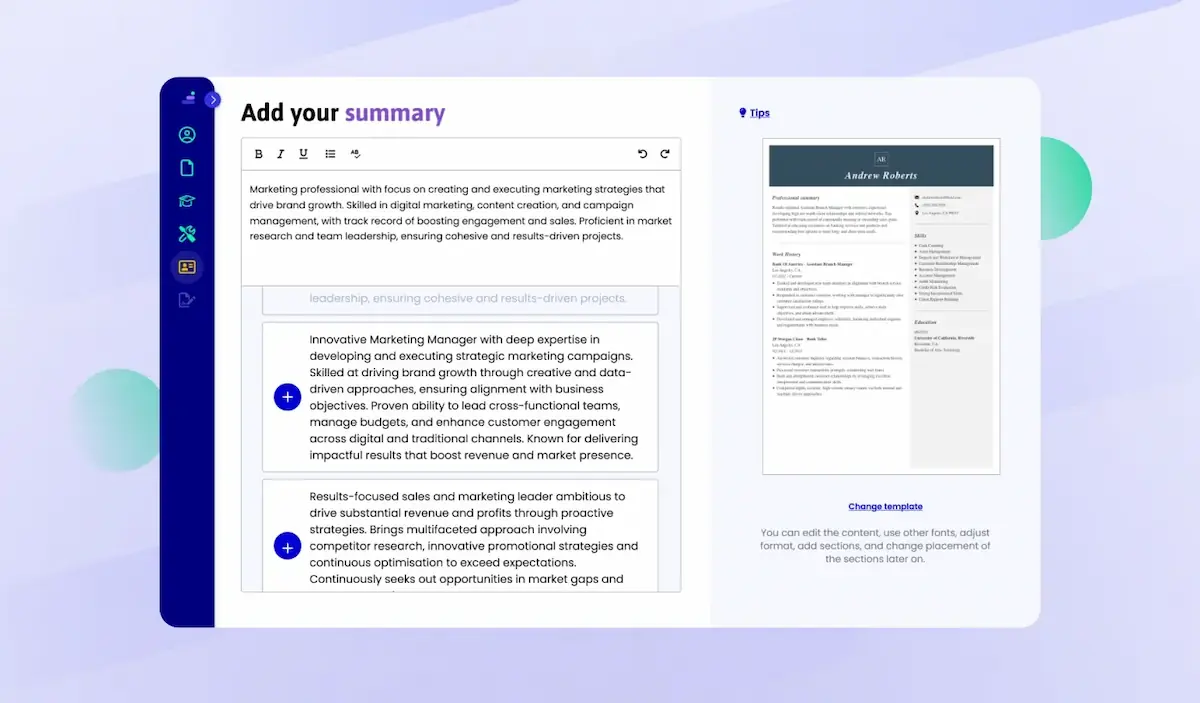
A strong CV summary will convince the recruiter you’re the perfect candidate. Save time and choose a ready-made personal statement written by career experts and adjust it to your needs in the LiveCareer CV builder.
Considering other positions? See CV examples for different jobs:
- Nursing CV Example
- Nurse Anesthetist CV Example
- Nursery Assistant CV Example
- Nursery Nurse CV Example
- Obstetrician CV Example
- Pharmacist CV Example
- Biomedical Science CV Example
- Care Assistant CV Example
- Paramedic CV Example
- Pharmacy Assistant CV Example
- Physiotherapy CV Example
- Rheumatologist CV Example
- Mental Health Nurse CV Example
- Urgent Care Physician CV Example
Thank you for reading. We hope you found our NHS Healthcare Assistant CV example, along with the accompanying guidelines, helpful in preparing your own. Feel free to use the comment section below to ask any questions or share your experiences with crafting an NHS CV.
How we review the content at LiveCareer
Our editorial team has reviewed this article for compliance with LiveCareer’s editorial guidelines. It’s to ensure that our expert advice and recommendations are consistent across all our career guides and align with current CV and cover letter writing standards and trends. We’re trusted by over 10 million job seekers, supporting them on their way to finding their dream job. Each article is preceded by research and scrutiny to ensure our content responds to current market trends and demand.
About the author
LiveCareer UK Editorial Team
LiveCareer UK CV builder is powered by career experts, CV writers, and HR professionals. Since 2013, our editorial team has supported job seekers with free, research-based career advice and expert tips to improve their job applications. LiveCareer UK CV builder has already helped thousands, and you can be next.
Looking for a job-winning CV?
Crafting a job-winning CV is all about showcasing your unique skills and experiences. Start with a strong personal statement that highlights your career goals and achievements.
Try Our CV Builder Now