Blog Writer CV Guide: How to Craft a Strong Blogger CV
Last updated on 9 February, 2026


Marta BongilajWriter, Professional Association of Resume Writers and Career Coaches (PARWCC)
Reviewed by Roma KończakEditor & Writer, Certified Professional Résumé Writers and Career Coaches (PARWCC)
Our customers have been hired by*:
Writing a CV for a blogger role means proving you can create content that attracts readers, builds trust, and drives results. Your CV should highlight your writing style, content performance, SEO skills, and ability to grow and engage an audience. Think of it as a snapshot of your digital footprint: showing what you write, who you reach, and the impact you make.
In this guide, you’ll find practical advice and examples to help you build a blogger CV that feels polished, credible, and on-brand.
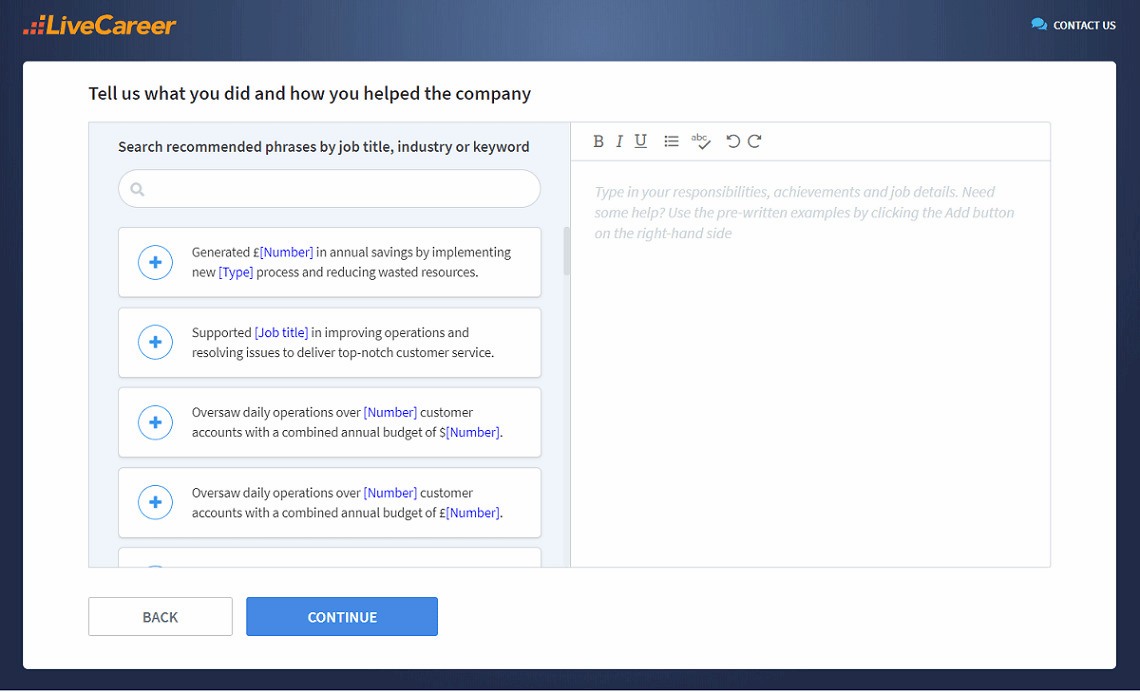
Writing a blog is easy for you, and so can be writing your blogger CV. Create it fast. Choose a professional CV template and fill in every section of your CV in a flash using ready-made content and expert tips.
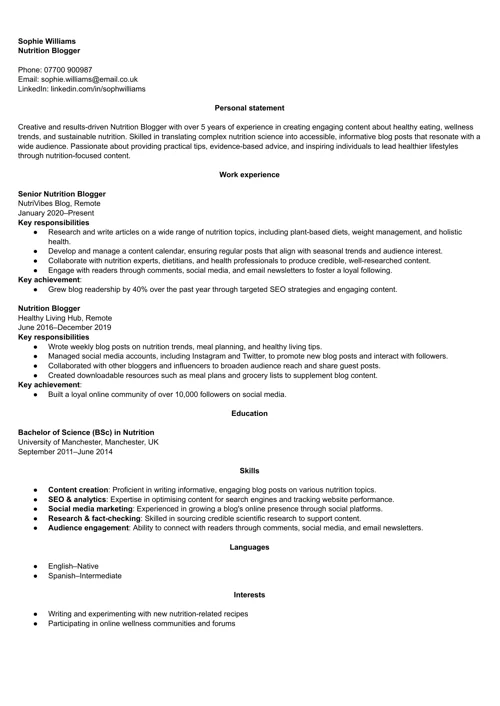
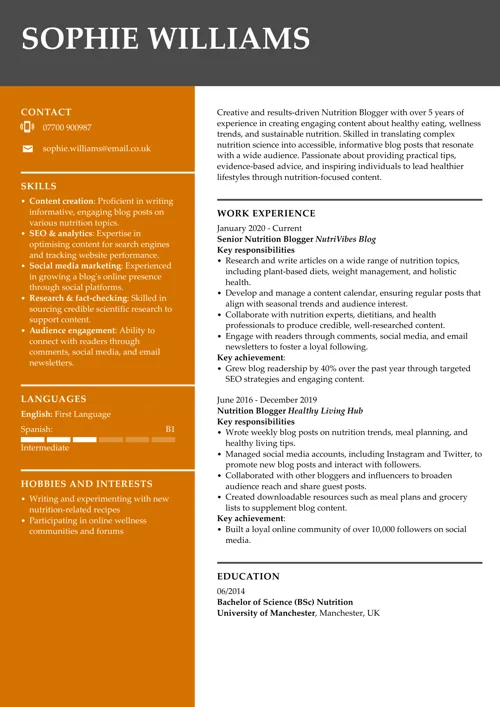
We created the sample on the left using our builder. See other good CV examples like this one.
Save a lot of time—just copy this example and use our tips to adjust it to your needs:
Blogger example CV example
Example
Sophie Williams
Nutrition Blogger
Phone: 07700 900987
Email: sophie.williams@email.co.uk
LinkedIn: linkedin.com/in/sophwilliams
Personal statement
Creative and results-driven Nutrition Blogger with over 5 years of experience in creating engaging content about healthy eating, wellness trends, and sustainable nutrition. Skilled in translating complex nutrition science into accessible, informative blog posts that resonate with a wide audience. Passionate about providing practical tips, evidence-based advice, and inspiring individuals to lead healthier lifestyles through nutrition-focused content.
Work experience
Senior Nutrition Blogger
NutriVibes Blog, Remote
January 2020–Present
Key responsibilities
- Research and write articles on a wide range of nutrition topics, including plant-based diets, weight management, and holistic health.
- Develop and manage a content calendar, ensuring regular posts that align with seasonal trends and audience interest.
- Collaborate with nutrition experts, dietitians, and health professionals to produce credible, well-researched content.
- Engage with readers through comments, social media, and email newsletters to foster a loyal following.
Key achievement:
- Grew blog readership by 40% over the past year through targeted SEO strategies and engaging content.
Nutrition Blogger
Healthy Living Hub, Remote
June 2016–December 2019
Key responsibilities
- Wrote weekly blog posts on nutrition trends, meal planning, and healthy living tips.
- Managed social media accounts, including Instagram and Twitter, to promote new blog posts and interact with followers.
- Collaborated with other bloggers and influencers to broaden audience reach and share guest posts.
- Created downloadable resources such as meal plans and grocery lists to supplement blog content.
Key achievement:
- Built a loyal online community of over 10,000 followers on social media.
Education
Bachelor of Science (BSc) in Nutrition
University of Manchester, Manchester, UK
September 2011–June 2014
Skills
- Content creation: Proficient in writing informative, engaging blog posts on various nutrition topics.
- SEO & analytics: Expertise in optimising content for search engines and tracking website performance.
- Social media marketing: Experienced in growing a blog’s online presence through social platforms.
- Research & fact-checking: Skilled in sourcing credible scientific research to support content.
- Audience engagement: Ability to connect with readers through comments, social media, and email newsletters.
Languages
- English–Native
- Spanish–Intermediate
Interests
- Writing and experimenting with new nutrition-related recipes
- Participating in online wellness communities and forums
An effective blogger CV should prioritise a variety of creative and marketing skills by detailing pertinent experience. The personal statement sets the tone by articulating how the candidate’s skills can benefit the company, while also highlighting a significant achievement early on. This strategic approach ensures that your CV not only stands out but also captivates hiring managers from the outset.
Here’s a quick writing guide to help you prepare a blogger CV that’s tailored to the job:
How to write a blogger example CV that beats competitors
You’ve seen what a strong CV for a blogger looks like. Now it’s time to learn how to write one that proves your writing impact, audience reach, and content strategy skills.
The tips below will help you target your blogger CV to a specific role, allowing you to tailor your application as needed:
1. Open your blogger CV with a click-worthy personal profile
Your personal profile sets the editorial and professional tone of your CV. A compelling CV introduction for blogging roles should reflect your content creation prowess and audience engagement experience. A strong profile balances creativity with measurable performance, clearly outlining your content expertise, platforms, and results.
Here’s how to write a great blogger CV profile:
- Define your niche and platform: Mention your blogging focus (e.g., lifestyle, tech, finance, travel) and where you publish.
- Highlight measurable performance: Include traffic growth, engagement rates, SEO wins, or monetisation results.
- Show your content positioning: Clarify your tone, audience, and editorial angle.
- Explain the value you bring: State how your writing supports brand awareness, audience growth, or revenue goals.
- Keep it concise and outcome-focused: 3–4 sentences (around 50–150 words) that quickly show your authority and impact.
It’s best to write this section last, once your achievements and metrics are clearly defined.
2. Present relevant blogger example achievements in your work experience section
The work experience section should show how your writing translates into audience growth, engagement, and measurable results. Focus on performance outcomes, content strategy, and platform influence rather than listing writing duties.
Here’s how to structure your experience:
- Use reverse chronological order with clear role titles: Include blog name, platform, location (if relevant), and dates.
- Start each point with an action verb: In a writing-focused career, showcasing eloquence matters. Choosing powerful, precise language on your CV is an effective way to highlight your communication skills.
- Focus on content achievements, not tasks: Use 4–6 bullets per role highlighting your strongest results.
- Add performance metrics: Include page views, rankings, CTR, subscriber growth, affiliate conversions, or revenue impact.
- Show cross-platform reach: Mention newsletters, social channels, collaborations, or syndication if relevant.
- Tailor content to the role: Emphasise experience relevant to the employer’s niche or editorial focus
Even if you lack prior roles as a blogger, you may possess relevant skills. Various jobs and even volunteer experiences involve similar tasks. Consider crafting a skills-based CV to position your pertinent qualifications prominently in your application.
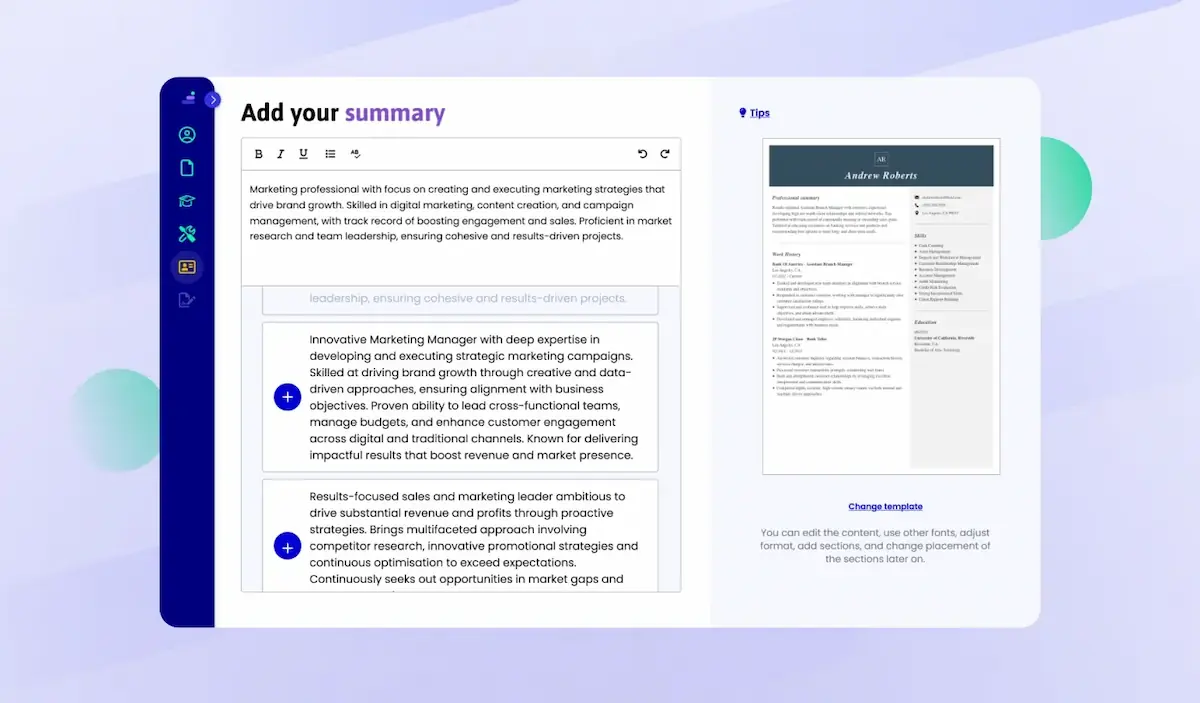
A strong CV summary will hook recruiters the same way a great blog post hooks readers: by highlighting your voice, your results, and the value you bring to their audience. Save time and choose a ready-made personal statement written by career experts and adjust it to your needs in the LiveCareer CV builder.
3. Present writing education and content training clearly
Your education section should reinforce your writing foundation and editorial development. Show how your learning supports storytelling, research, SEO, or digital publishing.
Here’s how to do it right:
- List your highest relevant qualification first: Include degree, institution, and completion date.
- Highlight writing-related modules: Journalism, creative writing, digital marketing, media studies, or SEO.
- Include relevant coursework and extracurricular activities: Feature published work, content campaigns, or editorial research.
- Add professional training: SEO certifications, content strategy workshops, or analytics courses.
- Keep it concise but relevant: Focus on learning that strengthens your credibility as a writer.
Even as a fresh blogger, your background can hint at potential, curiosity, and a foundation for growth in the digital content world.
4. List the key skills for a blogger example CV
Your skills section should demonstrate your ability to produce high-performing content, understand audiences, and publish strategically. Simply writing “creativity” won’t be enough. But there’s an easy way to do it right.
Here’s how to strengthen your blogger skills section:
- Match skills to the employer’s content needs: Use keywords like SEO, editorial planning, analytical skills, or audience growth.
- Balance hard skills with soft skills: Combine content writing, research, and platform expertise.
- Add brief context: Show how you apply each skill in real publishing environments.
- Keep the list focused: Aim for 6–10 strong, relevant skills.
- Avoid vague descriptors: Replace “good writing” with specific content capabilities.
However, before crafting this section, take another look at the skills the company values most for their blogging or content roles. Include relevant keywords from the job description in your skills section. This shows you match their needs and helps your CV pass Applicant Tracking Systems that scan for specific terms.
5. List the key skills for a blogger example CV
Presenting your top skills on a blogger CV requires thoughtful organisation, much like arranging a compelling blog post. Randomly listing skills without context won’t do you any favours. Tailor your skills to the job you’re applying for, providing descriptions that reflect your professional capabilities.
A successful blogger combines soft skills and hard skills, such as creativity, communication, time management, SEO proficiency, content creation, social media expertise, and analytical skills. Carefully read the job posting to ensure you’ve included all the necessary skills.
6. Enhance your blogger example CV with optional sections
Additional sections can showcase the full scope of your influence, from your publishing reach to your professional connections and industry involvement. They are especially valuable for freelancers or independent bloggers, highlighting the breadth of your experience beyond regular posts.
- Portfolio & published work: Include links to your blog, articles, or other content that demonstrates your writing and reach.
- Awards & recognition: List blogging awards, competitions, or industry acknowledgements to highlight your credibility.
- Guest blogging & collaborations: Mention partnerships, guest posts, or co-created content that show your versatility and networking.
- Speaking, workshops, or panels: Add webinars, panels, or events where you’ve shared insights on content, blogging, or digital media.
- Languages: Note any languages you write or publish in, with proficiency levels.
- Community or volunteer writing: Include pro-bono writing, editorial support, or content contributions to nonprofits or local projects.
- Hobbies and interests that reflect creativity or media awareness: Highlight activities that show engagement with writing, media trends, or digital storytelling.
Remember to focus on what’s truly relevant for the job you’re after, not only on what makes you an interesting blogger.
7. Format your blog-writing CV the right way
A blogger CV should feel clean, modern, and easy to scan. Strong formatting helps recruiters quickly understand your impact and content value.
Here’s how to format a CV for a blogger:
- Use a reverse-chronological layout: Keeps your latest work front-and-centre.
- Choose a clean, professional template: Avoid clutter or heavy graphics.
- Use clear headings and spacing: Make metrics and achievements easy to scan.
- Stick to readable fonts: Arial, Calibri, or Helvetica work best.
- Keep the correct CV length to up to 2 pages: Prioritise recent writing and performance highlights.
- Save as a PDF: Prevents formatting issues across devices.
8. Write a cover letter to add to your blog writer CV
A job application isn’t complete without a cover letter that expands on the information from the CV.Make your cover letter personal by expressing your genuine interest in the position.
Here’s how to do it right:
- Open your cover letter with your role fit and niche focus: State why you’re applying and your content strengths.
- Link your achievements to the brand’s goals: Highlight 2–3 relevant content wins.
- Explain your writing approach: Describe your editorial style, research process, and audience strategy.
- Show reliability and professionalism: Mention deadlines, collaboration, and content planning discipline.
- Close your cover letter confidently: Reinforce interest, availability, and attachment of your CV.
- Sign off professionally: Use Yours sincerely or Kind regards, followed by your name.
Together, your CV and cover letter should present you as a credible, performance-focused, and commercially aware blogger.
You don’t have to be a CV writing expert. In the LiveCareer CV builder you’ll find ready-made content for every industry and position, which you can then add with a single click.
Applying for other jobs? Try these CV examples as well:
- Marketing CV Example
- Marketing Manager CV Example
- Graphic Designer CV Example
- Photographer CV Example
- Video Editor CV Example
- Project Manager CV Example
- UX Designer CV Example
Remember, your CV is a reflection of your personal brand. Stay authentic, and let your passion for blogging shine through. Thank you for taking the time to read this guide!
How we review the content at LiveCareer
Our editorial team has reviewed this article for compliance with Livecareer’s editorial guidelines. It’s to ensure that our expert advice and recommendations are consistent across all our career guides and align with current CV and cover letter writing standards and trends. We’re trusted by over 10 million job seekers, supporting them on their way to finding their dream job. Each article is preceded by research and scrutiny to ensure our content responds to current market trends and demand.
Sources
About the author
Marta Bongilaj
Marta is a certified career expert with a marketing edge, offering strategic guidance to job seekers at every stage. She creates standout CVs and cover letters that help them land opportunities with confidence.
Looking for a job-winning CV?
Crafting a job-winning CV is all about showcasing your unique skills and experiences. Start with a strong personal statement that highlights your career goals and achievements.
Try Our CV Builder Now
![Write a Winning Goldman Sachs Cover Letter [+ Example]](https://cdn-images.livecareer.co.uk/pages/goldman_sachs_cover_letter_lcuk_1.jpg)