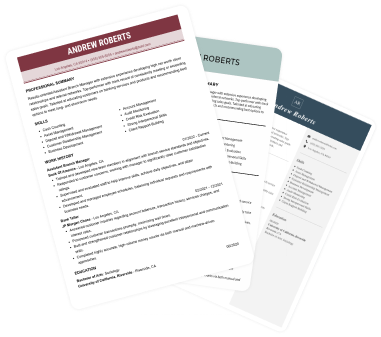
Great taste isn’t easy to put across on paper. Your fashion CV’s role is to get you to interview. To do that, it needs to list the most important information clearly and legibly. A simplistic, toned-down look.
Your artistic flair will be for nothing if the information is lost, or the CV is distracting. That’s why you need to see a professional fashion CV template that will make the front cover.
In this guide, you’ll get a fashion CV example better than most, plus, a fashion CV personal statement that attracts all the glances. On top of that, you’ll receive UK-specific fashion CV tips and examples to refine your application.
Create an effective CV in minutes. Choose a professional CV template and fill in every section of your CV in a flash using ready-made content and expert tips.
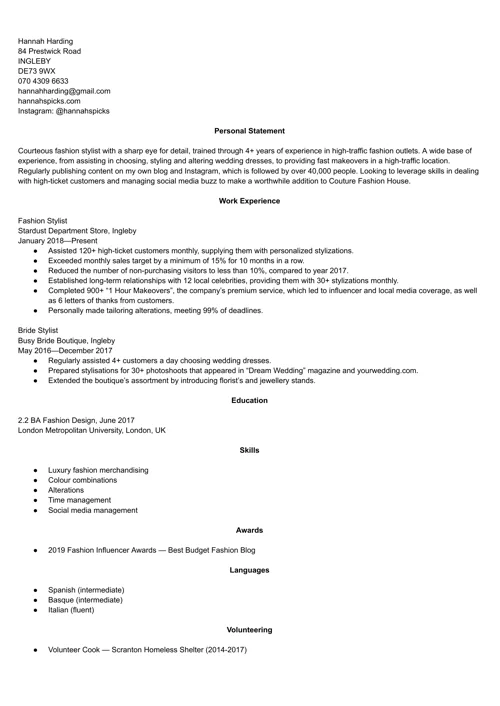
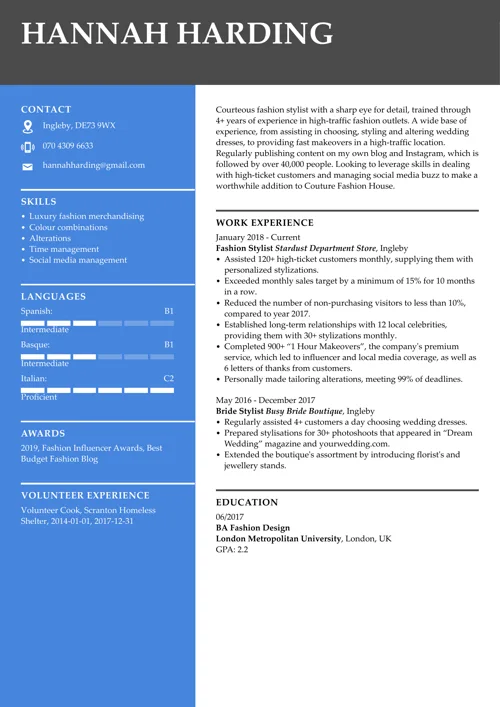
Courteous fashion stylist with a sharp eye for detail, trained through 4+ years of experience in high-traffic fashion outlets. A wide base of experience, from assisting in choosing, styling and altering wedding dresses, to providing fast makeovers in a high-traffic location. Regularly publishing content on my own blog and Instagram, which is followed by over 40,000 people. Looking to leverage skills in dealing with high-ticket customers and managing social media buzz to make a worthwhile addition to Couture Fashion House.
Work Experience
Fashion Stylist
Stardust Department Store, Ingleby
January 2018—Present
Assisted 120+ high-ticket customers monthly, supplying them with personalized stylizations.
Exceeded monthly sales target by a minimum of 15% for 10 months in a row.
Reduced the number of non-purchasing visitors to less than 10%, compared to year 2017.
Established long-term relationships with 12 local celebrities, providing them with 30+ stylizations monthly.
Completed 900+ “1 Hour Makeovers”, the company’s premium service, which led to influencer and local media coverage, as well as 6 letters of thanks from customers.
Personally made tailoring alterations, meeting 99% of deadlines.
Bride Stylist
Busy Bride Boutique, Ingleby
May 2016—December 2017
Regularly assisted 4+ customers a day choosing wedding dresses.
Prepared stylisations for 30+ photoshoots that appeared in “Dream Wedding” magazine and yourwedding.com.
Extended the boutique’s assortment by introducing florist’s and jewellery stands.
Education
2.2 BA Fashion Design, June 2017
London Metropolitan University, London, UK
Skills
Luxury fashion merchandising
Colour combinations
Alterations
Time management
Social media management
Awards
2019 Fashion Influencer Awards — Best Budget Fashion Blog
That’s how you strut your stuff. Here’s how to write a CV that lets you strut your stuff: here are the measurements for your own fashion CV.
1. Write a fashion CV personal statement
In fashion, making a statement is easier than on a CV. The personal statement summarises the most relevant points of your fashion CV to let the hiring person know who they’re dealing with right away (that’s why it’s also called a CV summary). Therefore, you should avoid the trivial, and focus on special achievements you may have.
In your CV profile of a fashion CV, sum up your years of experience, and the most crucial 2 or 3 achievements that will get you hired. Scour every job ad to see what’s most important to this employer, and personalise each CV for each job. Composing your personal statement comes easiest at the very end.
Fashion designer CV examples: personal statement
Courteous fashion stylist with a sharp eye for detail, trained through 4+ years of experience in high-traffic fashion outlets. A wide base of experience, from assisting in choosing, styling and altering wedding dresses, to providing fast makeovers in a high-traffic location. Regularly publishing content on my own blog and Instagram, which is followed by over 40,000 people. Looking to leverage skills in dealing with high-ticket customers and managing social media buzz to make a worthwhile addition to Couture Fashion House.
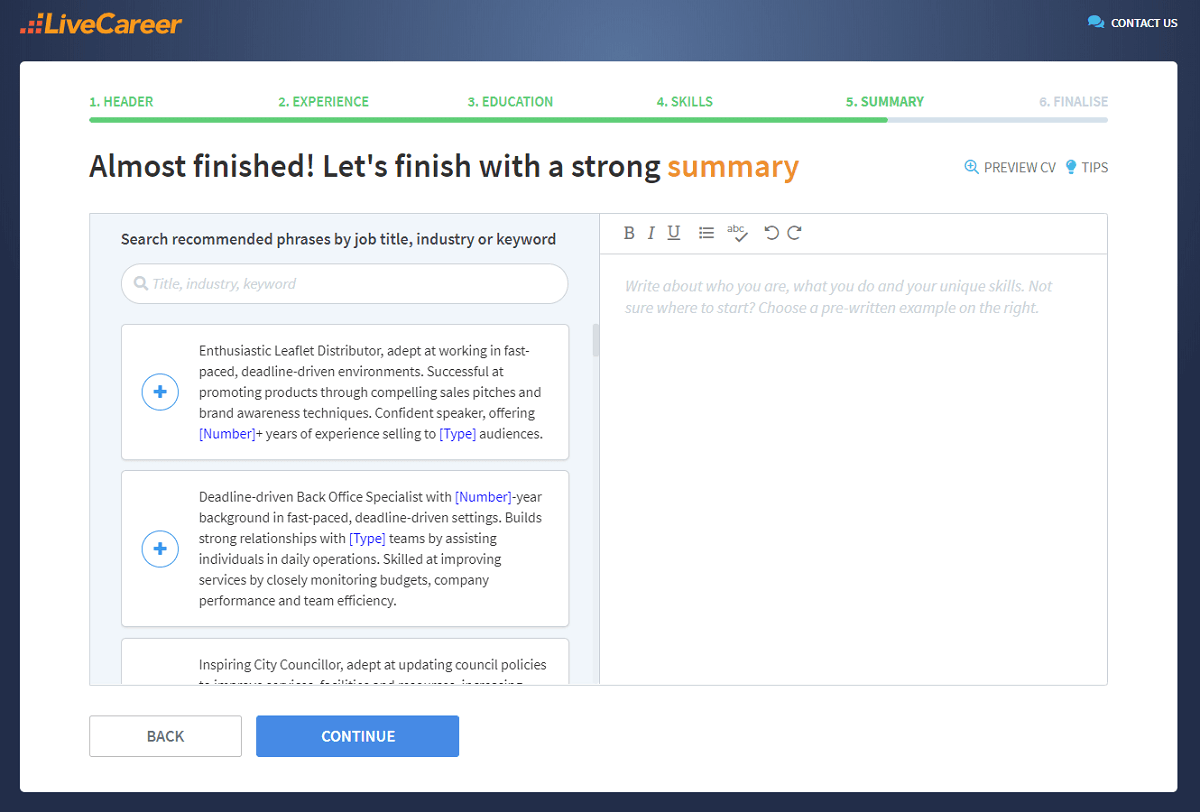
A strong CV summary will convince the recruiter you’re the perfect candidate. Save time and choose a ready-made personal statement written by career experts and adjust it to your needs in the LiveCareer CV builder.
Any fashion CV is not a place to discuss taste or preferences, it should illustrate your versatility, usefulness, and ability to deal with volume and intensity of work. List 5 to 7 bullet points for your most recent position, and 3 for the older ones.
Make sure around 75% of your bullet points have numbers to back you up, and so that the employer can imagine how you will perform with your new responsibilities. For everything subjective, you will have a portfolio and fashion cover letter, so keep it concise and factual.
Assisted 120+ high-ticket customers monthly, supplying them with personalized stylizations.
Exceeded monthly sales target by a minimum of 15% for 10 months in a row.
Reduced the number of non-purchasing visitors to less than 10%, compared to year 2017.
Established long-term relationships with 12 local celebrities, providing them with 30+ stylizations monthly.
Completed 900+ “1 Hour Makeovers”, the company’s premium service, which led to influencer and local media coverage, as well as 6 letters of thanks from customers.
Personally made tailoring alterations, meeting 99% of deadlines.
“A portfolio for a creative role stands out when it's visually appealing and well-organized, letting the work speak for itself without overwhelming the viewer. While creativity matters, clarity and specificity are crucial—highlight relevant projects that show a strong understanding of the brand, audience, and campaign goals. A well-structured CV that ties your creative work to measurable results is often more impactful than a purely artistic presentation”.
3. Stitch an education section onto your fashion CV
One thing never goes out of fashion—formal qualifications. You should record your highest level of education by listing your degree, grade (if beneficial), date of graduation, school and location.
If you only have A-Levels or other secondary qualifications, you can sum up your grades as “5 A*-C grades” for example. Singling them all out will take far too much space. Leave off grades below a C.
Once you have some work experience, you can stop listing the grades, but they can be very beneficial when looking for your first fashion job (and writing your first CV).
Fashion designer CV examples: education
Education
2.2 BA Fashion Design, June 2017
London Metropolitan University, London, UK
4. List your relevant fashion skills
Whether you’re handy with the hem tape or pick iconic colour combinations out effortlessly, these skills are worth listing on your CV. You can use this section to reiterate your strongest sides, or to list skills that did not warrant a full bullet point elsewhere.
Avoid the trivial. “Teamwork” is not a sought-after skill, it is a basic requirement of most jobs on planet Earth. If you are scarce in experience, you can expand on each skill by describing how you acquired it in 1-2 sentences, for example through private projects, etc.
Fashion design CV examples: skills
Luxury fashion merchandising
Colour combinations
Fast alterations
Time management
Social media management
5. Sew additional sections onto your fashion CV
A well-picked accessory can make all the difference. Stitching a few additional sections on can increase your chances of getting to interview, but only if they’re relevant to the position.
List your awards, certifications, languages, or volunteering experience under appropriate headings, and order them by what you think is the most relevant first.
Fashion design CV examples: additional sections
Awards
2019 Fashion Influencer Awards — Best Budget Fashion Blog
Jeans and a turtleneck. Florals and dots. Fashion CV and cover letter. They are inseparable. They are two halves of the same document, and the cover letter allows you a little more discussion and persuasion. Your CV proves your experience, your cover letter explains it and puts into context.
The first paragraph should read similar to the personal statement, but with a single most important achievement to hook them in. The body of the cover letter should discuss 2 to 3 aspects of the job at which you excel.
The last paragraph of your cover letter should tie it all together, tell them exactly what results they can expect should they hire you, and it ought to ask for an interview.
What else to remember about when writing a fashion design CV?
To make sure you get consistent interviews, you need consistent CVs. Use these measurements for your own design:
Set 1-inch margins on all sides and make sure your document is readable.
Use clear headings for each CV section, and leave space between them.
Save your fashion CV as PDF unless asked otherwise.
Keep track of all your applications in an Excel file and call them back if you don’t hear within a couple of weeks.
You don’t have to be a CV writing expert. In the LiveCareer CV builder you’ll find ready-made content for every industry and position, which you can then add with a single click.
Do you have more questions on how to write a fashion CV? Anything you want to suggest to make our article better? Did you find our fashion CV examples useful? Use the comments section below to let us know.
How we review the content at LiveCareer
Our editorial team has reviewed this article for compliance with LiveCareer’s editorial guidelines. It’s to ensure that our expert advice and recommendations are consistent across all our career guides and align with current CV and cover letter writing standards and trends. We’re trusted by over 10 million job seekers, supporting them on their way to finding their dream job. Each article is preceded by research and scrutiny to ensure our content responds to current market trends and demand.
"Fashion CV Examples & Templates (Guide with Tips)"
0/5
(Based on 0 votes)
About the author
LiveCareer UK Editorial Team
LiveCareer UK CV builder is powered by career experts, CV writers, and HR professionals. Since 2013, our editorial team has supported job seekers with free, research-based career advice and expert tips to improve their job applications. LiveCareer UK CV builder has already helped thousands, and you can be next.
Crafting a job-winning CV is all about showcasing your unique skills and experiences. Start with a strong personal statement that highlights your career goals and achievements.