Machine Learning Engineer CV Examples & Template (2025)
Last updated on 8 January, 2026

Danuta DetynaWriter, Professional Association of Resume Writers and Career Coaches (PARWCC)
Our customers have been hired by*:
Writing a tailored machine learning engineer CV can turn your technical projects into real interview opportunities. I’ll show you what to include, how to present achievements clearly, and how to format your machine learning CV so it works for both recruiters and Applicant Tracking Systems.
With practical tips and complete examples, you’ll be able to create a job application that’s scannable, credible and effective at getting the recruiter’s attention.
Create an effective CV in minutes. Choose a professional CV template and fill in every section of your CV in a flash using ready-made content and expert tips.
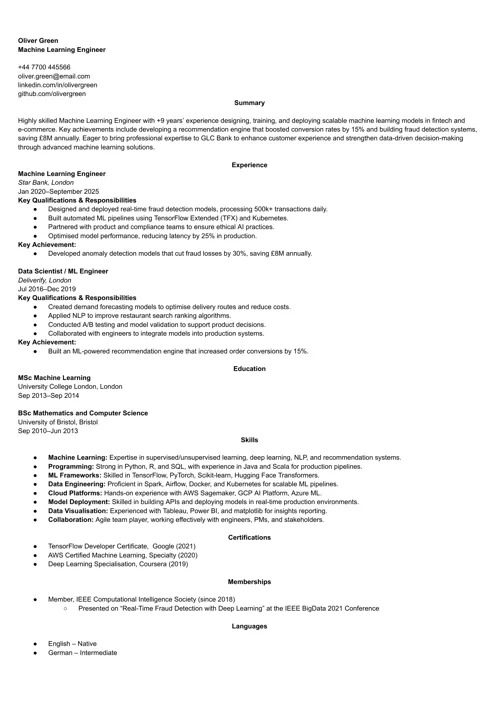
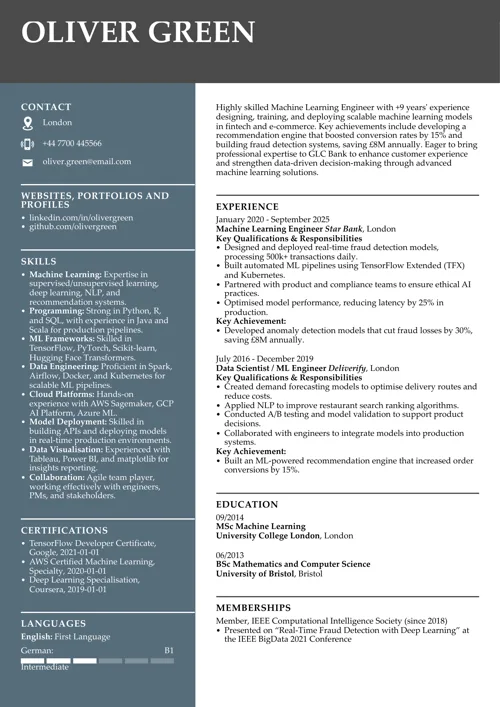
We created the sample on the left using our builder. See other good CV examples like this one.
Applying for other similar jobs? Here are CV examples that may interest you:
- Deep Learning Engineer CV Example & Writing Tips
- Full Stack Developer CV Example & Writing Tips
- Computer Science CV Example & Writing Tips
- DevOps Engineer CV Example & Writing Tips
- Engineering CV Example & Writing Tips
Machine engineer CV template
Oliver Green
Machine Learning Engineer
+44 7700 445566
oliver.green@email.com
linkedin.com/in/olivergreen
github.com/olivergreen
Summary
Highly skilled Machine Learning Engineer with +9 years’ experience designing, training, and deploying scalable machine learning models in fintech and e-commerce. Key achievements include developing a recommendation engine that boosted conversion rates by 15% and building fraud detection systems, saving £8M annually. Eager to bring professional expertise to GLC Bank to enhance customer experience and strengthen data-driven decision-making through advanced machine learning solutions.
Experience
Machine Learning Engineer
Star Bank, London
Jan 2020–September 2025
Key Qualifications & Responsibilities
- Designed and deployed real-time fraud detection models, processing 500k+ transactions daily.
- Built automated ML pipelines using TensorFlow Extended (TFX) and Kubernetes.
- Partnered with product and compliance teams to ensure ethical AI practices.
- Optimised model performance, reducing latency by 25% in production.
Key Achievement:
- Developed anomaly detection models that cut fraud losses by 30%, saving £8M annually.
Data Scientist / ML Engineer
Deliverify, London
Jul 2016–Dec 2019
Key Qualifications & Responsibilities
- Created demand forecasting models to optimise delivery routes and reduce costs.
- Applied NLP to improve restaurant search ranking algorithms.
- Conducted A/B testing and model validation to support product decisions.
- Collaborated with engineers to integrate models into production systems.
Key Achievement:
- Built an ML-powered recommendation engine that increased order conversions by 15%.
Education
MSc Machine Learning
University College London, London
Sep 2013–Sep 2014
BSc Mathematics and Computer Science
University of Bristol, Bristol
Sep 2010–Jun 2013
Skills
- Machine Learning: Expertise in supervised/unsupervised learning, deep learning, NLP, and recommendation systems.
- Programming: Strong in Python, R, and SQL, with experience in Java and Scala for production pipelines.
- ML Frameworks: Skilled in TensorFlow, PyTorch, Scikit-learn, Hugging Face Transformers.
- Data Engineering: Proficient in Spark, Airflow, Docker, and Kubernetes for scalable ML pipelines.
- Cloud Platforms: Hands-on experience with AWS Sagemaker, GCP AI Platform, Azure ML.
- Model Deployment: Skilled in building APIs and deploying models in real-time production environments.
- Data Visualisation: Experienced with Tableau, Power BI, and matplotlib for insights reporting.
- Collaboration: Agile team player, working effectively with engineers, PMs, and stakeholders.
Certifications
- TensorFlow Developer Certificate, Google (2021)
- AWS Certified Machine Learning, Specialty (2020)
- Deep Learning Specialisation, Coursera (2019)
Memberships
- Member, IEEE Computational Intelligence Society (since 2018)
- Presented on “Real-Time Fraud Detection with Deep Learning” at the IEEE BigData 2021 Conference
Languages
- English – Native
- German – Intermediate
Now, let me show you how to write a job application as good as the machine learning engineer CV sample above:
1. Start your machine learning engineer CV with a strong personal profile
A CV’s personal statement is the hook that determines whether a recruiter will keep on reading. A strong CV personal profile is crucial for getting their undivided attention, as hiring managers spend only a few seconds initially scanning each CV.
It may be counterintuitive since a CV summary is at the very top, but trust me, it’s much easier to create this CV section if you write it last. This way, you can cherry-pick the best bits from your entire CV.
When creating a CV summary, keep it focused to make every sentence justify a call-back. A great personal profile says who you are, what you’ve achieved (with numbers), and what you will bring to the employer – in plain language that mirrors the advert where appropriate.
Here’s a quick guide to creating a job-winning personal statement:
- Be succinct: 2–4 sentences (50–120 words) that sum up your specialism and seniority.
- Lead with role and value: name your job title and one thing you reliably deliver (e.g. “production recommender” or “low-latency inference”).
- Use one measurable achievement: pick one of the most impressive ones.
- State the goal: say what you’ll bring to the next team or product.
- Mirror key terms: include 1–2 job advert keywords naturally (e.g. “MLOps”, “feature store”).
Machine learning engineer CV example: personal statement
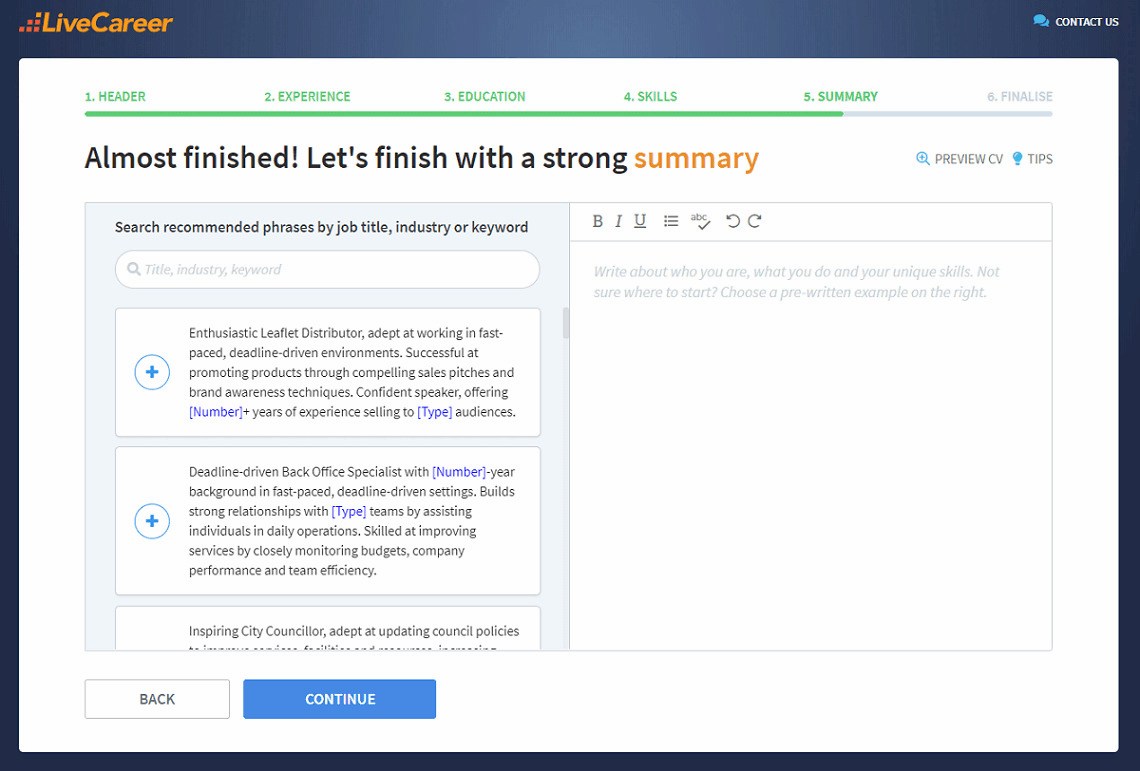
Highly skilled Machine Learning Engineer with +9 years’ experience designing, training, and deploying scalable machine learning models in fintech and e-commerce. Key achievements include developing a recommendation engine that boosted conversion rates by 15% and building fraud detection systems, saving £8M annually. Eager to bring professional expertise to GLC Bank to enhance customer experience and strengthen data-driven decision-making through advanced machine learning solutions.
A strong CV summary will convince the recruiter you’re the perfect candidate. Save time and choose a ready-made personal statement written by career experts and adjust it to your needs in the LiveCareer CV builder.
2. Structure a strong machine learning engineer CV experience section
The work experience section is the backbone of your CV – it proves your skills in action. Employers want to see evidence of career progression, notable achievements, and relevance to the vacancy. List roles in reverse chronological order, starting with your most recent position, and write 3–6 bullet points per role. Focus on outcomes, not just responsibilities.
Here’s how to create a persuasive experience section in your machine learning engineer CV:
- Begin each bullet with an action verb (e.g. designed, delivered, optimised) to show proactivity.
- Highlight relevant professional achievements, not just duties: instead of “Responsible for maintaining models,” write “Optimised a production model, cutting inference time by 30%.”
- Tailor examples to the role advertised: if the job ad stresses deployment, highlight your experience with production models.
- Quantify results wherever possible, e.g. accuracy scores, performance gains, reduced costs, and number of users served.
- Show the tools and methods you used, such as TensorFlow, Docker, and Airflow; keep them relevant rather than listing everything.
- Demonstrate scale and impact: whether that’s size of datasets, number of transactions, or business outcomes.
Machine learning engineer CV example: experience
Machine Learning Engineer
Star Bank, London
Jan 2020–September 2025
Key Qualifications & Responsibilities
- Designed and deployed real-time fraud detection models, processing 500k+ transactions daily.
- Built automated ML pipelines using TensorFlow Extended (TFX) and Kubernetes.
- Partnered with product and compliance teams to ensure ethical AI practices.
- Optimised model performance, reducing latency by 25% in production.
Key Achievement:
- Developed anomaly detection models that cut fraud losses by 30%, saving £8M annually.
3. Highlight your educational background
The education section demonstrates that you’ve the right academic foundations for machine learning roles. Recruiters expect to see your degree(s) listed clearly, along with relevant details such as dissertation topics or significant projects.
Sure, employers may value hands-on experience more than grades, but your education still demonstrates both your technical foundation and your ability to complete complex, long-term projects.
Here’s how to write an effective education section in a machine learning engineer’s CV:
- List your degrees in reverse chronological order, starting with the most recent.
- Include your degree type, subject, institution, and years of study, maintaining a consistent format.
- Add a one-line summary of your dissertation or capstone project, especially if it involved machine learning, AI, or data science.
- Include strong results or distinctions if they are recent and relevant.
- If you’re early in your career, mention relevant coursework (e.g. Deep Learning, Probability, Linear Algebra) to reinforce your skills.
Machine learning engineer CV example: education
MSc Machine Learning
University College London
Sep 2013–Sep 2014
BSc Mathematics and Computer Science
University of Bristol
Sep 2010–Jun 2013
4. Feature relevant machine learning skills in your CV
The skills section is a quick way for both recruiters and Applicant Tracking Systems (ATS) to see whether you meet the technical requirements of the role. You’re a machine learning engineer, so this section must highlight specific tools, programming languages, and methods that you’re confident using.
To effectively highlight machine learning skills in a CV:
- Keep the skill list clear and easy to scan: aim for 8–12 qualities that are most relevant to the job you’re targeting.
- Match the language of the job advert where it reflects your real experience (for example, “TensorFlow” or “Kubernetes”).
- Avoid generic skills in this section; instead, stick to technical abilities and methods.
- Double-check that each skill you list is supported elsewhere in your CV, either in your experience or project achievements.
- Place the section towards the end of the CV, unless you’re a junior candidate, in which case it can sit above education.
Machine learning engineer CV example: skills section
Skills
- Machine Learning: Expertise in supervised/unsupervised learning, deep learning, NLP, and recommendation systems.
- Programming: Strong in Python, R, and SQL, with experience in Java and Scala for production pipelines.
- ML Frameworks: Skilled in TensorFlow, PyTorch, Scikit-learn, Hugging Face Transformers.
- Data Engineering: Proficient in Spark, Airflow, Docker, and Kubernetes for scalable ML pipelines.
- Cloud Platforms: Hands-on experience with AWS Sagemaker, GCP AI Platform, Azure ML.
- Model Deployment: Skilled in building APIs and deploying models in real-time production environments.
- Data Visualisation: Experienced with Tableau, Power BI, and matplotlib for insights reporting.
- Collaboration: Agile team player, working effectively with engineers, PMs, and stakeholders.
5. Add extra sections to your machine learning engineer CV for a stronger impact
A CV doesn’t have to end with skills and education. Additional sections offer a smart way to show hiring managers qualities or achievements that don’t fit neatly under work experience. For a machine learning engineer, these sections can highlight projects, awards, publications, or contributions to the broader tech community – all of which help you stand out.
Here are some extras worth considering in your machine learning engineer CV:
- Projects and portfolio: Short entries that describe the problem, approach, and result of your work, with links to GitHub or demos if available. These show you can deliver working solutions, not just theory.
- Publications or research: Include peer-reviewed papers, conference talks, or significant blog posts that demonstrate your thought leadership.
- Awards and achievements: List hackathon wins, scholarships, or industry recognition that prove your impact beyond the workplace.
- Languages: Both programming and spoken languages can be relevant. Employers hiring internationally value English fluency, as well as proficiency in other languages.
- Professional memberships: For example, IEEE, ACM, or local data science meetups. Membership shows engagement with the field.
Machine learning engineer CV example: additional sections
Certifications
- TensorFlow Developer Certificate, Google (2021)
- AWS Certified Machine Learning, Specialty (2020)
- Deep Learning Specialisation, Coursera (2019)
Memberships
- Member, IEEE Computational Intelligence Society (since 2018)
- Presented on “Real-Time Fraud Detection with Deep Learning” at the IEEE BigData 2021 Conference
Languages
- English—Native
- German—Intermediate
6. Format your machine learning engineer CV like a pro
Presentation and accuracy are the last mile: a clear layout, consistent dates, and verified links mean your machine learning engineer CV gets read and trusted. Run practical checks that an ATS or hiring manager will care about.
Here’s a final checklist to polish and send your machine learning engineer CV:
- CV Length: 1 page for early career; 1–2 pages for senior engineers.
- File format: export as PDF unless otherwise requested.
- Contact details section: name, role, phone, professional email, LinkedIn, GitHub/portfolio link at the top.
- CV headings & dates: use plain headings and consistent date format (e.g. Jan 2022–Present).
- ATS optimisation: to make an ATS-friendly CV, avoid images, unusual section names or embedded tables; use common keywords from the advert.
7. Draft a tailored machine learning engineer cover letter
Are cover letters still a thing? Yes, because 83% of recruiters read them. A targeted, short cover letter lets you explain motivation, context, and trade-offs that may not be visible using bullet points. Use it to connect a concrete CV achievement to the company’s product problem and to show collaborative impact.
Here’s how to write a cover letter that complements your machine learning engineer CV:
- Open your cover letter with one line of impact (role + headline metric).
- Explain technical fit in one short paragraph: which problems you’ve solved that mirror the employer’s needs.
- Show collaboration/leadership skills with one paragraph (cross-functional work, mentoring).
- Close your cover letter with a call to action and keep the whole letter to about 250–400 words.
- Avoid repeating the CV verbatim: add brief context for decisions and trade-offs.
- Stick to a professional cover letter structure: pay attention to formatting and limit your cover letter length to one page.
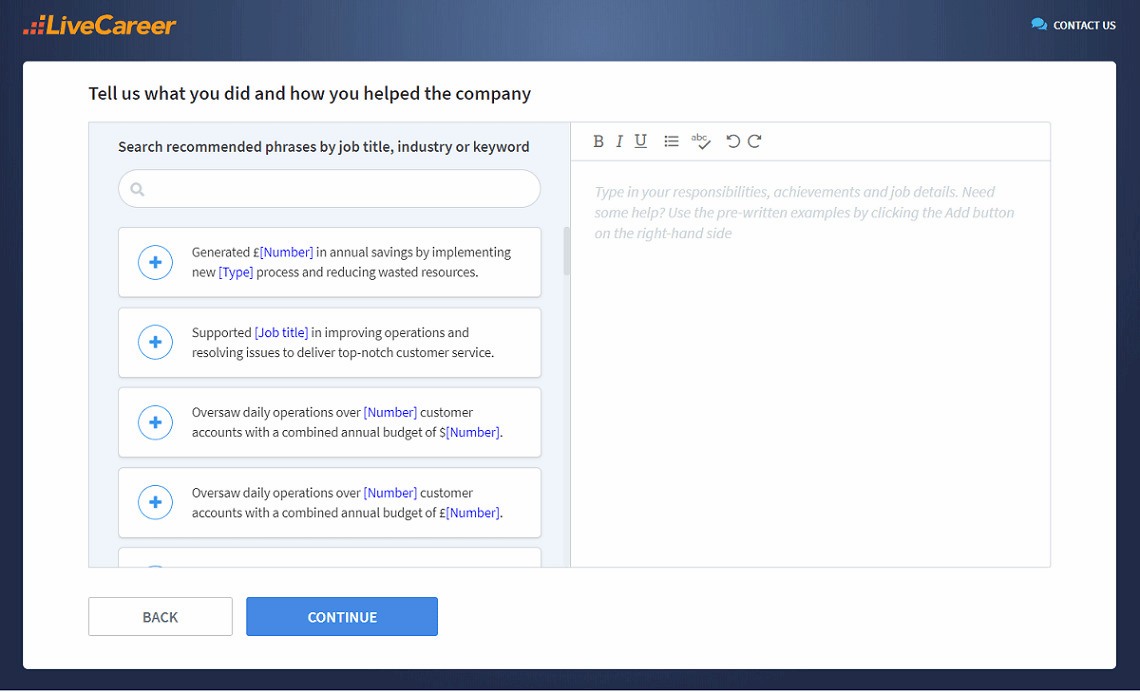
You don’t have to be a CV writing expert. In the LiveCareer CV builder you’ll find ready-made content for every industry and position, which you can then add with a single click.
Check these CV examples for other tech jobs:
- IT CV Example & Writing Tips
- Scrum Master CV Example & Writing Tips
- Cyber Security CV Example & Writing Tips
- CV Examples & Writing Tips for All Professions
Thank you for reading my article on how to write a machine learning CV. If you’d like to read more articles on CV writing and other career-related topics, don’t hesitate to check out our other blog posts!
How we review the content at LiveCareer
Our editorial team has reviewed this article for compliance with LiveCareer’s editorial guidelines. It’s to ensure that our expert advice and recommendations are consistent across all our career guides and align with current CV and cover letter writing standards and trends. We’re trusted by over 10 million job seekers, supporting them on their way to finding their dream job. Each article is preceded by research and scrutiny to ensure our content responds to current market trends and demand.
Sources
About the author
Danuta Detyna
Danuta Detyna is a Certified Professional Résumé Writer and career expert with over nine years of writing experience. Known for her empathetic, detail-oriented approach, she creates practical and empowering career resources that help job seekers move forward with confidence.
Looking for a job-winning CV?
Crafting a job-winning CV is all about showcasing your unique skills and experiences. Start with a strong personal statement that highlights your career goals and achievements.
Try Our CV Builder Now