How to Add a Driving Licence on CV: UK Format
Last updated on 5 February, 2026


Maciej Staszek TomaszewiczWriter, Professional Association of Resume Writers and Career Coaches (PARWCC)
Reviewed by Roma KończakEditor & Writer, Certified Professional Résumé Writers and Career Coaches (PARWCC)

Our customers have been hired by*:
Including a driving licence on a CV can be tricky. For some roles, it’s essential, while for others it adds little value. Understanding when a driving licence CV mention helps (and when it doesn’t) can make your application stronger and more focused.
Let me drive you through all the meanders of adding a driving licence to a CV. I’ll show you when and how to list it effectively, and what it signals to employers.
Create an effective CV in minutes. Choose a professional CV template and fill in every section of your CV in a flash using ready-made content and expert tips.
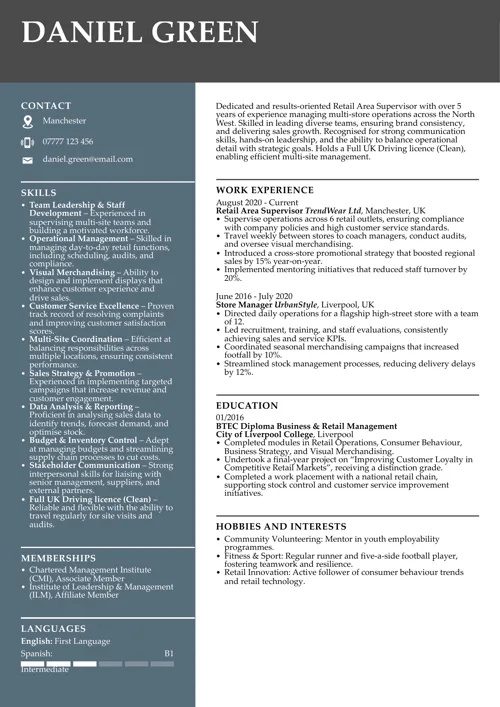
We created the sample on the left using our builder. See other good CV examples like this one.
Visit our other guides:
- Key Achievements to Put on CV
- What Are People Skills?
- 100 Fun Facts About Me
- Is a Degree Worth It in 2025?
- 500+ Action Verbs for a CV
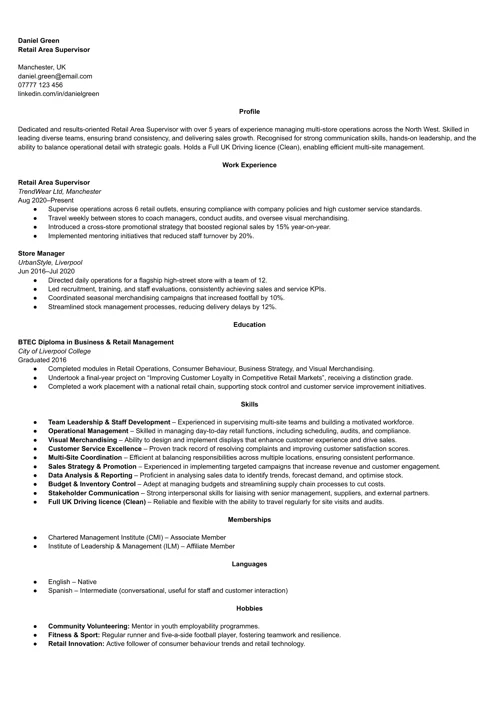
Driving licence: CV example
Example
Daniel Green
Retail Area Supervisor
Manchester, UK
daniel.green@email.com
07777 123 456
linkedin.com/in/danielgreen
Profile
Dedicated and results-oriented Retail Area Supervisor with over 5 years of experience managing multi-store operations across the North West. Skilled in leading diverse teams, ensuring brand consistency, and delivering sales growth. Recognised for strong communication skills, hands-on leadership, and the ability to balance operational detail with strategic goals. Holds a Full UK Driving licence (Clean), enabling efficient multi-site management.
Work Experience
Retail Area Supervisor
TrendWear Ltd, Manchester
Aug 2020–Present
- Supervise operations across 6 retail outlets, ensuring compliance with company policies and high customer service standards.
- Travel weekly between stores to coach managers, conduct audits, and oversee visual merchandising.
- Introduced a cross-store promotional strategy that boosted regional sales by 15% year-on-year.
- Implemented mentoring initiatives that reduced staff turnover by 20%.
Store Manager
UrbanStyle, Liverpool
Jun 2016–Jul 2020
- Directed daily operations for a flagship high-street store with a team of 12.
- Led recruitment, training, and staff evaluations, consistently achieving sales and service KPIs.
- Coordinated seasonal merchandising campaigns that increased footfall by 10%.
- Streamlined stock management processes, reducing delivery delays by 12%.
Education
BTEC Diploma in Business & Retail Management
City of Liverpool College
Graduated 2016
- Completed modules in Retail Operations, Consumer Behaviour, Business Strategy, and Visual Merchandising.
- Undertook a final-year project on “Improving Customer Loyalty in Competitive Retail Markets”, receiving a distinction grade.
- Completed a work placement with a national retail chain, supporting stock control and customer service improvement initiatives.
Skills
- Team Leadership & Staff Development – Experienced in supervising multi-site teams and building a motivated workforce.
- Operational Management – Skilled in managing day-to-day retail functions, including scheduling, audits, and compliance.
- Visual Merchandising – Ability to design and implement displays that enhance customer experience and drive sales.
- Customer Service Excellence – Proven track record of resolving complaints and improving customer satisfaction scores.
- Multi-Site Coordination – Efficient at balancing responsibilities across multiple locations, ensuring consistent performance.
- Sales Strategy & Promotion – Experienced in implementing targeted campaigns that increase revenue and customer engagement.
- Data Analysis & Reporting – Proficient in analysing sales data to identify trends, forecast demand, and optimise stock.
- Budget & Inventory Control – Adept at managing budgets and streamlining supply chain processes to cut costs.
- Stakeholder Communication – Strong interpersonal skills for liaising with senior management, suppliers, and external partners.
- Full UK Driving licence (Clean) – Reliable and flexible with the ability to travel regularly for site visits and audits.
Memberships
- Chartered Management Institute (CMI) – Associate Member
- Institute of Leadership & Management (ILM) – Affiliate Member
Languages
- English – Native
- Spanish – Intermediate (conversational, useful for staff and customer interaction)
Hobbies
- Community Volunteering: Mentor in youth employability programmes.
- Fitness & Sport: Regular runner and five-a-side football player, fostering teamwork and resilience.
- Retail Innovation: Active follower of consumer behaviour trends and retail technology.
Should I put a driving licence on a CV?
Quick Answer: Yes. Include your driving licence when writing a CV if it’s relevant to the job or gives you a clear advantage. In other words:
- Add it when driving is a required skill or a significant asset for the role you’re applying for.
- Omit it if it’s not pertinent; for example, a desk job with no travel needs won’t benefit from this information.
Ultimately, the aim is to use your CV space for qualifications that strengthen your application, so only include your licence when it adds value (and leave it out when it doesn’t).
When a driving licence on a CV is essential
In specific roles, possessing a driving licence is absolutely compulsory. If the ability to drive is essential to the job responsibilities, you should definitely include your licence on your CV.
Roles where a driving licence is essential include:
- Professional driver roles (HGV/lorry drivers, delivery drivers, couriers) require a valid licence by definition, often a specific category like HGV (Category C) or van (Category B).
- Field-based roles (such as sales representatives, field service engineers, and territory managers) involve a significant amount of time on the road visiting clients or sites. Employers will expect you to hold a full driving licence for efficiency.
- Any job listing “full driving licence required”: Always read the job description. If a full UK driving licence is explicitly listed as a requirement (such as transportation, home visit or logistics jobs), then yes, put it on your CV in a prominent spot.
In these situations, not mentioning your licence could cost you the opportunity. Recruiters might even exclude candidates who do not hold the required licence. Therefore, for essential roles, confidently demonstrate that you have a valid UK driving licence, including the relevant category.
When a driver’s licence in a CV is an advantage
Even when a licence isn’t a strict requirement, it can still be a valuable asset. For many jobs, having a driving licence gives you a competitive edge because it signals qualities like reliability, independence, and flexibility.
Consider adding a driving licence to your CV as a “bonus” qualification if:
- The role occasionally involves travel or off-site meetings. For example, office roles where you might need to visit clients, attend events, or travel between company sites. Being able to drive (instead of relying on public transport) shows you can travel on short notice and adapt to different locations.
- It’s a role where flexibility and punctuality are valued. A driving licence hints that you’re likely able to commute or respond to urgent requests more easily. Employers often see a licence as a sign of responsibility and commitment.
- You’re in a rural or field environment. If the job is outside major cities (with limited public transit), having a car and a licence can be a practical advantage. It tells the employer you won’t have issues with transportation to work or meetings.
In these cases, including your licence can differentiate you from candidates who don’t drive. It’s essentially a soft skill indicator – implying you’re self-reliant and can handle travel needs.
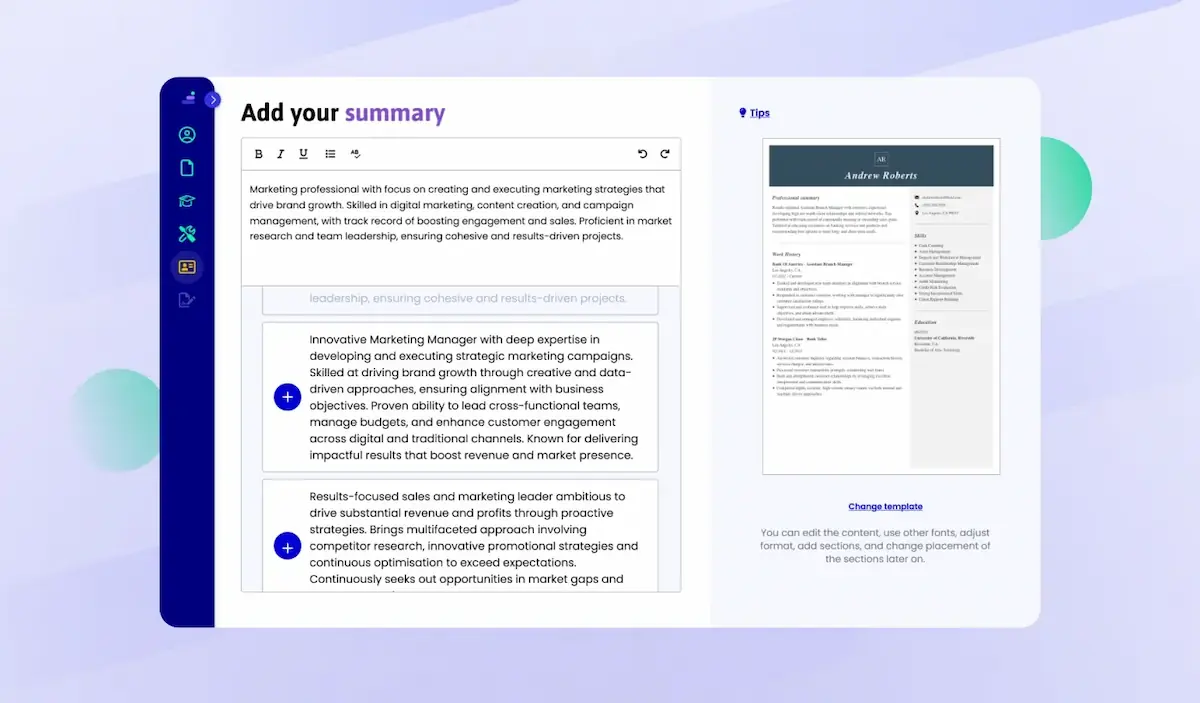
A strong CV summary will convince the recruiter you’re the perfect candidate. Save time and choose a ready-made personal statement written by career experts and adjust it to your needs in the LiveCareer CV builder.
Where should I put a driving licence on a CV?
Include your driving licence in the contact information section of your CV if driving is essential for the role, or in the skills or certifications section for other positions. For roles where driving is a core requirement, such as delivery or bus driver roles, consider creating a dedicated section labelled “Licences” or “Certifications” to highlight it.
Wherever you include it, keep the licence information brief and clear. You don’t need to give excessive detail. The goal is to quickly show the type of licence you hold.
In your personal details
A common place to mention a driving licence is in the CV header or personal details section of your CV, often near your contact information. This makes it immediately visible. For example, include it as a simple line under or beside your address.
Jessica Hyde
Nurse
Broughton
+44 79 1362 5054
jessica.hyde@email.co.uk
linkedin.com/in/jessica.hyde.nursing
Driving licence: B
Placing it here is useful when a licence is either required or a big selling point for the role. It’s upfront, so a recruiter scanning won’t miss it. Be sure to specify the type of licence (e.g. full UK driving licence) and any relevant driving licence category if needed.
In a skills section
Another option is to include your driving licence in your core skills or key qualifications section. If you have a section for “Skills” or “Core Competencies” and a licence is a relevant asset for the role, add it there. This approach works well if you’re listing multiple skills in bullet points or a short list.
- Full UK Driving licence (Clean) – Reliable and flexible with the ability to travel regularly for site visits and audits.
By including it among your skills, you present your licence as one of your relevant capabilities for the role. This is especially suitable when driving ability is one of several key qualifications (for example, a role that values both technical skills and the ability to travel).
In a qualifications or certifications section
If you have a dedicated section for Qualifications, Certifications, or Licences, you can include your driving licence details there, especially if it’s a specialised licence beyond the standard car category. This option is great for professional or commercial driving licences. For example, heavy vehicle operators or bus drivers often have specific categories that function like certifications.
Certifications
- Private Hire Driver’s Licence, Transport for London, 2023
By putting your driving licence in a qualifications section, you emphasise that your licence is a formal credential. This is most useful when the job actually calls for that specific licence type.
Expert advice: For standard licences (Category B), it’s usually not necessary to have a whole licence section. A brief mention in the personal details or skills will do. But for special categories (C, D, etc.), treating them as certifications ensures they stand out properly.
What are the UK driving licence categories?
To effectively showcase your driving credentials, it helps to understand specific UK-specific details, such as licence categories and the meaning of terms like “clean licence.”
UK driving licence categories (vehicle types & roles)
The UK driving licence is divided into categories that determine what types of vehicles you can drive. If a job needs a particular category (like driving a lorry or bus), make sure to mention that category on your CV.
Here are the main categories relevant to job applications, along with what they allow you to drive:
- Category B: Standard car and light van licence. It covers vehicles up to 3.5 tonnes and eight passenger seats. It’s the usual full car licence most hold, the default for most applicants, suitable for roles involving cars or small vans.
- Category C1 / C: Medium and large goods vehicles. Category C1 allows driving commercial vehicles between 3.5 and 7.5 tonnes, while Category C covers vehicles over 7.5 tonnes, used in logistics and haulage. (Category C+E adds towing heavy trailers.)
- Category D: Passenger carrying vehicles (PCV), i.e. buses and coaches. A Category D licence allows driving vehicles with over eight passenger seats, such as full-size buses or coaches. It’s needed for bus/coach drivers and passenger transport roles. D1 covers minibuses up to 16 seats, but D is the full bus licence.
If you hold any of these special categories and it’s relevant to the job (e.g. applying to be a delivery truck driver with a Category C licence), definitely specify it on your CV. It shows you meet the legal requirement for that vehicle type.
On the flip side, don’t list categories that aren’t relevant. For instance, having a motorcycle licence (Category A) is usually not pertinent unless the job involves motorcycles.
What is a ‘clean’ driving record in the UK?
You’ll often see the term “clean driving licence”. This is a positive point worth including if it applies to you. A clean driving licence means your driving record has no active penalty points or endorsements. In other words, you haven’t been caught for driving offences, or any past points have expired. Essentially, it’s a licence free of any marks for infractions. Employers love to see this, as it indicates you’re a safe and responsible driver.
If you do have a clean record, mentioning it (simply by using the word “clean”) can be a major differentiator. For example, writing “Full UK Driving licence (Clean)” immediately tells the reader you have zero penalty points, which can set you apart from candidates who might have minor convictions. It subtly communicates trustworthiness.
Expert advice: If you’re not sure whether your licence is clean or how many points you have, you can check your driving record online through the DVLA’s website to confirm. Keeping tabs on your record ensures you represent your licence status accurately on your CV.
Provisional licence
What if you only have a provisional licence (the licence you get before passing your driving test)? In most cases, do not include a provisional licence on your CV. A provisional by itself doesn’t qualify you to drive unaccompanied, so it usually isn’t valuable to employers. Listing it could even confuse or mislead, since employers typically assume a listed licence means full privileges.
Only include a Provisional licence in specific cases, such as applying for a driver training programme or apprenticeship where employers know you’re learning to drive. Some companies might help you get your full licence as part of the job, so mentioning your provisional status could be relevant. Otherwise, leave it off and wait until you have a full licence before including driving details on your CV.
In brief, unless the employer explicitly looks for candidates who are learners, a provisional licence doesn’t add value to a CV. And definitely don’t refer to it as a “full” licence. Use “full” only when you have passed the driving test.
You don’t have to be a CV writing expert. In the LiveCareer CV builder you’ll find ready-made content for every industry and position, which you can then add with a single click.
How we review the content at LiveCareer
Our editorial team has reviewed this article for compliance with LiveCareer’s editorial guidelines. It’s to ensure that our expert advice and recommendations are consistent across all our career guides and align with current CV and cover letter writing standards and trends. We’re trusted by over 10 million job seekers, supporting them on their way to finding their dream job. Each article is preceded by research and scrutiny to ensure our content responds to current market trends and demand.
Sources
About the author
Maciej Staszek Tomaszewicz
Maciej is a certified career expert who brings over a decade of expertise in crafting tailored CVs and cover letters. He combines deep industry knowledge with a friendly, accessible writing style, aiming to empower job seekers with practical tips and insightful career advice.
Looking for a job-winning CV?
Crafting a job-winning CV is all about showcasing your unique skills and experiences. Start with a strong personal statement that highlights your career goals and achievements.
Try Our CV Builder Now