Cover Letter for an Internal Position + Examples
Last updated on 12 December, 2025

Danuta DetynaWriter, Professional Association of Resume Writers and Career Coaches (PARWCC)

Our customers have been hired by*:
Writing a cover letter for an internal position gives you the chance to highlight achievements, show your commitment, and explain why you’re the best fit. Unlike external applications, an internal position cover letter should build on your company knowledge and showcase measurable results.
In this guide, I’ll show you practical tips and cover letter examples for internal position applications – whether you’re aiming for a promotion or a transfer – so you can approach the next career step with confidence.
Use the LiveCareer cover letter builder and your cover letter will write itself. Choose a professional template, answer a few easy questions and the creator will generate a professional cover letter for you with just one click.
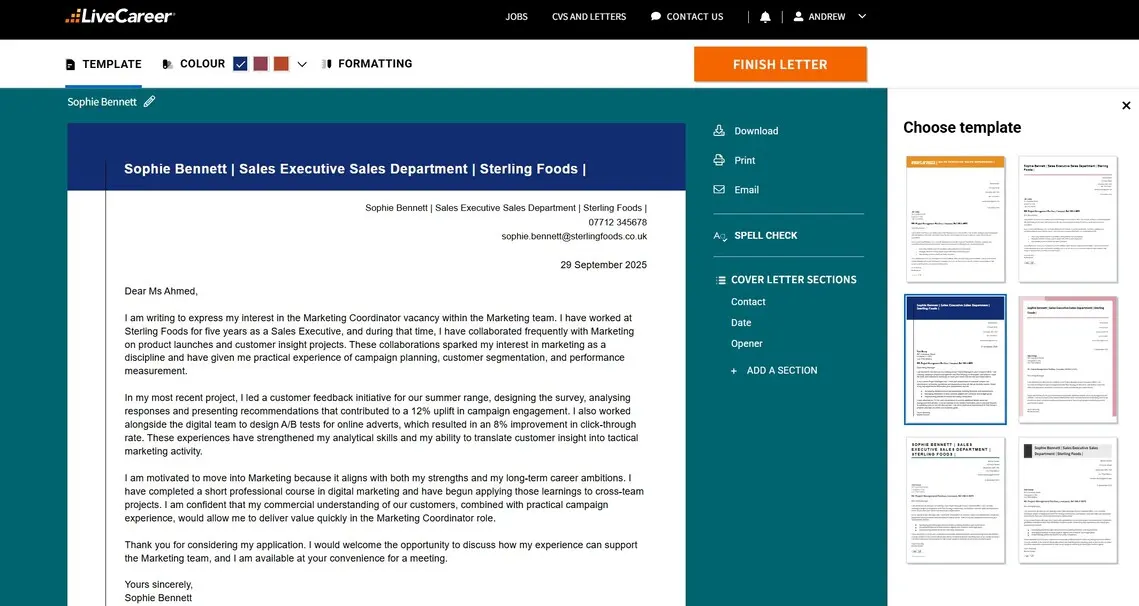
Full-length sample cover letter for an internal position
Below is a fully written example you can use as a cover letter template for an internal position and customise it to your particular situation. It’s structured to highlight transferable skills and concrete achievements that align with the target role.
Sophie Bennett
Sales Executive, Sales Department
Sterling Foods | sophie.bennett@sterlingfoods.co.uk
07712 345678
29 September 2025
Dear Ms Ahmed,
I am writing to express my interest in the Marketing Coordinator vacancy within the Marketing team. I have worked at Sterling Foods for five years as a Sales Executive, and during that time, I have collaborated frequently with Marketing on product launches and customer insight projects. These collaborations sparked my interest in marketing as a discipline and have given me practical experience of campaign planning, customer segmentation, and performance measurement.
In my most recent project, I led a customer feedback initiative for our summer range, designing the survey, analysing responses and presenting recommendations that contributed to a 12% uplift in campaign engagement. I also worked alongside the digital team to design A/B tests for online adverts, which resulted in an 8% improvement in click-through rate. These experiences have strengthened my analytical skills and my ability to translate customer insight into tactical marketing activity.
I am motivated to move into Marketing because it aligns with both my strengths and my long-term career ambitions. I have completed a short professional course in digital marketing and have begun applying those learnings to cross-team projects. I am confident that my commercial understanding of our customers, combined with practical campaign experience, would allow me to deliver value quickly in the Marketing Coordinator role.
Thank you for considering my application. I would welcome the opportunity to discuss how my experience can support the Marketing team, and I am available at your convenience for a meeting.
Yours sincerely,
Sophie Bennett
Interested in other related articles? Here’s a selection for you:
- Cover Letter Essentials: What to Include and Why
- How to Write the Perfect Cover Letter (Step by Step)
- Proven Strategies for Getting Hired Faster
- Understanding Employment Gaps: Insights from the UK Report
- AI-Proof Jobs: Fields with Long-Term Security
- The Boom of the Side Hustle: Why More People Are Doing It
- Leave Letter Format & Examples
- How to Write a Professional Appreciation Letter
- Writing a Powerful Recommendation Letter: Guide & Sample
- Cover Letter Samples That Get You Noticed
What is a cover letter for an internal position?
A cover letter for an internal position is a formal document submitted when applying for a specific role within your current company. It explains your motivation, highlights relevant achievements, and demonstrates why you are the right fit for the position.
Although similar to a letter of interest, it differs in purpose. A cover letter responds to an advertised vacancy and supports your application, while a letter of interest is more informal, signalling your interest in future opportunities before a role is posted. Understanding this distinction ensures your application is targeted and professional.
Why should you write an internal cover letter?
You should write an internal position cover letter because even though colleagues and managers may know you, it formalises your interest and frames your application. It is an opportunity to present a focused narrative about how your experience has prepared you for this particular vacancy, to highlight achievements that may not appear on everyday reports, and to demonstrate your understanding of the department’s priorities.
In short, an internal position cover letter complements your internal record: it connects the dots between what you’ve done and what the new role requires. Submitting a professional, tailored letter demonstrates that you take the move seriously and are prepared to present yourself as any external candidate would – with the added advantage of insider knowledge.
How to write a cover letter for an internal position?
A strong internal job application cover letter needs more than enthusiasm – it requires structure, clarity, and professionalism. Even though you’re already employed at the company, you should approach the letter as you would any formal application, demonstrating that you understand the role and can deliver results. Here’s how to write an internal position cover letter step by step:
1. Follow a professional structure
Use a conventional business-letter format: your contact details at the top, a salutation addressed to the hiring manager where possible, a brief opening that states the role and your current job, two or three middle paragraphs that make your case, and a clear closing that offers next steps.
To keep a proper cover letter structure, remember that each main paragraph should be substantive: explain, illustrate, and connect back to the requirements of the position. Avoid very short sentences or single-line paragraphs; instead, develop each idea fully, so the hiring manager has a clear sense of your impact and potential.
2. State your purpose and context
In the opening paragraph, be explicit about the role you are applying for and your current job title, including how long you’ve been in the position. If someone internal encouraged you to apply or has offered to provide a reference, briefly mention that here; it can help the hiring manager place your candidacy in context.
This paragraph should be compact but informative: name the vacancy, state your current role and tenure, and signal your enthusiasm for the opportunity. Making your purpose obvious at the outset saves the reader time and positions the rest of the letter as evidence rather than an introduction.
3. Explain motivation and show fit
Use the middle section to explain two things: why you want the role, and why you are the best person for it. When explaining your motivation, tie it to concrete aspects of the job: a desire to lead a particular type of project, an interest in strategic planning, or a wish to move into a specialised area where you already have relevant exposure.
Then, in the following paragraph or two, demonstrate your fit with detailed examples. Pick two or three professional achievements from the current role that map directly to the duties of the vacancy. Quantify outcomes wherever possible – percentage improvements, time saved, cost reductions, increased engagement figures – because numbers make impact tangible.
Expert advice: Remember to highlight cross-departmental work, mentoring, formal training, qualifications, and any initiatives where you took responsibility beyond your current remit. The goal is to demonstrate to the hiring manager that you will require minimal ramp-up time and that your contributions will be immediate.
4. Be polite, proactive, and practical
End by thanking the reader for considering your application and offering a practical next step, such as a meeting or a short discussion. If you’ve already discussed the move with the manager and they are supportive, consider mentioning that in a sentence to reassure the reader about continuity.
Keep the final lines confident but courteous; you want to convey readiness without presuming selection. Finish your cover letter with an appropriate sign-off: “Yours sincerely” if you have addressed a named person; “Yours faithfully” if you have used a generic salutation.
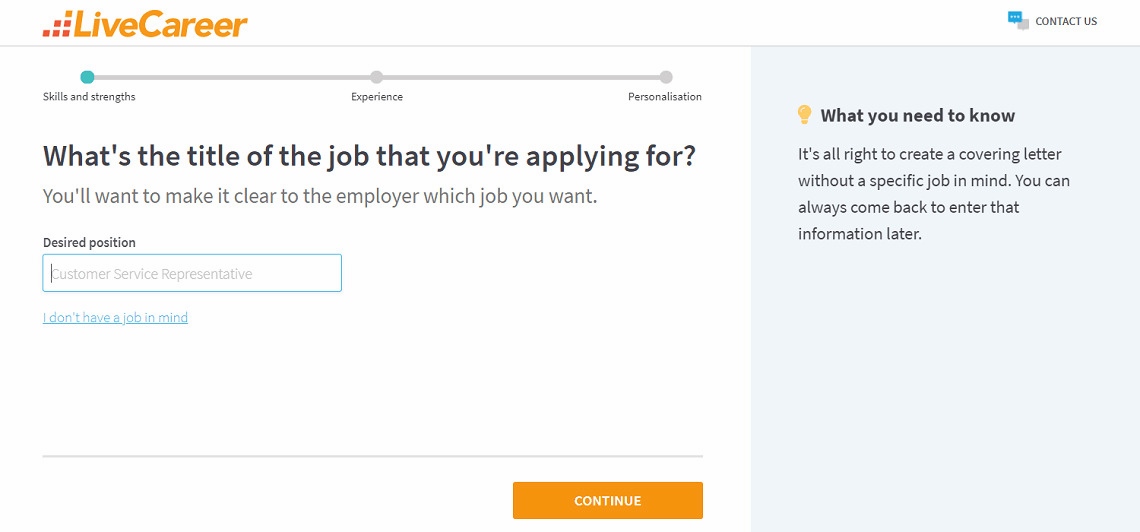
You can adjust every cover letter created in the builder to meet the job requirements. Choose the name of your profession and the company to which you’re applying, and the LiveCareer cover letter builder will automatically adapt the content for you. Create a cover letter faster than you ever thought possible and apply for the job in record time.
5. Keep the tone professional, direct and positive
Adopt a professional tone that is direct and positive. Avoid overly casual phrasing, even if you know the recipient well. Use active verbs and short, clear sentences to communicate accomplishment and responsibility.
Refrain from negative language about your current role or colleagues; the cover letter’s job is to present the case for the move, not to explain away dissatisfaction. Where appropriate, express gratitude for opportunities you’ve had in the company – a brief line recognising your development shows maturity and reinforces loyalty.
6. Final checklist before you send
Before you submit, read the letter aloud to check tone, clarity, and flow. Confirm that the job title and the recipient’s name are correct. Limit the cover letter length to one page and attach an up-to-date CV if requested, saving documents as PDFs when emailing.
Consider informing your current manager before applying. If they haven’t been notified, check your company’s customary practice and any internal listing instructions. Finally, remove any jargon that the hiring manager outside your current team may not understand; be clear and accessible.
How an internal position cover letter differs from an external one
An internal job cover letter should skip lengthy personal introductions and instead get straight to the point. The reader already knows your name; what they need is clarity on which role you want, why you’re suited to it, and how you will transition.
This means your opening paragraph should immediately state the job title and your current position, while subsequent paragraphs should focus on relevant accomplishments, cross-team collaboration, and readiness for additional responsibility. You can adopt a slightly warmer tone if you have a close working relationship with the hiring manager, but maintain a professional standard throughout: your letter will be filed and considered alongside other formal applications.
Short cover letter for an internal position template
If the application process requests a brief statement or you are sending an internal email, use a concise version that still covers purpose, fit, and availability. For example:
Dear [Hiring Manager’s Name],
I am applying for the [Job Title] in [Team]. I currently work as [Your Job Title] and over the past [time period] I led [project], which resulted in [measurable outcome]. I am excited by the opportunity to bring my experience in [skill/area] to your team and would welcome the chance to discuss my application further.
Yours sincerely,
[Your name]
This brief cover letter for an internal position is ideal when a concise explanation is needed, yet a persuasive case must be made.
Cover letter for a promotion example
When applying for a higher grade or level, emphasise leadership, ownership and consistent performance over time. The internal promotion cover letter example below demonstrates how to position current responsibilities as evidence of readiness.
Dear Mr Clarke,
I wish to apply for the Senior Analyst role in Finance. Over the three years I have spent as Analyst II, I have led our quarterly forecasting work, improving forecast accuracy by 15% and implementing a reporting template that has reduced monthly reporting time by ten hours. I have also mentored two junior analysts, chaired the cross-team process review group and taken lead responsibility for a system migration project.
These duties have required me to coordinate multiple stakeholders, present to senior management and make data-driven recommendations that have supported planning decisions. The Senior Analyst role requires exactly this mix of technical competence, leadership and strategic insight, and I am keen to continue developing in this direction. I welcome the opportunity to discuss how I can contribute to the team in a more senior capacity.
Yours sincerely,
Mark Smith
A carefully written internal position cover letter turns your existing company experience into a persuasive case for the next step. Focus on relevant, measurable achievements, explain how the new role fits your development, and show you are prepared to make a smooth transition.
You don’t have to create any content yourself. The LiveCareer cover letter generator will automatically suggest the best content for your cover letter with ready-made examples and expert tips.
Thank you for reading my guide on how to write a cover letter for a promotion or an internal position. If you’d like to find out more about cover letters or any career-related topic, head over to our blog!
How we review the content at LiveCareer
Our editorial team has reviewed this article for compliance with LiveCareer’s editorial guidelines. It’s to ensure that our expert advice and recommendations are consistent across all our career guides and align with current CV and cover letter writing standards and trends. We’re trusted by over 10 million job seekers, supporting them on their way to finding their dream job. Each article is preceded by research and scrutiny to ensure our content responds to current market trends and demand.
Sources
About the author
Danuta Detyna
Danuta Detyna is a Certified Professional Résumé Writer and career expert with over nine years of writing experience. Known for her empathetic, detail-oriented approach, she creates practical and empowering career resources that help job seekers move forward with confidence.
Looking for a job-winning CV?
Crafting a job-winning CV is all about showcasing your unique skills and experiences. Start with a strong personal statement that highlights your career goals and achievements.
Try Our CV Builder Now

![Career Stability vs. Job Hopping in the UK [Real Data]](https://cdn-images.livecareer.co.uk/pages/career_stability_vs_job_hopping_lc_uk_thumbnail.jpg)


