10 Prompt Engineering Skills to Work with AI
Last updated on 29 December, 2025

Marta BongilajWriter, Professional Association of Resume Writers and Career Coaches (PARWCC)

Our customers have been hired by*:
In AI, the way you phrase a request determines the result that you get. Prompt engineering skills enable you to craft the optimal inputs, guiding AI systems toward more accurate responses. Whether you’re generating content, solving problems, or building applications, learn prompt engineering skills to utilise AI more effectively.
In this guide, I’ll explain which prompt engineering skills are worth developing to work with AI efficiently and seek job opportunities as a professional prompt engineer.
Create an effective CV in minutes. Choose a professional CV template and fill in every section of your CV in a flash using ready-made content and expert tips.
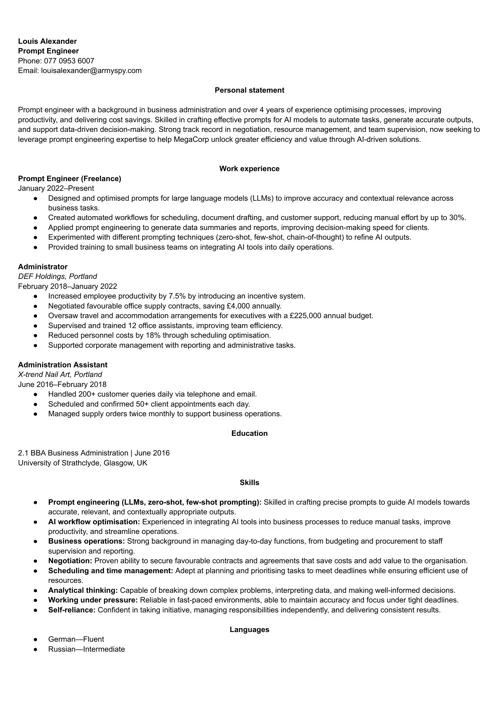
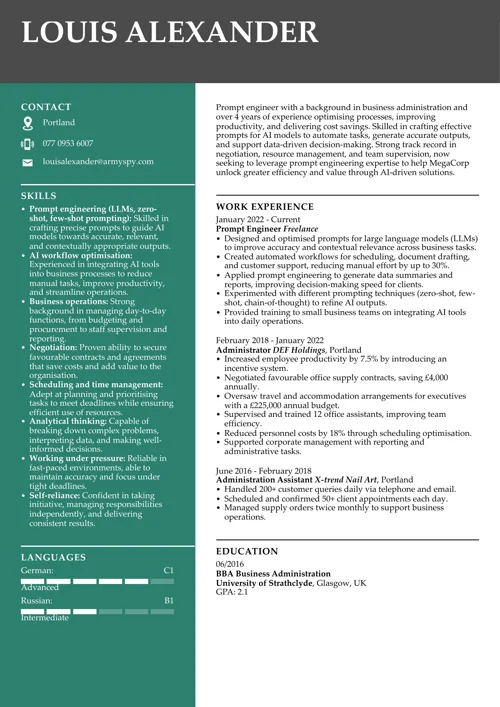
We created the sample on the left using our builder. See other good CV examples like this one.
What are prompt engineering skills?
Prompt engineering skills are the ability to craft effective requests (prompts) for AI models to produce desirable outcomes. This requires understanding how these specific models function, possessing strong communication and analytical skills, and the ability to utilise various prompting techniques.
Why prompt engineering matters?
Prompt engineering skills are needed to make AI work well in any real-world application, from building customer service tools to automating content or providing intelligent recommendations. If your prompt isn’t clear or well-structured, even a powerful AI can miss the mark. When you get it right, however, you can get AI to produce precisely what you need. This means getting an accurate answer to your question, summarising text, or solving a problem.
Top 10 prompt engineering skills
Writing effective AI prompts depends on a unique combination of hard and soft skills. I’ve gathered a list of core competencies required to master prompt engineering:
Understanding AI and LLMs
A deep understanding of artificial intelligence (AI) and large language models (LLMs) is the bedrock of effective prompt engineering. You should know how these models work, how they process and generate language, and what limitations they carry.
Key concepts include tokenisation, training data, model architecture (such as transformers), and the biases that may influence outputs. Having this knowledge, you can better predict how a model will respond to different inputs and create prompts that deliver more accurate results.
Strong language proficiency
Prompt engineering is basically about communicating with machines. As such, strong language proficiency is fundamental. This means that you need to not only understand grammar and syntax but also be able to adjust word choice, tone, and phrasing—the more precise the prompt, the more effective the responses that you receive. Even slight changes in wording can lead to entirely different outputs.
Critical thinking and creativity
While prompt engineering is often viewed as a typically technical thing, it also requires creativity and critical thinking. In many cases, you’ll need to think outside the box to solve complex problems that occur during model interaction—experimenting with different phrasing, structures, or types of inputs to find the most effective tactic.
Thanks to strong critical thinking skills, you can analyse and evaluate the outputs you receive, identify patterns, inconsistencies, or potential improvements. Creativity, on the other hand, helps you come up with entirely different ways to ask questions or present information to the model so you can get even more effective outputs.
Data analysis
If you want to create effective prompts, you can’t rely solely on understanding the language. You’ll also need to learn how to analyse data. Whether you’re working with structured datasets or unstructured text, you must know how to interpret and extract meaningful insights from the information that you collect.
For instance, if you’re fine-tuning an AI model for a specific application, understanding the data you’re working with will help you create prompts that align with the unique characteristics of the data. Strong analytical skills help you evaluate prompts and adjust them based on the responses.
Familiarity with AI tools and platforms
Prompt engineers often use a variety of AI tools and platforms to experiment with models and test different prompt variations. Knowing platforms such as OpenAI’s API, Hugging Face, or cloud-based machine learning environments such as AWS, Google Cloud, is a significant advantage. These platforms provide tools for integrating, deploying, and testing models, as well as fine-tuning them for specific tasks. To achieve the best results, you need to understand how they work, their limitations, and how to leverage them for prompt engineering.
Programming proficiency
Prompt engineering doesn’t require you to excel at programming. However, with programming skills, it will be easier for you to automate tasks, analyse model outputs at scale, and build systems that integrate with AI models.
For instance, you may need to write scripts that batch-test different prompts or process large amounts of data to fine-tune a model. Programming proficiency can also help you troubleshoot and debug when things go wrong, as well as create custom solutions that address specific needs within the context of prompt engineering.
Prompting techniques
As a prompt engineer, you need to know when and how to apply a specific prompting technique to achieve the best result for a given problem. To become truly effective in creating prompts, you might want to peer into techniques such as:
- Zero-shot prompting: asking the model to perform a task without specific examples, relying solely on its pre-trained knowledge.
- Few-shot prompting: providing the model with a few examples to help it understand the task more clearly.
- Chain-of-thought prompting: encouraging the model to break down its reasoning process step by step to improve clarity and correctness.
- Instructional prompting: directly instructing the model on how to answer a question or perform a task.
Problem-solving skills
Prompt engineering is often about trial and error. You’ll encounter situations where your initial prompt doesn’t give you the desired response, or the model’s answer is ambiguous or incorrect. This is where problem-solving skills come into play.
An adept prompt engineer can quickly identify whether there is an issue with phrasing, insufficient context, or something else, and then they adapt a prompt accordingly. Problem-solving also comes in handy in cases where you need to deal with unexpected outputs, as you’ll need to adjust your approach to steer the model in the right direction.
Domain expertise
Domain expertise can help you craft even more effective prompts, particularly when working with specialised tasks. Whether you’re developing a chatbot for healthcare, legal, or technical applications, having a solid understanding of the specific domain ensures that your prompts are both contextually accurate and relevant. Such expertise enables you to incorporate industry-specific terminology and understand the factors that influence the model’s performance.
Continuous learning
AI is a highly dynamic field where new models, techniques, and practices pop up frequently. That’s why, as a prompt engineer, you need to engage in continuous learning, study research papers, follow industry blogs, and experiment with innovative tools and platforms. If you stay current with advancements in machine learning and natural language processing, you can leverage the latest techniques and apply them to your work. And that’s how you make yourself more professional and attractive to an employer.
What does prompt engineering look like in practice?
In practice, prompt engineering involves determining the most effective way to ask AI about a specific topic to obtain the desired response. Let’s say that you’re building a chatbot. You’d start by crafting simple prompts and then tweak them based on how the AI answers your queries. Then, you might want to refine the wording, add more context, or experiment with different phrasing styles. It’s a lot of trial and error, but the more you adjust, the better the AI’s responses become. Ultimately, the goal is to find the right balance, so the AI understands precisely what you’re asking and delivers what you want.
Looking for other skills guides? Check this list:
- Active Listening Skills for a CV
- Analytical Skills to Include in a CV
- Customer Service Skills Examples
- Digital Skills to Add to a CV
- IT Skills Examples & Definition for 2025
- Key Employability Skills for a CV
- Organisational Skills Examples for a CV
- People Skills: Meaning & Examples
- Problem-Solving Skills to Use in a CV
- Teamwork Skills to Include in a CV
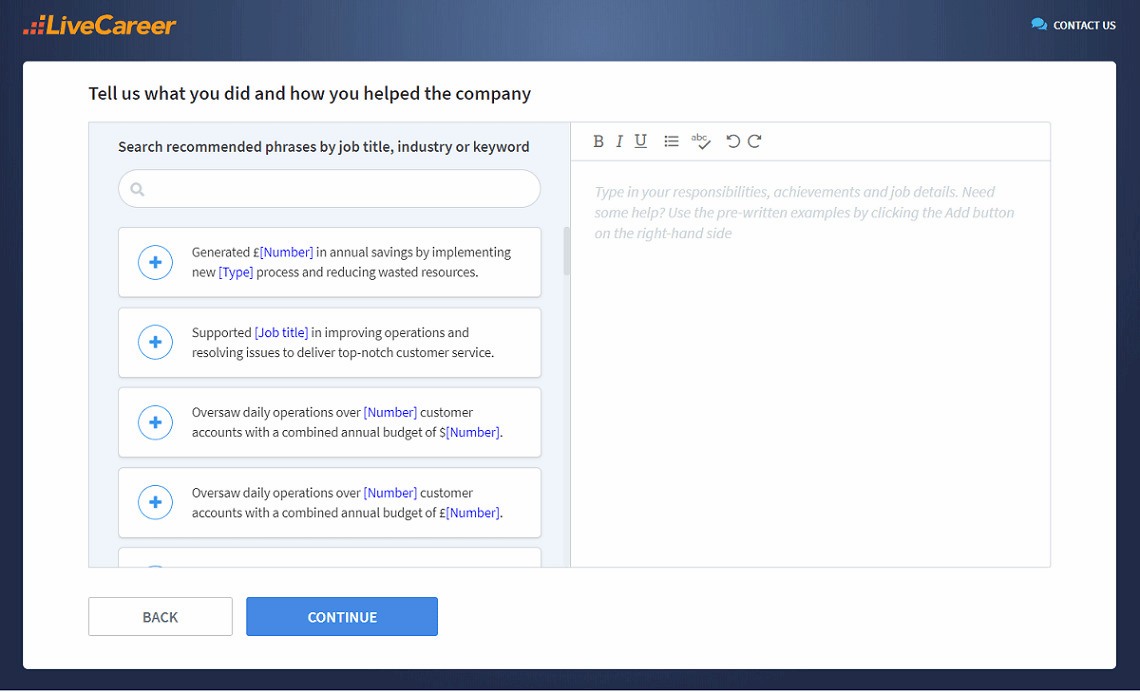
You don’t have to be a CV writing expert. In the LiveCareer CV builder you’ll find ready-made content for every industry and position, which you can then add with a single click.
Thank you for reading this article on prompt engineering skills. I hope you’ve found a specific area to focus on and enhance your abilities, helping you in your next job search.
How we review the content at LiveCareer
Our editorial team has reviewed this article for compliance with Livecareer’s editorial guidelines. It’s to ensure that our expert advice and recommendations are consistent across all our career guides and align with current CV and cover letter writing standards and trends. We’re trusted by over 10 million job seekers, supporting them on their way to finding their dream job. Each article is preceded by research and scrutiny to ensure our content responds to current market trends and demand.
Sources
About the author
Marta Bongilaj
Marta is a certified career expert with a marketing edge, offering strategic guidance to job seekers at every stage. She creates standout CVs and cover letters that help them land opportunities with confidence.
Looking for a job-winning CV?
Crafting a job-winning CV is all about showcasing your unique skills and experiences. Start with a strong personal statement that highlights your career goals and achievements.
Try Our CV Builder Now