When you’re hunting for a new job, your CV is the best tool to make a great impression on recruiters. But creating a great CV can be challenging. Everyone has an opinion on what a strong CV looks like – and it’s hard to know which CV writing tips will have an impact
If you’re going to ask for CV writing tips, who better to ask than the people who see CVs every day? So we turned to three of the UK’s leading recruiters and asked for their top CV writing tips. With over 35 years’ experience in the industry, they’ve literally seen tens of thousands of example CVs cross their desks.
Want to get your CV noticed for all the right reasons? Here are their top 10 CV writing tips:
Top 10 CV Writing Tips
1. Tailor your CV for the job you want – highlight your relevant experiences
A well-tailored CV makes it easy for a recruiter to see how your experiences align with the open role.

Zumar Dean
“It’s impossible to make a single CV relevant for every role you apply for,” says Zumar Dean, co-founder of SaaSjobs.io. “Tailoring your CV for a specific role allows you to put the most relevant version of you in front of a hiring manager.”
CV writing tip: Call attention to your most pertinent experience and achievements. Provide less information on unrelated responsibilities.
2. Mirror the language used in the job ad or description
CVs are typically screened (either by a human, or software) to find a clear match between keywords the employers use and how you describe yourself.
“It’s essential to mirror the language used in the job description in your CV, so it stands out to the person who’s reading it. This will dramatically increase your chance of Matt Dodgson being invited in,” says Matt Dodgson , co-founder and director of Market Recruitment Ltd.
CV writing tip: Look for the critical keywords and phrases in the job ad or description, and use them in your own CV. For example, if the ad says “retail management”, use this instead of “manager at a store”.
3. Focus on results, not responsibilities
Recruiters don’t want to learn only the duties that you performed – they want to know what you achieved.
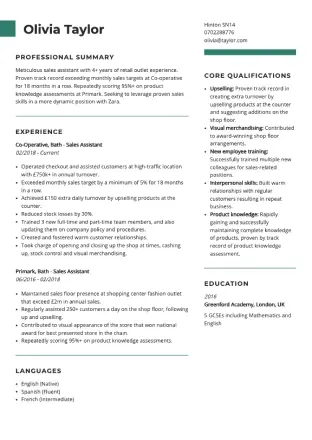
“Think about key metrics and achievements. It can’t be fluffy, like ‘I helped improve our customer services’, ” says Matt. “It has to be tangible, ideally with numbers attached – for example, ‘Our NPS score improved by 25% in 12 weeks because I …’.”
CV writing tip: Include numbers to show the impact of your hard work. For example, “Drove a 50% increase in traffic through new campaigns”.
4. Keep it professional

Leah Ross
“CVs are professional documents, which means it’s most appropriate to use professional language,” says Leah Ross , Associate Director at Carter Murray. “Think about how you would want to see someone’s CV written if you were hiring.”
CV writing tip: Professional means you need to be more formal than an email to a friend. Edit your CV to make sure you’re not using slang, or text-speak – for example, instead of “c”, use “see”. Though you might think that this point is obvious, you should watch out. You might accidentally slip these expressions in just out of habit.
5. Be concise
Your CV should contain the five standard CV sections – but longer doesn’t mean better.
“A CV shouldn’t contain your life story, nor does it need to list every single job you’ve ever had,” says Zumar. “Demonstrate your most relevant experience, but don’t bore the reader with a novel!”
CV writing tip: Write more about your most recent role. Why? Your last job is probably most relevant to the job that you want. Consider incorporating bullet points to make the text easy to read.
6. Make sure you include contact details
“Having contact details on your CV is imperative,” says Leah. “This may seem obvious; however a large proportion of candidates don’t put their contact details on their CVs. This can make you seem complacent, and can be the difference between being contacted about a role, or not”.
CV writing tip: Double check to ensure that you provided your contact details – mobile phone and email address. Look again. Are they correct? Remember that sharing an old email address could ruin your chance to move forward in the process.
7. Be thoughtful about explaining CV gaps
“Don’t shy away from explaining why you left a role, if it’s appropriate,” says Zumar. “ It can also help to state that certain roles were short-term contracts (if they were) to explain why you didn’t spend very long in the role. Use your initiative, and if it makes sense to disclose the information on your CV, then do it.”
CV writing tip: Check your CV for gaps in employment, or shorter jobs. Add in details on your reason for leaving, or the length of fixed-term contracts, if appropriate.
8. Use spell check

Matt Dodgson
“Spelling mistakes make you look unprofessional, and can also mean keywords may not get picked up by CV scanning software.” says Matt. “This is one of the simplest CV writing tips, but you’d be surprised how many people forget it!”
CV writing tip: Use spell check! Make sure it’s set to UK English for UK jobs, and make sure you edit your entire CV. If there are several possible spellings, choose one and make sure it’s consistent. For example, “email”, “e-mail” or “e mail”.
9. Keep the layout neat
It’s important that your CV looks professional, easy to read and appropriate for your industry.
“You want your CV to stand out – but not because it has lots of pointless images or unnecessary logos,” says Zumar. “Save space for valuable information, and by all means add a little colour, but be sensible.”
CV writing tip: Check to make sure you’re using the same fonts throughout your CV, and that the colours you use are appropriate. Make sure you only add images when they communicate something useful – not to fill up space!
10. Get someone else to read your CV
A second perspective will help you spot things you missed out, as well as checking that your writing makes sense.
“Asking someone you trust to check your CV is invaluable,” says Leah. “A fresh pair of eyes will be able to look at it objectively.”
CV writing tip: Before you send off your CV, ask a friend or family member to spend half an hour reading a printed copy. Get them to point out any errors they spot.
Let’s Wrap Up
A great CV is your ticket to a great job – but most of us need a few CV writing tips to ensure success. With help from our UK recruiters’ top 10 CV writing tips, you’ll have an excellent CV – and a great new job – in no time!