1 in 5 Employees Left a Job Because of a Bad Manager
Last updated on 29 May, 2026

Jasmine EscaleraCareer Expert

Our customers have been hired by*:
The old saying goes, “people leave managers, not companies”. As workplace dynamics evolve in 2026, the quality of leadership remains a decisive factor in whether a professional stays or walks away.
A new LiveCareer UK survey of 1,000 professionals across Europe found a deepening leadership crisis that threatens to derail team performance and retention. According to the Bad Bosses Report, poor management is no longer seen as an isolated incident, but rather a typical, and often unavoidable, reality of the modern corporate landscape.
The study highlights a significant disconnect between corporate values and the daily experiences of employees, showing that nearly one in five professionals has already walked out the door due to poor management. It also exposes several common systemic failures, including the widespread normalisation of toxic behaviour, the corporate protection of “brilliant jerks”, and glaring accountability voids.
Key Findings
- The bad boss-provoked exodus is real: 19% of employees have already left a job because of a bad manager, and another 41% have seriously considered it.
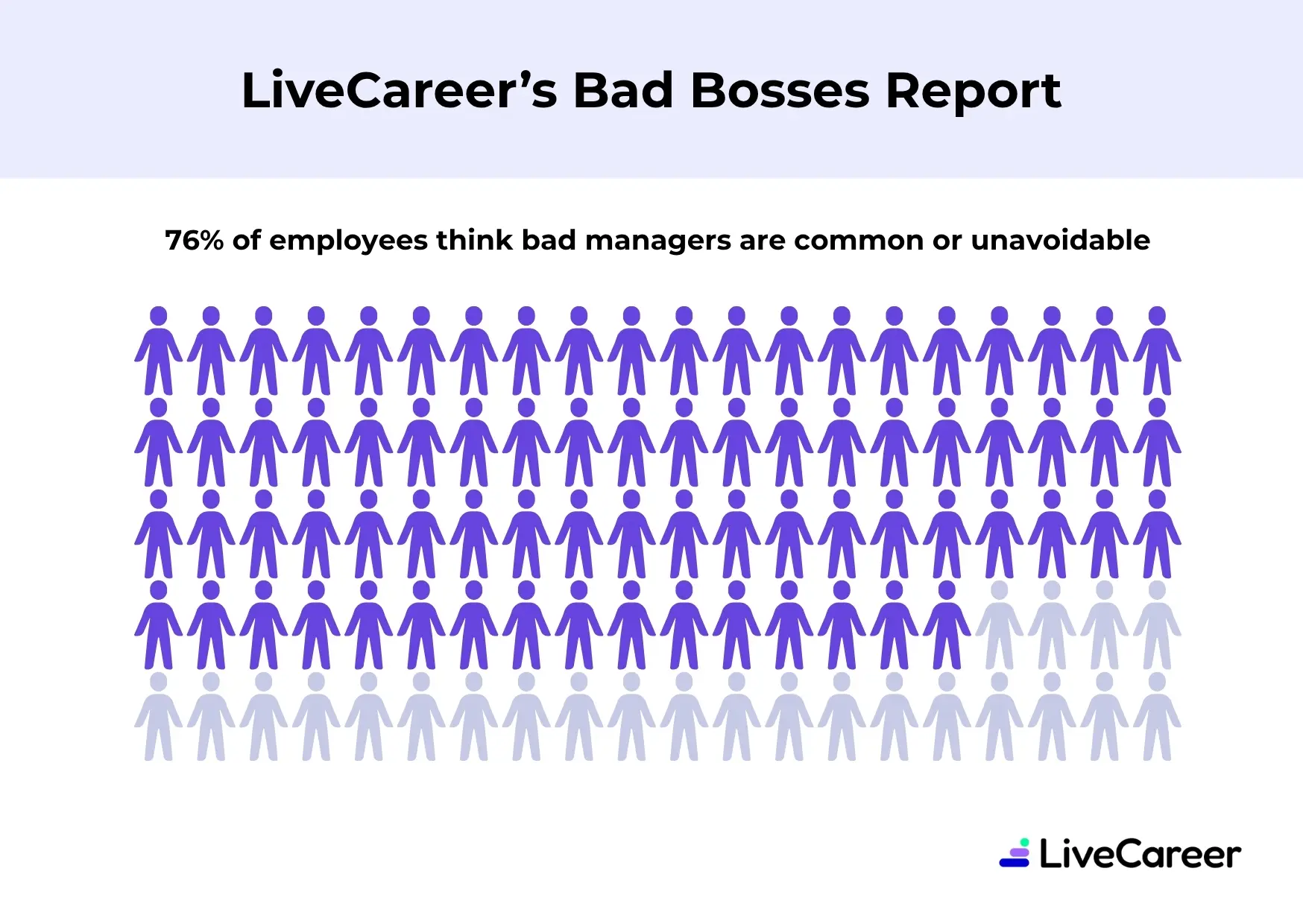
- Toxic management is the norm: Over three-quarters (76%) of employees believe bad managers are a common fixture – or even unavoidable – in today’s workplaces.
- Toxic leaders “fail up”: Nearly half (48%) of bad managers receive promotions despite poor leadership or stay in place without consequences. Only 6% actually improve through coaching.
- Tolerance for brilliant jerks: 66% of employees believe businesses are likely to tolerate a high-performing but toxic manager.
- The “open door” policy is failing: 54% of employees do not feel safe escalating issues to HR, viewing it as a risky or unsafe move for their careers.
The Good Manager Paradox
The line between effective leadership and toxic behaviour can be subjective, often depending on individual work styles. However, the overwhelming consensus is that toxic management is widespread. Even those who have had positive experiences with leadership recognise how prevalent bad managers are across the workforce.
How employees rate the managers they’ve worked with in their career:
- Good – 49%
- Mixed (good and bad in equal measure) – 39%
- Poor – 12%
How common employees think bad managers are:
- Common – 73%
- Rare – 24%
- Unavoidable – 3%
What this means: While nearly half of employees report having generally good managers, the vast majority still perceive toxic leadership as a widespread issue. Even positive personal experiences may not mask the reality that bad bosses are viewed as a highly common workplace element.
Toxic Leadership in Practice
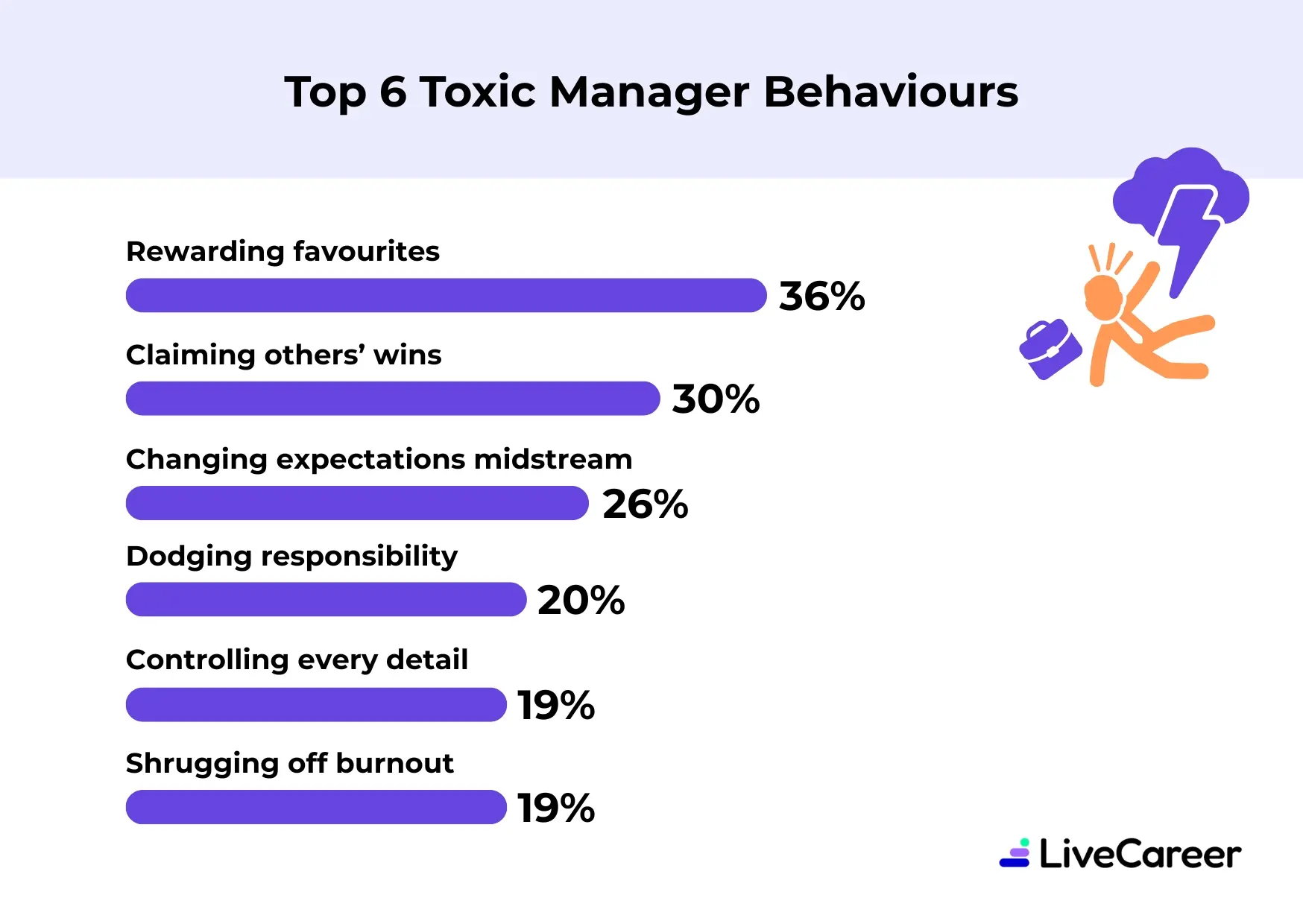
When looking at specific toxic traits of bad managers, employees pointed to a lack of integrity rather than just poor technical skills. The data shows that “credit thieves” and managers who play favourites are incredibly common. Behaviors employees have personally experienced from a manager include:
- Rewarding favourites – 36%
- Claiming others’ wins – 30%
- Changing expectations midstream – 26%
- Dodging responsibility – 20%
- Controlling every detail – 19%
- Shrugging off burnout – 19%
- Humiliating people publicly – 18%
- Not knowing what they were doing – 18%
- Running everything as a fire drill – 16%
- Making it feel hostile or unsafe – 15%
What this means: Toxic management is largely characterised by ethical failures rather than mere incompetence. The dominance of behaviours like credit-taking and favouritism suggests that toxicity is often strategic, not accidental. Ultimately, this indicates that organisational reward systems may be unintentionally incentivising self-serving techniques, signalling to leaders that the corporate ladder is best climbed by sacrificing team morale for personal gain.
The Snowball Effect on Teams and Performance
Poor management doesn’t just create isolated problems – it triggers a ripple effect that slowly damages team dynamics and business results. What starts as team conflict can grow into disengagement, burnout, and eventually missed targets. The outcomes most commonly linked to bad management include:
- Conflict and tension in the team – 52%
- People leaving (high turnover) – 41%
- Poor performance and missed goals – 35%
- Declining mental health (stress/anxiety) – 34%
- Low trust and low psychological safety – 33%
- Disengagement / “quiet quitting” – 30%
- Burnout and exhaustion – 27%
- Career stagnation / people stopping growth – 22%
- None of the above – 9%
What this means: A bad manager can create a destructive chain reaction, where initial interpersonal conflict scales into high turnover, poor performance, and declining mental health across the team. This suggests that intervening at the first sign of friction is more effective than attempting later-stage fixes like performance management.
Bad Managers: The Leading Catalyst for Turnover
LiveCareer UK’s data demonstrates that management quality plays a significant role in an employee’s decision to leave. When asked whether they have ever considered leaving a job because of a bad manager, respondents said:
- Yes, I left a job because of a manager – 19%
- Yes, I seriously considered leaving – 41%
- No, I was frustrated, but didn’t consider leaving – 20%
- No, I never considered it – 20%
What this means: Bad management is a massive risk for businesses. With a combined 60% of employees having either quit or seriously thought about quitting because of their boss, poor leadership directly drives employee turnover.
Workers Say Reporting Bad Bosses is Risky
More than half of surveyed employees don’t feel safe formally reporting or escalating a bad manager. This may reflect a workplace culture where many employees still fear negative consequences for speaking up. Here’s how safe employees feel formally reporting or escalating a bad manager:
- Risky or unsafe – 54%
- Safe – 46%
What this means: The fact that the majority of workers view escalating a bad boss to HR as a career risk highlights a systemic lack of psychological safety when dealing with leadership issues.
The Accountability Void
Despite the severe damage bad managers cause, companies rarely hold them accountable. High-performing toxic bosses are protected, and almost half (48%) of bad managers are either promoted or left in place without consequences. Genuine improvement is the exception rather than the rule – only 6% of respondents report seeing bad managers change their behaviour through coaching or training.
Here’s what most often happens to bad managers in the workplace:
- They get promoted anyway – 26%
- They get moved laterally – 22%
- Nothing changes, they stay in place – 22%
- They eventually leave on their own – 15%
- They’re fired – 9%
- They improve (coached / trained / warned) – 6%
Respondents were also asked how likely it is that a high-performing but toxic manager would be tolerated in the workplace. The results show:
- Likely – 66%
- Unlikely – 34%
What this means: Workplaces often enable toxic leadership, especially if the manager delivers results. Because the vast majority of bad managers are simply promoted or ignored, true accountability is incredibly rare.
The survey results show that bad managers are still common in today’s workplaces. Because businesses frequently tolerate toxic behaviour, many employees ultimately leave to protect their well-being and careers.
Instead of being reprimanded, bad leaders frequently fail upward without facing any consequences. As data shows, until organisations stop protecting them and start prioritising accountability, team conflict and high turnover will persist. Ultimately, ignoring poor management may become a direct path to losing valuable talent.
Methodology
The findings presented in the Bad Bosses Report are based on a survey conducted by LiveCareer in March 2026, collecting responses from 1,000 employed professionals across the UK, France, Germany, Italy, and Spain. Respondents answered a mix of single-selection and multiple-choice questions regarding experiences with management, the outcomes of toxic leadership, and perceptions of workplace accountability.
About the author
Jasmine Escalera
Jasmine is a career expert with a background in nonprofit management and significant experience as a hiring manager and leader. She focuses on helping job seekers improve their professional CV’s to highlight their unique skills and experience. Jasmine holds a B.S. in biochemistry and PhD in neuropharmacology and offers six years of specialized experience helping candidates navigate the complexities of today’s online job market, with a strong focus on CV optimization and effective self-presentation. She has had her work featured on LiveCareer’s CV builder and in these online publications: Fast Company, CNBC, Fortune, and more.
Looking for a job-winning CV?
Crafting a job-winning CV is all about showcasing your unique skills and experiences. Start with a strong personal statement that highlights your career goals and achievements.
Try Our CV Builder Now

![Career Stability vs. Job Hopping in the UK [Real Data]](https://cdn-images.livecareer.co.uk/pages/career_stability_vs_job_hopping_lc_uk_thumbnail.jpg)